Pre-foreclosure in Guilford County, North Carolina: what investors should know
A plain guide to how foreclosure runs in Guilford County, which other filings put homes on the market, and how to treat owners fairly.

Pre-foreclosure in Guilford County: what the housing looks like
Guilford County has 542,987 residents and 235,833 housing units, with a median home value of $235K. About 60% of homes are owner-occupied, and 63% are single-family detached, just above the U.S. figure of 61%. That is a market built mostly on ordinary houses that an investor can actually rehab, hold or resell.
Fewer owners are mortgage-free. Owner-occupied homes with no mortgage make up 35% here, compared with 39% for the U.S. A larger share of owners carry a loan, which is the basic condition for pre-foreclosure. It also means you should not assume an estate or divorce property has no lender attached.
The housing stock is younger than average. Only 6% of homes were built before 1940, against 12% nationally. You still need to inspect each house, but you are less likely to find the oldest-home problems at scale.
Vacancy is lower and building slowed. Vacant units are 8% of the total, against 10% for the U.S. New permits came to 2,876 units in 2025, a change of -25% from 2024. Fewer new homes and fewer empty ones suggest less new supply competing with the houses you buy and resell. Those figures come from the Census Bureau's American Community Survey and building permits survey.
Rents matter if you hold. HUD's Fair Market Rent for the Greensboro-High Point area is $1,330 a month for a 2-bedroom and $1,703 for a 3-bedroom (HUD). Compare those to your purchase and repair costs before deciding between a flip and a rental.
Source: U.S. Census ACS 2023
Which filings come before a sale in Guilford County, and why
A sale rarely appears out of nowhere. Something usually happens in the owner's life first, and a court filing records it. Each type tells you something different about the seller's situation.
- Pre-foreclosure: a lender has started the process after missed payments. The owner is often under time pressure but may still hold equity.
- Probate: an owner has died and the estate must be handled. Heirs may want a clean sale rather than a house to manage.
- Divorce: a shared home often has to be sold or bought out, and both spouses may need to agree.
- Tax sale: unpaid property taxes lead to a foreclosure sale, covered below.
- Partition: co-owners disagree about what to do with a property, and one asks a court to force a sale or division.
With 16% of residents aged 65 or older, close to the 17% U.S. figure, estates are a steady part of the picture rather than a defining feature. Because fewer owners here are mortgage-free, expect many estate and divorce homes to have a loan to pay off from the proceeds.
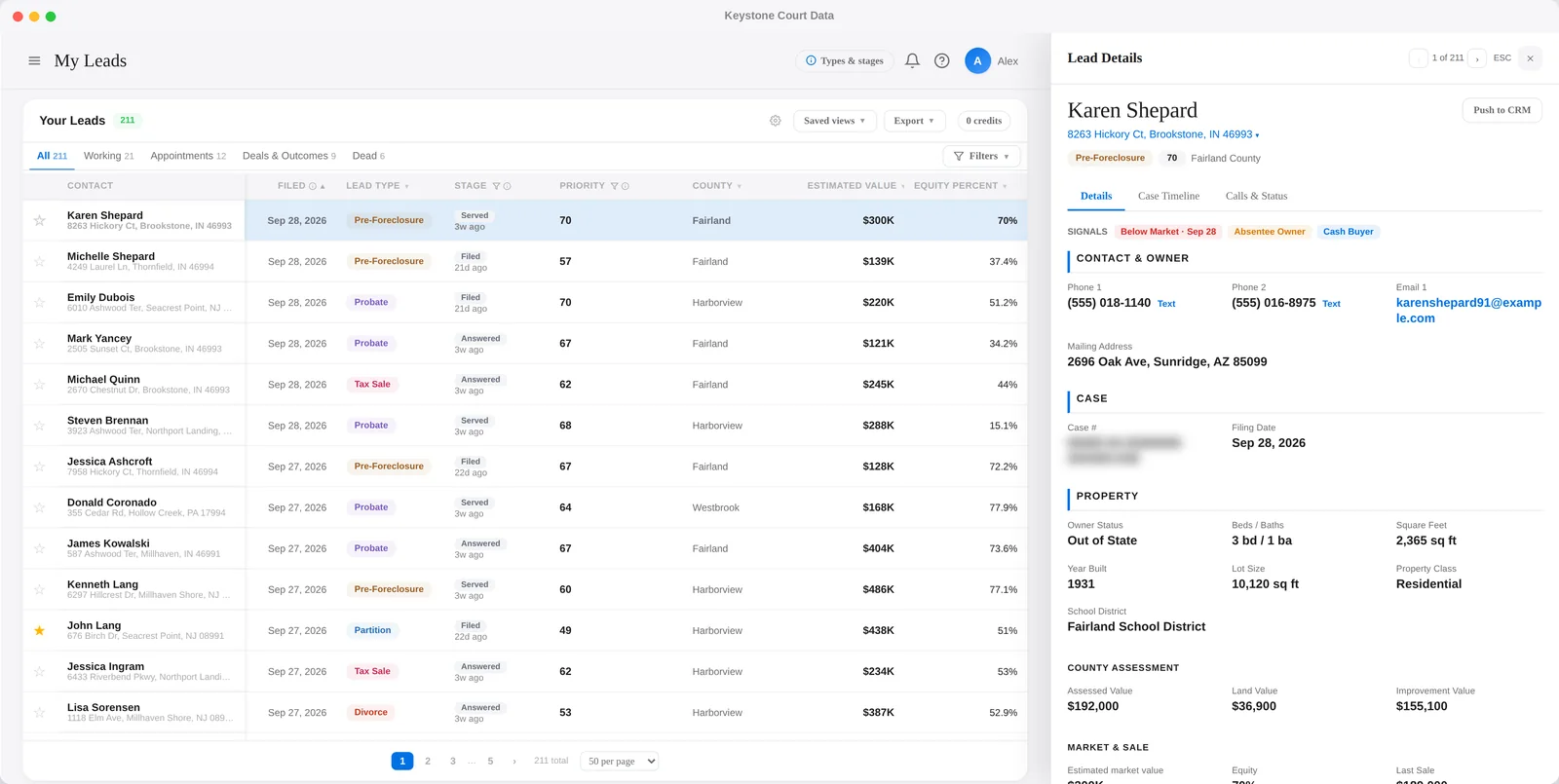
These records are public. Keystone Court Data delivers them with the owner and property already matched, if you want that work done for you. You can see what is offered for Guilford County.
How foreclosure works in North Carolina, in plain terms
North Carolina uses a power of sale process, which generally means the lender does not file a normal lawsuit. Instead, the matter goes before the clerk of superior court in a hearing, and if the clerk allows it, a public sale follows. The rules are in Chapter 45 of the North Carolina General Statutes.
Notice and hearing come first. The owner must be notified and gets a chance to appear before the clerk. This is the window where a sale to you, a repayment plan or a loan modification may still happen.
After the sale, an upset bid period applies. In North Carolina, a higher (upset) bid can be placed within 10 days after the report of the sale is filed with the clerk, and each new upset bid starts a fresh 10-day period. That means a winning bidder at the sale does not have a final deal on day one. Confirm exact deadlines and amounts with an attorney, since they can change.
For the county's tax foreclosure sales (covered below), Guilford County's foreclosure preview information says sale dates are set as needed and sales occur at noon. The deposit is 20% of the bid, paid in cash or certified funds made payable to Zacchaeus Legal Services. If you plan to bid, have those funds ready in the right form.
Probate works differently. In North Carolina the clerk of superior court acts as judge of probate, and an executor or administrator needs proper authority before selling estate real estate. Ask for proof of that authority, and have a closing attorney confirm it.
Tax foreclosure in Guilford County works differently
Guilford County does not sell tax lien certificates; the county says state law prohibits the sale of property tax liens. Unpaid taxes go to a tax foreclosure handled by an outside attorney, Zacchaeus Legal Services, according to the county.
Opening bids and the deed. If no one places an opening bid at a tax lien foreclosure sale, the county, city or town bids the minimum opening bid. The final bidder receives a Commissioner's Deed. Have a title professional review what that deed does and does not clear before you rely on it.
The tax calendar shapes owner stress. The county revalues real estate every five years. The county's tax page gives 2022 as the most recent revaluation and lists a 2026 reappraisal as upcoming. Changed values can change tax bills, which matters for owners on tight budgets. Personal property must be listed in January to avoid a 10% late penalty, while real property does not need to be listed unless there was an improvement or deletion.
The county Collector's Office collects property taxes for Greensboro, Jamestown, Oak Ridge, Pleasant Garden, Sedalia, Summerfield, Whitsett, Gibsonville, and parts of Archdale, Burlington, Kernersville and High Point. So a tax problem can touch several towns, not just Greensboro.
How to approach owners respectfully and legally
Most people in a foreclosure, probate or divorce are having one of the worst years of their lives. Start from that. Your goal is to offer a real option, not to create panic.
Be honest about who you are. Say you are an investor, explain that you buy houses, and make clear that they owe you nothing. Never imply you are from the lender, the court or a government agency.
Follow phone rules. If you call, screen against the National Do Not Call Registry (donotcall.gov) and follow North Carolina's telemarketing rules and calling-time limits. Letters and in-person visits have their own considerations, so keep them courteous and brief. Stop contacting anyone who asks you to.
Do not rush grieving or divorcing families. For an estate, speak with the personal representative, not around them. In a divorce, remember that both spouses may have a say. Tell people they can talk with an attorney or a HUD-approved housing counselor before deciding. Some states have extra rules for buying from homeowners facing foreclosure, so have an attorney confirm what applies in North Carolina.
What to check before you make an offer
A motivated seller is not automatically a good deal. Before you put a number on paper, work through the basics.
- Liens and loan balances. Ask a title professional what is owed and in what order. Equity is what remains after all of it.
- Who can sign. In an estate, confirm the executor's authority. In a divorce or partition, confirm every owner is on board or ordered to sell.
- Where the process stands. A property close to a sale date, or in the upset bid period, leaves less time than one early in the process.
- Condition. With only 6% of homes built before 1940, many Guilford County houses will not be very old, but inspect anyway. Budget for the roof, systems and any deferred upkeep.
- Your exit. At a median home value of $235K, test your numbers for resale and for rent against HUD's $1,330 and $1,703 Fair Market Rents.
Because the rules vary and change, run each deal past a North Carolina real estate attorney. Try pricing a fair offer that still works if the timeline slips.
Questions investors ask
Is foreclosure judicial in North Carolina?
Mostly no. North Carolina uses a power of sale process in which a hearing is held before the clerk of superior court, followed by a public sale if the clerk allows it. Under Chapter 45 of the General Statutes, notice of the hearing must be served at least 10 days before it, and notice of the sale must be posted at least 20 days before the sale. An attorney can explain how those deadlines apply to a given case.
Can I buy a house in pre-foreclosure before the sale?
Often yes, if the owner agrees and the lender is paid off or approves the arrangement. Get a title review first so you know every lien. Have an attorney confirm what applies in North Carolina.
What is the upset bid period in North Carolina?
After a foreclosure sale, someone can place a higher bid within 10 days after the report of the sale is filed with the clerk, and each new upset bid starts a fresh 10-day period. A winning bid is therefore not final right away. Check current deadlines and amounts with an attorney.
Does Guilford County sell tax lien certificates?
No. Guilford County says state law prohibits the sale of property tax liens, so it does not sell certificates. Tax foreclosures go through an outside attorney, and the final bidder at the sale receives a Commissioner's Deed.
Can I call homeowners facing foreclosure?
You can in some cases, but you must follow the National Do Not Call Registry and North Carolina telemarketing rules. Be honest about who you are, keep calls short and stop if asked. When in doubt, ask an attorney.
See Guilford County leads for 7 days, free
Real court filings with the owner and property matched. No credit card.