Investing in Tippecanoe County, Indiana: where motivated sellers show up in the court record
A young population and a lot of renters make this county different from most Indiana markets. Here is what that means for finding and treating motivated sellers.

Tippecanoe County Indiana real estate investing starts with a young, renter-heavy market
Tippecanoe County has 187,399 residents and 79,327 housing units, and the median resident is 28.8 years old against 38.9 nationally. Only 54% of homes are owner-occupied. That is the first thing to understand about Tippecanoe County Indiana real estate investing: this is a county with a lot of renters, and the people who own are often landlords as well as homeowners.
The median home value is $218K. Vacancy is 6% against 10% for the U.S., which points to a tight market where homes do not sit empty for long. HUD's Fair Market Rent for the Lafayette-West Lafayette area is $1,242 a month for a 2-bedroom and $1,489 for a 3-bedroom.
Supply is also moving. The county permitted 3,979 new housing units in 2025, up 157% from 2024. New construction competes with the older rentals you might buy, so run your hold numbers against that.
Major employers include Caterpillar, Subaru Indiana Automotive, Wabash National, Franciscan Health Lafayette and State Farm Insurance, spread across Lafayette and West Lafayette. A mix of manufacturing, health care and insurance gives you more than one source of renter demand.
Source: U.S. Census ACS 2023
What the county's numbers mean for the kinds of sellers you will meet
Equity is a bit thinner than the national picture. In Tippecanoe County, 34% of owner-occupied homes have no mortgage, compared with 39% for the U.S. Fewer free-and-clear homes means that in an estate, divorce or partition sale you are more likely to meet a seller who still owes something. Plan for payoffs and lien positions before you assume there is room in the deal.
Probate is real but not the biggest door. Residents 65 or older are 12% of the population, below the 17% national figure. Estate sales still happen, but a lead strategy built only on aging owners would be thin here.
Age of the housing stock is about average. Homes built before 1940 are 12% of the total, the same as the U.S. figure, and single-family detached homes are 59% against 61% nationally. Do not assume every house is a century-old money pit, but budget for a proper inspection of anything older.
A younger county means more landlords and more divorces among working-age owners. Rental properties, small multi-unit buildings and starter homes are the likely mix of what you see sold under pressure.
Which court filings tend to come before a sale here, and why
A court filing is a signal that something in an owner's life has changed. It is not a promise of a sale. Here is what each type usually means.
- Pre-foreclosure. A lender has filed suit over missed mortgage payments. The owner may want to sell, catch up, or negotiate, and the timeline gives you room to have an honest conversation.
- Probate. An estate has been opened after an owner's death. Heirs often live elsewhere and may prefer a clean sale over managing a house.
- Divorce. A dissolution of marriage often ends with a house that has to be sold or bought out. Under the county's local rules, a dissolution petition can be filed in the Tippecanoe Circuit Court or Superior Court No. 1 or No. 2 in Lafayette, and one with a fee-waiver request goes to Superior Court No. 2.
- Partition. Co-owners, often heirs or former partners, cannot agree and one asks a court to resolve it. Sales can follow.
Divorce deserves a local note. In dissolution cases with children under 18, both parties must complete the work on UpToParents.org, or a comparable co-parenting website, within 30 days of the initial filing, and must complete a co-parenting class as the court may order. Those cases carry a lot of emotion and structure, so a patient, no-pressure approach matters more than speed.
How the process works in Indiana, in plain terms
Foreclosure goes through the courts. Indiana is a judicial foreclosure state, which means a lender must sue and win a judgment before a property is sold. After that, the property is sold at a sheriff's sale.
The format, schedule and bidding rules for each sale are set out in its notice. Learn how they work before you ever bid, and confirm the details of any specific sale with an attorney.
Tax sales are separate. Unpaid property taxes can lead to the county's annual tax sale. Rules on redemption after a tax sale are technical, so confirm them with an attorney before relying on any tax sale property.
Probate and family matters move through the county's courts, which are seated at the Tippecanoe County Courthouse in Lafayette. Tippecanoe County's courts of record are a Circuit Court and Superior Courts No. 1 through No. 7. Timelines for estates, divorces and partition suits vary by case, so an attorney should confirm any deadline that matters to your deal.
How to approach owners respectfully and legally
Lead with honesty, not urgency. A person facing foreclosure, a death in the family or a divorce does not need a countdown. Say who you are, why you are reaching out, and that they are free to say no. If a letter feels kinder than a call, send the letter.
Follow the phone rules every time. Calls are regulated. Federal rules on telephone solicitations set the National Do Not Call Registry, a calling window of 8 a.m. to 9 p.m. local time and company do-not-call lists (47 C.F.R. 64.1200), and Indiana keeps its own Do Not Call list through the Attorney General's office, which says most telemarketers are forbidden from calling or texting numbers on it. Whether a call offering to buy a house is covered depends on the facts, so an Indiana attorney can confirm. Keep your own do-not-contact list. When someone asks you to stop, stop.
Do not imply you are affiliated with a court, a lender or a government office. Do not pressure an heir who has not yet been named as a personal representative, since they may not have the authority to sell yet. For probate, the court-appointed personal representative is who you ultimately need to work with.
Be careful in foreclosure situations, too. Deals with distressed owners can raise their own legal questions, so many investors have an attorney review their purchase agreement and any contract they use with these sellers.
What to look for before making an offer
A filing tells you why a seller might be motivated. It does not tell you whether the deal works. Before you offer, think through these points.
- Payoffs and liens. With 34% of owner-occupied homes owned free and clear (U.S.: 39%), do not assume equity. Confirm what is owed through a title company.
- Condition. Older homes need real inspection. Budget for roof, foundation, electrical and plumbing before you decide on a price.
- Who can sign. In an estate, only the authorized representative can sell. In a divorce or partition, all owners and sometimes the court must sign off.
- Exit. If you will rent, test your numbers against the $1,242 (2-bedroom) and $1,489 (3-bedroom) HUD Fair Market Rents and the recent jump in new permitted units.
- Timing. Sheriff's sale and tax sale properties have their own rules. Confirm the status of any property with an attorney before you commit.
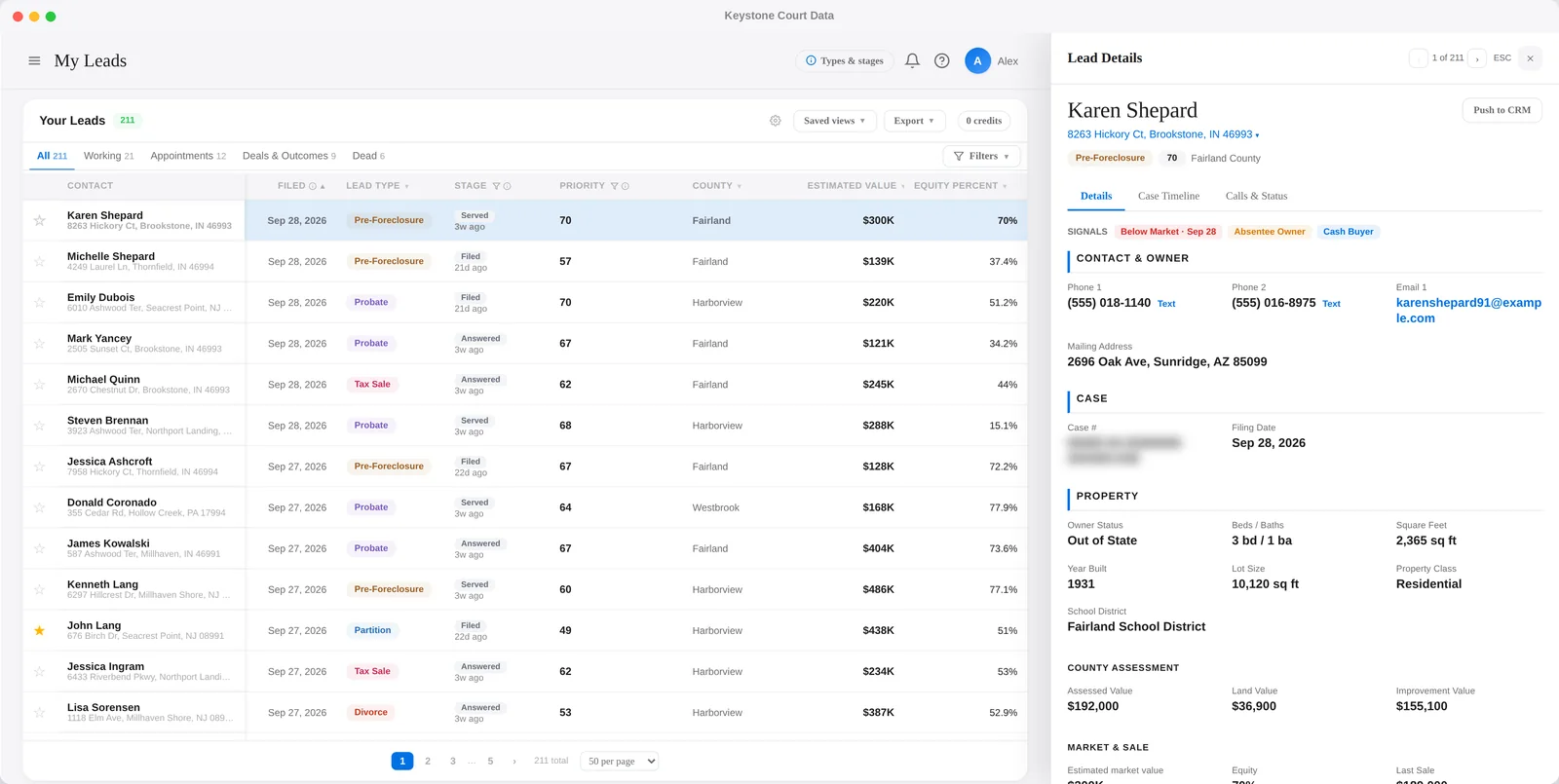
All of these filings are public records. If you want them delivered with the owner and property already matched, Keystone covers Tippecanoe County for pre-foreclosure, probate, divorce and partition, and you can see how it works or try a county free for 7 days with no credit card.
Questions investors ask
Is Tippecanoe County good for buy-and-hold investing?
The numbers support rental demand: 54% of homes are owner-occupied, the median age is 28.8, and HUD Fair Market Rent is $1,242 for a 2-bedroom and $1,489 for a 3-bedroom. Vacancy is 6%, below the U.S. figure of 10%. The 3,979 units permitted in 2025 mean new supply, so test your rents carefully.
Does Indiana foreclose through the courts?
Yes, Indiana uses judicial foreclosure. The lender must file suit and obtain a judgment before the property is sold by the sheriff. Timelines vary by case, so confirm any deadline with an attorney.
How are sheriff's sales held in Tippecanoe County?
After a foreclosure judgment, the property is sold at a sheriff's sale. The format, schedule and bidding rules for each sale are set out in its notice, so read the current notice before bidding.
Can I call homeowners I find in court filings?
Calls are regulated. Federal rules on telephone solicitations set the National Do Not Call Registry, a calling window of 8 a.m. to 9 p.m. local time and company do-not-call lists (47 C.F.R. 64.1200), and Indiana keeps its own Do Not Call list through the Attorney General's office, which says most telemarketers are forbidden from calling or texting numbers on it. Whether a call offering to buy a house is covered depends on the facts, so an Indiana attorney can confirm. Stop when asked. Many investors choose a short, respectful letter first. Have an attorney confirm what applies to your business.
Who can sell a house after the owner dies?
Usually the court-appointed personal representative of the estate, though the details depend on the will and the case. An heir alone may not have the authority to sign. Have an attorney confirm who can sell before you make an offer.
See Tippecanoe County leads for 7 days, free
Real court filings with the owner and property matched. No credit card.