Investing in Hamilton County, Indiana: where motivated sellers show up in the court record
A county of owner-occupied single-family homes, high values and tight vacancy means sellers here rarely look distressed from the street. The court record is where the pressure shows first.

What the housing in Hamilton County looks like
Hamilton County is a suburban, owner-occupied market. The county has a population of 357,176 and 140,389 housing units, and 76% of homes are owner-occupied. The median home value is $379K. If you are searching for Hamilton County Indiana real estate investing opportunities, start by accepting that this is not a bargain-bin market.
Three numbers set it apart from the U.S. picture. Single-family detached homes make up 75% of housing (U.S.: 61%). Vacancy is 5% (U.S.: 10%). Only 3% of homes were built before 1940 (U.S.: 12%).
Tight vacancy and mostly newer houses mean few abandoned properties and fewer deep-rehab projects. A typical deal is a well-built house that needs cosmetic work, an owner who needs to move quickly, or a family that needs to settle an estate.
Owners here are also less likely to be debt-free. Just 26% of owner-occupied homes are owned free and clear (U.S.: 39%). That leaves less cushion when income stops, and it is why mortgage default matters more here than in counties with a lot of paid-off homes.
Residents aged 65 or older are 13% of the population (U.S.: 17%), and the median age is 38.0 (U.S.: 38.9). Probate exists here, but it is a smaller share of the story than in older counties. Expect divorce and mortgage trouble to carry more weight.
Source: U.S. Census ACS 2023
Where the rent and building numbers point for buy-and-hold
HUD Fair Market Rent for the Indianapolis-Carmel-Greenwood area is $1,473 a month for a two-bedroom and $1,907 for a three-bedroom. Set those against a $379K median home value and you can see why rentals here are usually about stability and appreciation, not cash flow on day one.
Supply is cooling, not collapsing. The county permitted 4,146 new housing units in 2025, down 9% from 2024. Fewer new homes can support resale demand for existing houses, but do not treat one year of permit data as a forecast.
Demand is tied to the employers around Carmel, Fishers, Westfield and Noblesville. Carmel and Fishers are each about 27% of the county population. Major employers include CNO Financial Group, Roche Diagnostics, Navient, OpenLane and Delta Faucet. Job-driven demand tends to hold values up even when an individual owner is in trouble, which is what you want when buying from a motivated seller.
Which court filings come before a sale here
Pre-foreclosure. A foreclosure complaint means a lender has asked the court to enforce a mortgage after missed payments. Because fewer owners here are mortgage-free, this filing carries more weight in Hamilton County than the national average would suggest. Owners at this stage often still hold real equity at a $379K median value, and they may prefer a negotiated sale to a forced one.
Probate. When an owner dies, the estate is opened in court and a personal representative is appointed. The heirs often live elsewhere and may not want to maintain a house. With a smaller share of residents 65+, probate leads are present but less dominant here.
Divorce. A dissolution filing often ends with the marital home being sold or one spouse buying out the other. The case follows the court's schedule, so a sale decision may come after the couple reaches terms, not at filing.
Partition. When co-owners cannot agree, the dispute can end up in court as a partition case. These are often inherited properties with several heirs, and they can be a fit if you can offer a clean exit to people who disagree.
How the process works in Indiana, in plain terms
Indiana foreclosure is judicial. A lender must sue in court and get a judgment before a sheriff's sale can happen. Timelines depend on the loan, the owner's response and the court calendar, so confirm specifics with an attorney rather than relying on a rule of thumb.
In Hamilton County, probate, dissolution and foreclosure cases are heard in the county's courts in Noblesville, the county seat, and the filings are public court records.
The Hamilton County Sheriff's Office lists upcoming sheriff's sales on its public sale site, and it states that cashier's checks must be made out to "Sheriff of Hamilton County" to be valid. Registration, payment and other terms are set out for each sale.
A bidder has to research liens, unpaid water or sewage bills and condition without the owner's help. That is the main reason many investors prefer to deal with owners before the auction.
Property taxes add another layer. A property with unpaid taxes can eventually reach a tax sale. If a tax sale buyer purchases it, redemption costs 110% of the minimum bid within six months, or 115% after six months, plus any overbid and 5% annual interest on the overbid, along with other amounts the statute lists (IC 6-1.1-25-2). Business entities registering to bid must provide a Certificate of Existence or Foreign Registration Statement from the Secretary of State to the Treasurer (IC 6-1.1-24-5.1).
How to approach owners respectfully and legally
Assume the person is having a hard year. A family settling an estate, a couple divorcing or an owner behind on a mortgage does not need pressure. Introduce yourself plainly, say why you are reaching out, and make it easy to say no.
- Offer to explain your process and let them take time with an attorney or advisor.
- Never imply you are connected to the court or the lender.
- Do not misstate what a filing means or how much time they have.
- Respect a no immediately and keep a record of it.
Calls are regulated. Federal rules on telephone solicitations set the National Do Not Call Registry, a calling window of 8 a.m. to 9 p.m. local time and company do-not-call lists (47 C.F.R. 64.1200), and Indiana keeps its own Do Not Call list through the Attorney General's office, which says most telemarketers are forbidden from calling or texting numbers on it. Whether a call offering to buy a house is covered depends on the facts, so an Indiana attorney can confirm. Mail and in-person letters are often better received than cold calls in a hard moment. Rules differ by situation, so ask an attorney about your own practice.
Foreclosure outreach can raise its own legal questions, so many investors have a local attorney review their contracts before using them.
What to look for before making an offer
Check the title before the price. Mortgages, judgments, unpaid utility bills and tax issues can all follow a property. A title professional or attorney can clear the path before you commit money.
- Who has authority to sell. In probate, confirm the personal representative's authority. In divorce, confirm both spouses and any court restrictions. In partition, expect several signers.
- Equity and payoff. A $379K median home value leaves room in many deals, but a recent refinance can erase it.
- Condition. With few pre-1940 homes, plan around updates, systems and deferred maintenance more than structural surprises.
- Exit. Compare resale against rent. With two-bedroom rent at $1,473 and three-bedroom at $1,907, make sure your hold numbers work against your purchase price.
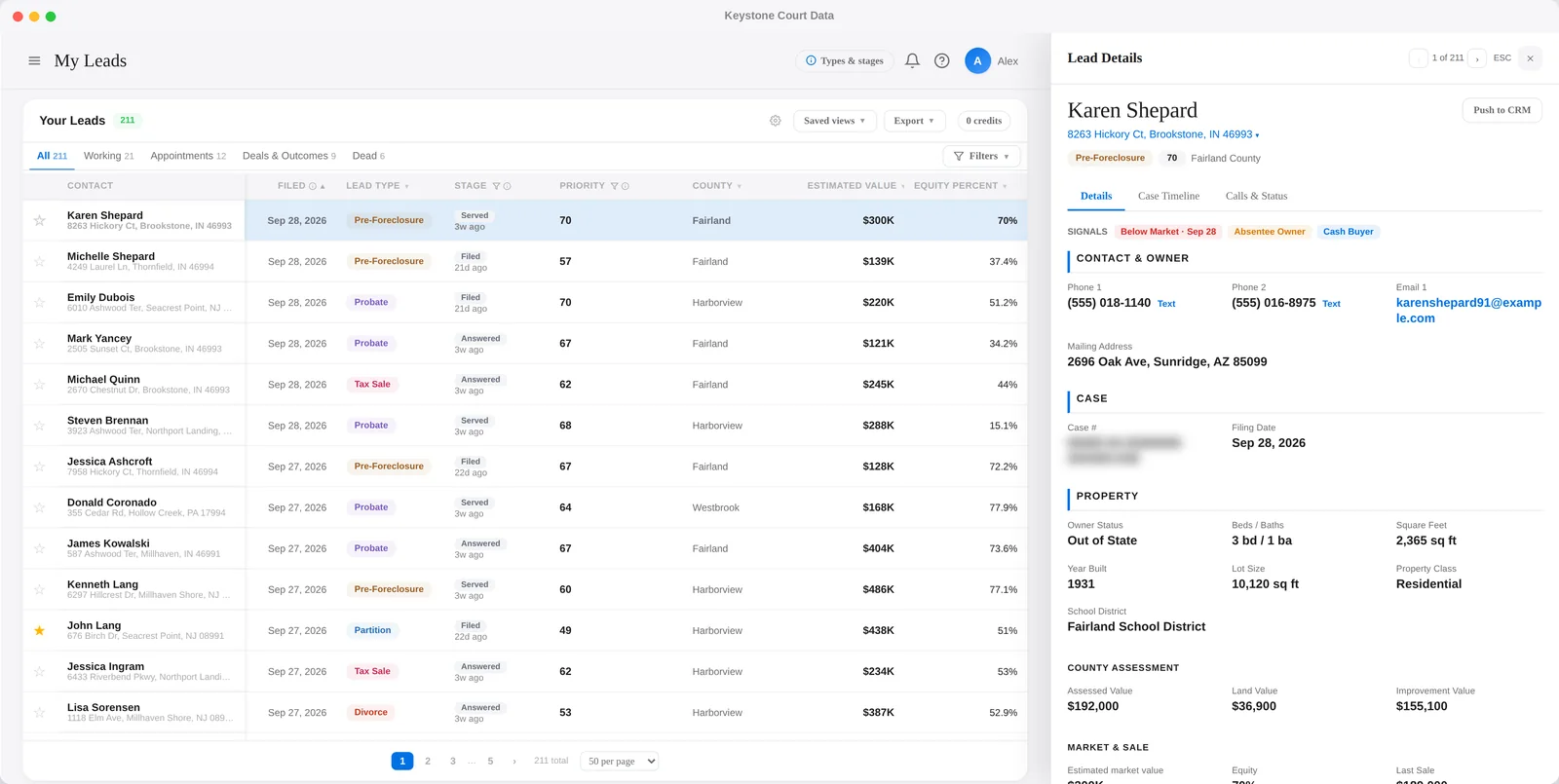
The filings behind these situations are public. If you want them delivered with the owner and property already matched, Keystone offers that for Hamilton County, with a free 7-day trial and no credit card.
Questions investors ask
Is Hamilton County a good place for real estate investors?
It can be, but it rewards patience and equity-focused deals more than deep discounts. The county has a $379K median home value, 5% vacancy and mostly owner-occupied single-family homes. Run your numbers carefully before you commit.
Is foreclosure judicial in Indiana?
Yes. A lender must file a court case and obtain a judgment before a sheriff's sale. Exact timing varies by case, so confirm with the court or an attorney.
Can I inspect a house before a Hamilton County sheriff's sale?
Do not count on it. A sheriff's sale is an auction, and bidders research liens, water or sewage bills and condition on their own. The Sheriff's Office sets out the terms for each sale, including that cashier's checks must be made out to "Sheriff of Hamilton County."
What happens if a property goes to tax sale in Hamilton County?
The owner can still redeem. Redemption costs 110% of the minimum bid within six months of sale or 115% after six months, plus any overbid and 5% annual interest on the overbid, along with other amounts the statute lists. Confirm current details with an attorney.
Can I call homeowners I find in court filings?
Calls are regulated. Federal rules on telephone solicitations set the National Do Not Call Registry, a calling window of 8 a.m. to 9 p.m. local time and company do-not-call lists (47 C.F.R. 64.1200), and Indiana keeps its own Do Not Call list through the Attorney General's office, which says most telemarketers are forbidden from calling or texting numbers on it. Whether a call offering to buy a house is covered depends on the facts, so an Indiana attorney can confirm. A respectful letter is often a gentler first contact for people in hard situations.
See Hamilton County leads for 7 days, free
Real court filings with the owner and property matched. No credit card.