Pre-foreclosure in Montgomery County, Texas: what investors should know
Texas usually forecloses without a judge, and Montgomery County sells on one fixed day each month. Here is what that means for the owners you talk to and the homes you might buy.

What Montgomery County housing looks like for investors
Montgomery County is a large, newer suburban market. About 654,722 people live here, in 253,801 housing units. The median home value is $318K, and 72% of homes are owner-occupied. That makes this mostly a market of homeowners, not renters.
The mix of homes is what sets it apart. About 68% are single-family detached, against 61% nationally. Only 1% of homes were built before 1940, compared with 12% across the U.S. You will see fewer century-old money pits and more suburban houses where the work is usually cosmetic, roofs, HVAC and the slow wear of newer construction. Still, inspect every property.
Vacancy is 7%, below the U.S. figure of 10%, which points to steady demand for housing. New construction backs that up: 13,614 units were permitted in 2025, up 3% from 2024. For a flipper, that means new-build competition. For a buy-and-hold investor, HUD Fair Market Rent in the Houston-Pasadena-The Woodlands area is $1,497 for a 2-bedroom and $2,017 for a 3-bedroom, which gives you a starting point for rent math.
Residents aged 65 or older make up 14% of the county, below the U.S. 17%. The median age is 37.2, against 38.9 nationally. This is a younger county, so many owners are in their working years with a recent mortgage. That is the profile of the owners who most often hit trouble through job loss, medical bills or divorce.
Source: U.S. Census ACS 2023
Which filings come before a sale here, and why
Pre-foreclosure is the main one, but it is not the only path to a distressed house. A lender's notice of default and the later notice of sale signal a loan in serious trouble. In a typical Texas mortgage foreclosure these steps happen outside court, so the owner often has little warning of how fast it moves.
Probate matters because a house can pass to heirs who live elsewhere and do not want it. Montgomery County Probate Court No. 1 is the county's only statutory probate court and hears probate, guardianship and mental health matters. A mortgage that goes unpaid during an estate can turn into a foreclosure problem.
Divorce is the third lead type. Family cases are heard in the district courts in Conroe, including the 410th and 418th. The 418th requires mediation before hearing a family case unless an objection to mediation has been filed and not overruled. A couple who must sell and split proceeds is often more open to a calm offer than one in a contested fight.
Unpaid property taxes are another route. Taxes are due by January 31, and penalty and interest begin in February. Real property accounts still unpaid by June 30 of the delinquency year are referred to the delinquent tax attorney with an additional 15% to 20% penalty. Delinquent tax foreclosure sales are run online by the County Constables on the first Tuesday of the month at 10 a.m.
How pre-foreclosure works in Texas, in plain terms
Usually no judge is involved. Texas is mainly a non-judicial foreclosure state. The deed of trust gives a trustee the power to sell the home if the borrower defaults, so the lender does not have to file a lawsuit first. A home equity loan is the main exception: it can be foreclosed only by court order (Texas Constitution art. XVI, sec. 50(a)(6)(D)). In Montgomery County, the County Clerk has no involvement in the sale itself. Questions go to the trustee or attorney named on the Notice of Sale.
The general sequence under Chapter 51 of the Texas Property Code goes like this:
- If the home is the borrower's residence, the mortgage servicer must send a notice of default by certified mail giving the borrower at least 20 days to cure.
- If the default is not cured, the lender can post a notice of sale. It must go out at least 21 days before the sale.
- The sale is held on the first Tuesday of the month, between 10:00 AM and 4:00 PM, with exceptions when that day is January 1 or July 4.
That calendar is the useful thing to understand. The window between a default notice and the first Tuesday can be short, and owners who have not sought help are often under real stress. Rules for specific loans, military service members and bankruptcy can change the timeline, so confirm any deadline that matters with a Texas attorney.
Using the equity picture in your offers
Equity drives how a deal can work. About 38% of owner-occupied homes in the county have no mortgage, close to the U.S. figure of 39%. The other homes carry a loan, and many were bought or refinanced during a period of rising values. A median home value of $318K suggests many owners in default still have meaningful equity.
That changes what you should offer. An owner with equity has options: sell, refinance, work out a plan with the lender or let the house go to auction. A fair offer that leaves them better off than the auction outcome is easier to defend than a lowball. Do not make promises about what the lender will accept. Suggest they talk to a housing counselor or attorney as well.
For heirs and divorcing owners, equity is often what makes a quick sale realistic, since both sides may want cash out of a shared asset. Be clear about your timeline and your terms in writing.
How to approach owners respectfully and legally
Assume the person is having one of the worst months of their year. Foreclosure, a death or a divorce is not a sales opportunity to push. Be honest about who you are, that you are an investor, and what you are offering. Never imply you are from the lender or the court.
Mail and in-person visits that are polite and brief tend to work better than repeated pressure. If you phone, check the National Do Not Call Registry rules and Texas telemarketing rules first. Respect any request to stop contact right away and keep your own record of it.
Buying a home from an owner facing foreclosure can raise extra legal issues, so talk to a real estate attorney before you structure a deal. Never take advantage of confusion about deadlines.
What to check before you make an offer
Know what you are actually buying. At a Texas foreclosure sale you buy the property "as is," at your own risk, with no warranties except as to title (Texas Property Code 51.009). Buying before the sale, directly from the owner, lets you inspect the home and negotiate, but you still need clean title work and a title company you trust.
- Condition: with so many newer homes, look at roof age, HVAC, foundation movement and drainage, not just finishes.
- Liens and taxes: unpaid property taxes, second mortgages and HOA dues can all follow the property.
- Who can sign: in an estate or divorce, confirm who has authority to sell, and whether a court has to approve.
- Your exit: compare resale value with the HUD rent figures if you may hold the house as a rental.
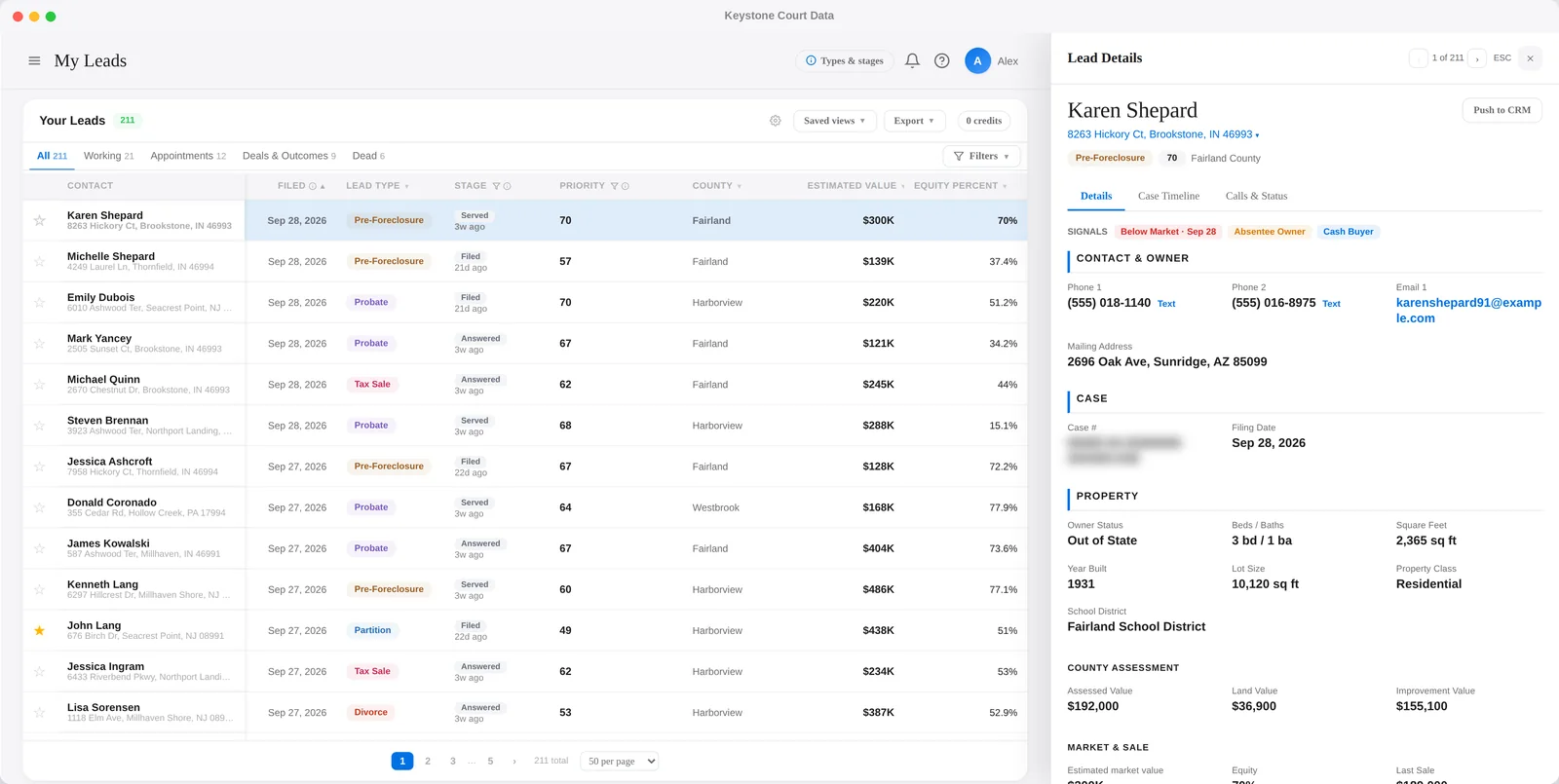
Foreclosure, probate and divorce filings are public records. Keystone Court Data delivers them with the owner and property already matched; you can try Montgomery County free for 7 days, with no credit card.
Questions investors ask
Is Texas a judicial or non-judicial foreclosure state?
Texas is mainly non-judicial. For most mortgages, a trustee named in the deed of trust sells the home without a lawsuit, so the process is run by the lender's side. A home equity loan can be foreclosed only by court order. Confirm timing on any specific loan with an attorney.
When are foreclosure sales held in Montgomery County?
Mortgage foreclosure auctions are held on the first Tuesday of each month between 10:00 AM and 4:00 PM. Exceptions apply when that day falls on January 1 or July 4. Notices must be posted at least 21 days before the sale.
Who do I contact with questions about a specific sale?
Questions go to the trustee or attorney named on the Notice of Sale. The County Clerk has no involvement in the sale itself.
Can an owner stop a foreclosure after the notice of sale?
Sometimes. Owners may cure the default, reach a loan modification or sell the home before the sale date, and bankruptcy can pause a sale. Each case depends on the loan and the lender, so owners should speak with an attorney or housing counselor.
Can I call homeowners in pre-foreclosure?
You can, but you must follow the National Do Not Call Registry and Texas telemarketing rules. Many investors prefer a short letter or a polite visit, and you should stop contact the moment an owner asks.
See Montgomery County leads for 7 days, free
Real court filings with the owner and property matched. No credit card.