Buying a house from an estate in Texas: the steps, from first contact to closing
Who can legally sell, what paperwork the title company will ask for, and how to talk with a grieving family without pressure.

- 1Identify what kind of situation you are dealing with
- 2Confirm who has legal authority to sell
- 3Make respectful, low-pressure contact
- 4Understand whether court approval is needed
- 5Put the terms in writing and open title
- 6Close and keep the paper trail
Buying a house from an estate in Texas: what is actually going on
A man dies in Texas and leaves a paid-off house to three adult children who live in three different cities. None of them wants to manage a vacant property, and none of them is sure who is allowed to sell it. That is the typical situation behind buying a house from an estate in Texas, and it is why these deals can be good for everyone when handled well.
The house does not belong to whoever is handling things. Under Texas law it passes at death to the people named in the will or to the heirs, subject to the estate's debts and any administration (Texas Estates Code 101.001), and a sale needs someone with legal authority to sign. Your job as a buyer is to work out who that is and to avoid deals that a title company will refuse to insure.
Texas has several ways an estate can move through the courts, and the path decides how fast and how cleanly you can buy. A will may be admitted with an executor appointed. A will may be admitted as a muniment of title, which allows title to pass without an appointed personal representative. With no will, the court may declare heirship or appoint an administrator. Details differ by county and by case, so treat everything here as general information and confirm specifics with a Texas probate attorney.
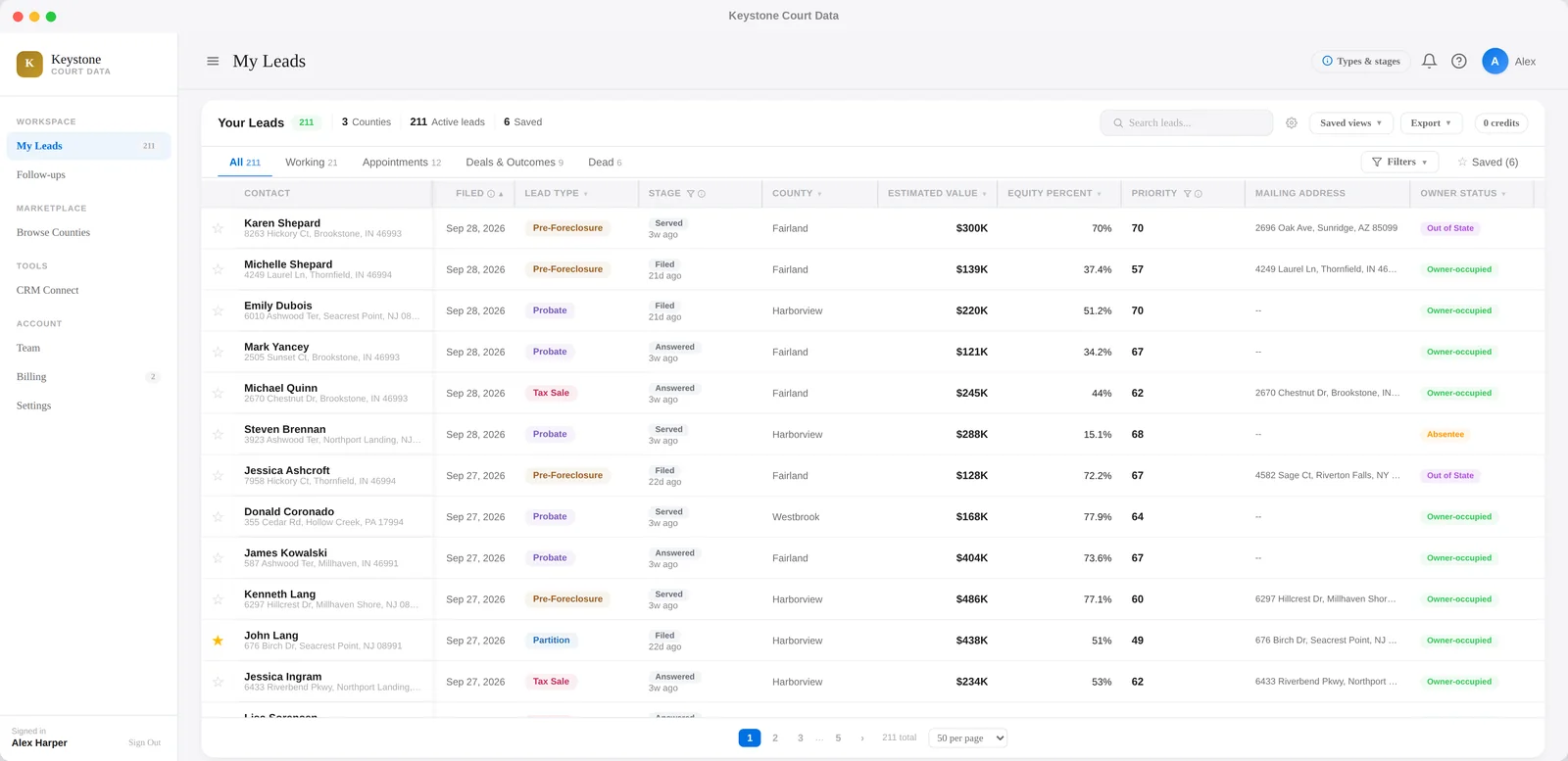
Probate filings are public records. Keystone delivers them with the owner and property already matched, and the probate leads page explains what a probate lead looks like.
The steps
- 01
Identify what kind of situation you are dealing with
Work out whether a probate case has been opened, whether there is a will, and who has been named or appointed. The answer tells you who can sign and how long things may take. If the family is unsure, say so and suggest they speak with a probate attorney.
- 02
Confirm who has legal authority to sell
Ask for proof of authority, such as letters testamentary or letters of administration, or the court order that applies. A person who is simply a relative or lives in the home does not necessarily have it. Never rely on a verbal claim.
- 03
Make respectful, low-pressure contact
Introduce yourself, say what you do, and offer to answer questions without any deadline. Follow Do Not Call and Texas telemarketing rules if you phone, and respect any request to stop. A short letter often lands better than a call.
- 04
Understand whether court approval is needed
In an independent administration the executor can usually sell without a court order for the sale. In a dependent administration, a court order is required unless the will authorizes the executor to sell. Put that condition in the contract and confirm the details with an attorney.
- 05
Put the terms in writing and open title
Write a contract that names the signer and their capacity, such as executor of the estate, and includes a clause tying closing to the proper authority and any needed order. Open title early so problems such as liens or missing heirs come up before you have spent money.
- 06
Close and keep the paper trail
Let the title company confirm the documents and handle funds and recording. Keep copies of everything that proves the seller's authority. That file protects you when you later resell.
Why the type of administration decides your timeline
In an independent administration, the executor can generally sell estate real property without asking the court to approve each sale. This is common in Texas and is often the smoothest path for a buyer, because the seller can act once letters testamentary are issued.
In a dependent administration, the court supervises more closely, and a sale of real property requires a court order unless the will authorizes the executor to sell (Texas Estates Code 356.001, 356.002). That adds time and uncertainty, and the contract should say so plainly.
Some wills are admitted as a muniment of title, and some estates are resolved by determining heirship. Each produces different paperwork for the title company. Do not assume a family member can tell you which one applies. Ask for copies of the court documents, and let the title company and an attorney read them.
Timing also matters. Under Texas law, a will generally cannot be admitted to probate more than four years after the death unless the person offering it was not in default for the delay (Texas Estates Code 256.003), and families sometimes sit on a house for a long stretch without any filing. In that case no one may have authority to sell yet, and the deal depends on the family starting the process.
Common mistakes buyers make with estate sales
Signing with the wrong person. A son who has the keys, or a daughter who pays the utilities, may have no authority. A contract with someone who cannot convey title is a contract you may not be able to close.
Ignoring the other heirs. If heirs share ownership and no one has been appointed, every one of them may need to take part. One holdout can stall the whole transaction.
Rushing a grieving family. Pressure tactics leave a bad taste and can wreck a deal that would have worked in a few weeks. Be plain about who you are and what you are offering, and let them talk to a lawyer or a trusted relative.
Forgetting the rules on phone calls. If you call, follow the federal Do Not Call rules and Texas telemarketing requirements, and keep your own suppression list. A letter or a short, polite call is usually better than repeated attempts.
- Skipping a title review before you spend money on repairs or marketing.
- Promising a closing date the court process cannot support.
- Giving legal advice to the family instead of suggesting they talk to an attorney.
What to do after the contract is signed
Once you have a signed contract, the title company runs the process. Expect it to ask for the court documents that prove authority, such as letters testamentary or letters of administration, or the order or instrument that applies in that estate. If a court order is required for the sale, closing waits for it.
Stay in touch with the seller or their attorney, answer questions quickly, and keep your promises about the timeline. Estates sometimes hit delays that nobody caused, and a calm buyer is the one the family remembers.
After closing, record your deed through the title company and keep your complete file, including the authority documents. If you plan to resell, that file shows your own buyer how clean the chain of title is.
Questions investors ask
Can an executor sell a house in Texas without court approval?
Often yes, if the estate is in independent administration and the executor holds letters testamentary. In a dependent administration, a court order is required unless the will authorizes the executor to sell. Confirm which applies with a Texas probate attorney.
Can I buy a house before probate is finished?
Sometimes, but only from someone with legal authority, and the title company must be satisfied. If no one has been appointed yet, a sale may have to wait. Build any needed approvals into the contract.
What if the person died without a will in Texas?
The estate passes under Texas intestacy law, and the court may declare heirship or appoint an administrator. Who can sign depends on that outcome. The title company will want the court documents that establish it.
Do I need an attorney to buy from an estate?
Nothing here is legal advice, and rules vary by case. An attorney or a title company familiar with Texas estates helps you avoid defects in authority. It is a sensible cost for a purchase this size.
Is it okay to call heirs about buying the house?
You can contact them, but be considerate and honest. If you call, follow federal Do Not Call rules and Texas telemarketing requirements, and stop when asked. Many investors start with a short letter.
See Texas leads for 7 days, free
Real court filings with the owner and property matched. No credit card.