Investing in Weber County, Utah: where motivated sellers show up in the court record
Weber County is mostly owner-occupied, single-family and young. That shapes which sellers you meet and which court filings come before a sale.
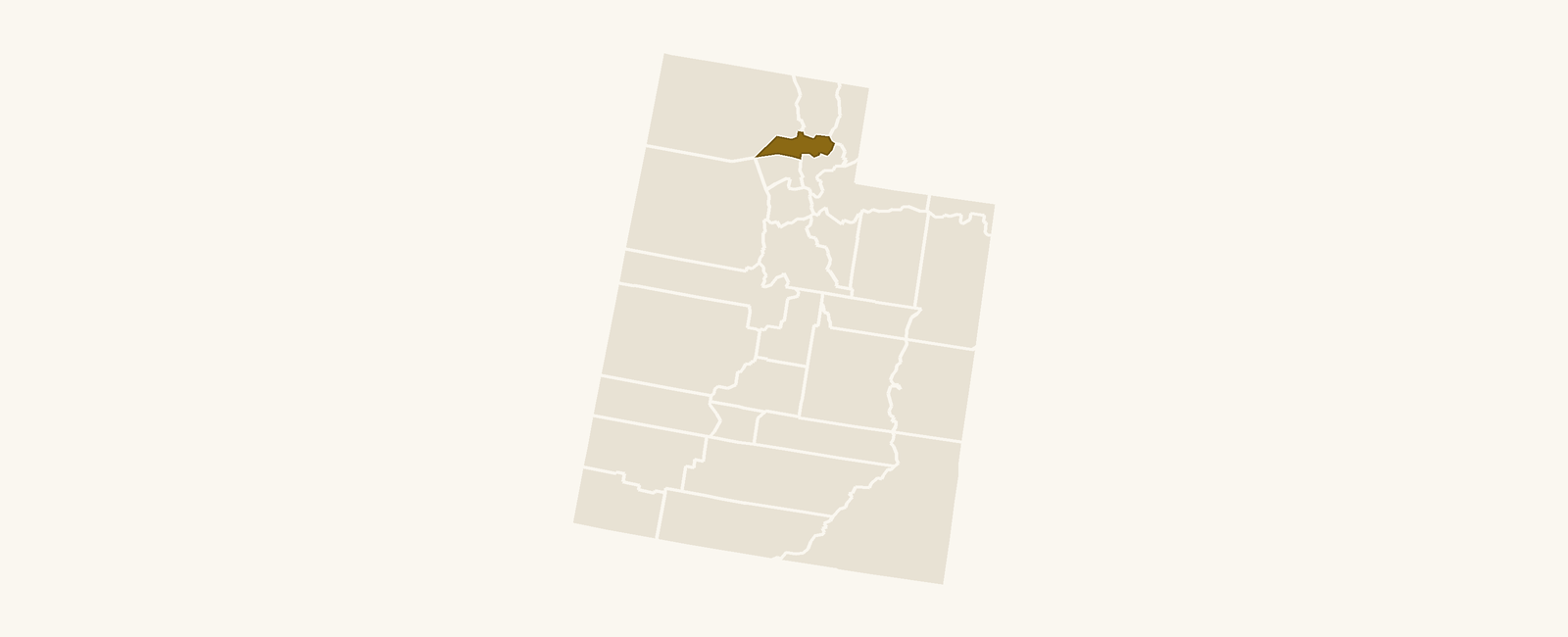
Weber County Utah real estate investing: what the housing data says
Weber County has 98,595 housing units and about 266,183 residents, with Ogden as the county seat. Three out of four homes are owner-occupied (75%), and 71% are single-family detached, compared with 61% nationally. If you invest here, you are mostly buying houses from people who live in them.
Values and rents. The median home value is $389K. HUD's Fair Market Rent for the Ogden area is $1,591 a month for a two-bedroom and $2,132 for a three-bedroom. Run those against your purchase and repair numbers before you decide whether a deal is a flip, a wholesale or a hold.
Young and not very vacant. The median age is 33.5, against 38.9 nationally, and only 6% of housing units are vacant, against 10% nationally. That points to steady demand and few abandoned properties. The motivated sellers you find here are usually occupants in a life event, not owners of boarded-up houses.
Supply is cooling slightly. The county permitted 1,490 new housing units in 2025, down 9% from 2024. Less new construction can keep existing homes competitive for buyers and renters.
The main employers are Weber State University, the U.S. Forest Service Regional Headquarters, the IRS Service Center, McKay-Dee Hospital and Ogden Regional Medical Center. Government is the largest employer category, followed by wholesale and retail trade, services and manufacturing. Stable employers can mean fewer distressed sales, so the ones that do happen often trace back to a specific event such as a death, a divorce or a missed payment.
Source: U.S. Census ACS 2023
Equity and age: why the free-and-clear number matters
Only 30% of owner-occupied homes in Weber County have no mortgage, compared with 39% nationally. For you, that means a lot of sellers still owe a lender. An estate or divorce sale may have less spare equity than the median home value suggests, so your offer has to work around a payoff.
Probate is real, but not the whole market. Residents 65 or older make up 12% of the county, against 17% nationally. Estates will still produce sales, but with a younger population you should not build your whole plan on probate. Pair it with other filing types.
Older homes are not the main risk. Only 10% of homes were built before 1940, against 12% nationally. Still budget for age-related surprises such as roofs, plumbing, electrical and deferred maintenance. Heirs and stressed owners often leave repairs undone, so walk every house before you commit.
Which court filings tend to come before a sale here
Weber County sits in Utah's Second Judicial District, along with Davis and Morgan Counties. Each filing type below is a signal that a property may change hands, and each signals a different kind of seller.
- Pre-foreclosure. A lender has started the process after missed payments. The owner is often looking for a way out while there is still some equity. Time is short, so the conversation needs to be clear and honest.
- Probate. An owner has died and someone has asked the court to open an estate. The home may be sold by the personal representative, which is Utah's term for what many people call an executor. These sellers are usually grieving and often live elsewhere.
- Divorce. A couple may need to sell or buy out a spouse. In cases involving children under 18, both parents must complete the Mandatory Parenting Course and the Divorce Orientation Course before a final order is signed, unless waived. That can affect timing.
- Tax sale. Taxes went unpaid for years and the county is moving toward auction. This is the most self-directed route and the one with the most title risk.
- Partition. Co-owners, often heirs, disagree about what to do with a shared property and ask a court to resolve it. Someone in that group may be glad to sell their share.
These are public records, and Keystone delivers them with the owner and property already matched. Our Weber County page lists what is available here.

How the process works in Utah, in plain terms
Foreclosure. When the loan uses a deed of trust, a Utah foreclosure can be handled outside court through a trustee's sale, or, at the lender's option, in court like a mortgage (Utah Code 57-1-23). For a trustee's sale, notice of sale cannot be given until at least three months after the notice of default is recorded (Utah Code 57-1-24), the owner can cure the default within three months of the notice of default (Utah Code 57-1-31), and there is no right of redemption after the sale (Utah Code 57-1-28). The loan documents and bankruptcy can change the timing, so an attorney can confirm it for the specific property.
Probate. Probate is handled in the district court. Once appointed, a personal representative can sell estate land without a court order unless the will or a court order restricts that power, and in supervised administration any restriction is endorsed on the letters (Utah Code 75-3-504, 75-3-710, 75-3-714). Those letters are the proof of authority to ask for before signing anything.
Property tax calendar. Weber County property tax is due November 30 and becomes delinquent December 1, with a penalty. The penalty rises to 2.5% if the balance is unpaid after January 31. Property is appraised as of a January 1 lien date, and appeals go to the Weber County Board of Equalization by September 15 each year. For 2026, valuation notices went out around July 20 and tax notices on October 17.
Tax sale. The county typically holds its annual tax sale the Thursday before Memorial Day. Properties go to auction after taxes have been delinquent for four years from the final payment deadline. Bidders register in person that morning, and payment must be cash or bank-certified funds with no county financing. Buyers receive a tax deed rather than a warranty deed, and the county makes no guarantees about title or condition. Treat that as a title-clearing project; a title company or attorney can review it before bidding.
If a property goes to a sheriff's sale instead, the sheriff's civil section requires a deposit and charges service fees for items such as trustee sales and a sheriff's deed. Ask the office or your attorney for current amounts before you plan around them.
Approaching owners respectfully and legally
Most of these owners did not choose their situation. A family is dealing with a death, a couple is separating, or someone is behind on a loan. Be plain about who you are, what you are offering and that you are a buyer, not a rescuer.
Keep it low pressure. A short letter or a respectful note works well. Say you buy houses, explain that you are not asking for a decision today, and give them a way to reach you. Do not imply you are affiliated with the court or the lender. Do not tell people a sale is their only option.
Phone rules apply. Utah law bars unsolicited telephone solicitations to Utah numbers on the National Do Not Call Registry and, without prior express consent, calls between 9 p.m. and 8 a.m., on Sundays and on legal holidays. A caller must identify the business and end the call when the person responds negatively (Utah Code 13-25a-103, 13-25a-108). Federal rules apply as well. Honor opt-outs right away, and an attorney can confirm whether a particular call is covered.
Foreclosure and heirs need extra care. Distressed homeowners can be targeted by scams, so put terms in writing and encourage them to talk to an attorney or housing counselor. With estates, speak to the personal representative and do not pressure heirs individually. In partition cases, remember that co-owners may have conflicting interests.
What to look for before making an offer
Payoff and liens. With only 30% of owner-occupied homes owned free and clear, expect a mortgage. Get a payoff figure through the seller and a title company, and ask about other liens before you price the deal.
Authority to sell. For an estate, confirm who is legally able to sign. For a divorce, confirm whether a court order controls the sale. For co-owned property, confirm that every owner agrees.
Condition. Walk the house or have a contractor do it. Whatever the age, deferred maintenance is common when owners are stressed or an estate has sat.
Your exit. Compare your numbers to the $389K median value and the HUD rents of $1,591 for two bedrooms and $2,132 for three. Single-family houses dominate here, so test the deal both as a resale and as a rental.
Tax sale extras. Because there are no title guarantees and no county financing, line up funds and title review before the morning of the sale. A Utah attorney can review the legal steps. You can see how Keystone works on our how it works page or read the Utah overview.
Questions investors ask
Is Weber County a good place to invest in single-family homes?
Single-family detached homes make up 71% of the county's housing, compared with 61% nationally, so that is where most of the opportunity sits. The median home value is $389K. Whether it works depends on your purchase price, repairs and exit.
Does Utah use judicial foreclosure?
Both routes exist. A Utah trust deed can be foreclosed outside court through a trustee's sale or, at the lender's option, in court like a mortgage (Utah Code 57-1-23). An attorney can confirm the process and timing for a specific property.
Can an executor sell a house in Utah?
In Utah the role is usually called a personal representative. Once appointed, they can sell estate real estate without a court order unless the will or a court order restricts that power (Utah Code 75-3-710, 75-3-714). Their letters are the proof of authority, and title and legal review before closing can confirm it.
How does the Weber County tax sale work?
The county typically holds its annual tax sale the Thursday before Memorial Day for properties delinquent four years from the final payment deadline. Bidders register in person that morning and pay with cash or bank-certified funds. You receive a tax deed with no guarantee about title or condition.
Can I call homeowners I find through court filings?
Utah law bars unsolicited telephone solicitations to Utah numbers on the National Do Not Call Registry and, without prior express consent, calls between 9 p.m. and 8 a.m., on Sundays and on legal holidays. A caller must identify the business and end the call when the person responds negatively (Utah Code 13-25a-103, 13-25a-108). Federal rules apply as well. Many investors start with a respectful letter, and an attorney can advise on your specific outreach.
See Weber County leads for 7 days, free
Real court filings with the owner and property matched. No credit card.