Investing in Muskegon County, Michigan: where motivated sellers show up in the court record
A county of mostly owner-occupied, mostly paid-down houses behaves differently from a rental-heavy market. Here is what that means for pre-foreclosure, probate and the offers you make.

Muskegon County real estate investing starts with a paid-off house
In Muskegon County, 78% of homes are owner-occupied, and 42% of those owner-occupied homes carry no mortgage. The U.S. figure for owned free and clear is 39%. The county has 74,969 housing units and a median home value of $181K, according to the American Community Survey.
Why that matters for you. A seller with no mortgage has more room to negotiate and more options than one who is underwater. When a paid-off home changes hands because of a death or a family change, the equity belongs to heirs or co-owners who may care more about speed and simplicity than top dollar.
The housing mix is also traditional. About 77% of homes are single-family detached, compared with 61% nationally. That means fewer condo and apartment complexes, and more houses that fit a flip, a wholesale deal or a single-family rental. Vacancy sits at 10%, the same as the U.S. figure, so the county is not unusually empty, and you should not assume every quiet house is abandoned.
Source: U.S. Census ACS 2023
Which court filings tend to come before a sale here
Court filings are the paper trail of a seller who may need to act. In this county, two types matter most for investors: pre-foreclosure and probate.
Pre-foreclosure. A foreclosure filing or notice means a lender is moving toward a sale because payments stopped. The owner often has a limited window to sell or work something out. That window is where a fair, informed offer can help both sides.
Probate. Muskegon County has a median resident age of 39.9 (U.S.: 38.9), and 18% of residents are 65 or older (U.S.: 17%). The gap is modest, but combined with high free-and-clear ownership it means estates here often hold houses with little or no debt. Heirs may live out of town, may not want the house, and may not know the next step.
Other court records exist as well. Divorces are heard in the family division of the circuit court (MCL 600.1021), and unpaid property taxes can end in a tax foreclosure judgment entered by the Circuit Court. Those are useful background for understanding how sellers get into difficulty, but the lead types offered for this county are pre-foreclosure and probate.
How foreclosure, probate and tax sales work in Michigan, in plain terms
Mortgage foreclosure. Most Michigan mortgage foreclosures are not decided by a judge. The lender follows a statutory process, and the sale is held publicly. Michigan law has the sale held at public auction, to the highest bidder, by the person appointed in the mortgage or by the sheriff, undersheriff or a deputy sheriff of the county (MCL 600.3216).
After a sale, Michigan law gives the former owner a redemption period. For a home of up to four units it is generally six months when more than two-thirds of the original loan was still owed, one year when less was owed, and shorter if the home is found abandoned, and the certificate of sale must state the date by which the property must be redeemed (MCL 600.3240). A Michigan attorney can explain a buyer's rights during that period.
Probate. When an owner dies, a Michigan probate court oversees the estate. A personal representative appointed by the court generally has to hold the authority to sell real estate before a buyer can close. If the heirs tell you they are still waiting on that authority, believe them and keep your timeline flexible.
Property taxes. Unpaid property taxes are returned delinquent to the county treasurer on March 1, when a 4% administration fee and 1% monthly interest are added (MCL 211.78a). Unpaid taxes then forfeit and are foreclosed by a circuit court judgment, and redemption rights expire on the March 31 after that judgment, or 21 days after the judgment in a contested case (MCL 211.78k(5)). Michigan law requires the foreclosing governmental unit to hold one or more auction sales of tax-foreclosed property, which may be held online, between the third Tuesday in July and the first Tuesday in November after the foreclosure judgment (MCL 211.78m(2)). Treat tax debt as one more sign of financial pressure, and confirm all deadlines with an attorney.
Reading the Muskegon market: rents, age of housing and demand
For buy-and-hold, HUD publishes Fair Market Rents for the Muskegon-Norton Shores area: $1,285 a month for a 2-bedroom and $1,534 for a 3-bedroom, per HUD. Set those against a median home value of $181K to sketch a first-pass rental scenario, then adjust for condition and taxes.
Plan for age. 16% of homes here were built before 1940, compared with 12% nationally. Older houses can mean knob-and-tube wiring, galvanized plumbing, old roofs and foundation questions. Build a repair cushion into every offer, and do not rely on a quick drive-by to price it.
Demand has some support. The county permitted 451 new housing units in 2025, up 7% from 2024, per the Census Building Permits Survey. Employment helps, too. The county's economic development office names GE Aviation, Bayer CropScience, Pratt & Whitney and Arconic among employers, and manufacturing is a major part of the local economy, with the Port of Muskegon described as the area's greatest economic asset. A job base like that tends to keep tenants and buyers looking for ordinary single-family houses.
How to approach Muskegon County owners respectfully and legally
The people behind these filings are facing a missed payment, a death in the family or both. Lead with courtesy, not urgency.
- Be honest about who you are. Say you are an investor, say you may buy the house for cash, and never pose as a lender, an attorney or a government agency.
- Offer information first. Let owners know they can talk to a housing counselor or attorney before deciding. A seller who feels respected is more likely to call you back.
- Respect phone rules. Calls are regulated. Federal rules on telephone solicitations set the National Do Not Call Registry, a calling window of 8 a.m. to 9 p.m. local time and company do-not-call lists (47 C.F.R. 64.1200). Michigan uses the federal list as its state do-not-call list, bars telephone solicitations that use a recorded message, requires the caller to give their name and organization at the start of the call, and bars solicitation calls to anyone who has asked not to get them (MCL 445.111a, 445.111b, 445.111c). Whether a call offering to buy a house is covered depends on the facts, so a Michigan attorney can confirm. Mail and in-person notes are often gentler, but they have their own rules, so ask an attorney if you are unsure. The FTC's telemarketing guidance is a good starting point.
- Never pressure. Do not rush an heir who is grieving or an owner who has just received a foreclosure notice. Give written terms and time to read them.
- Stay in your lane. You are a buyer, not a legal adviser. Do not tell anyone what their rights are; suggest they ask an attorney.
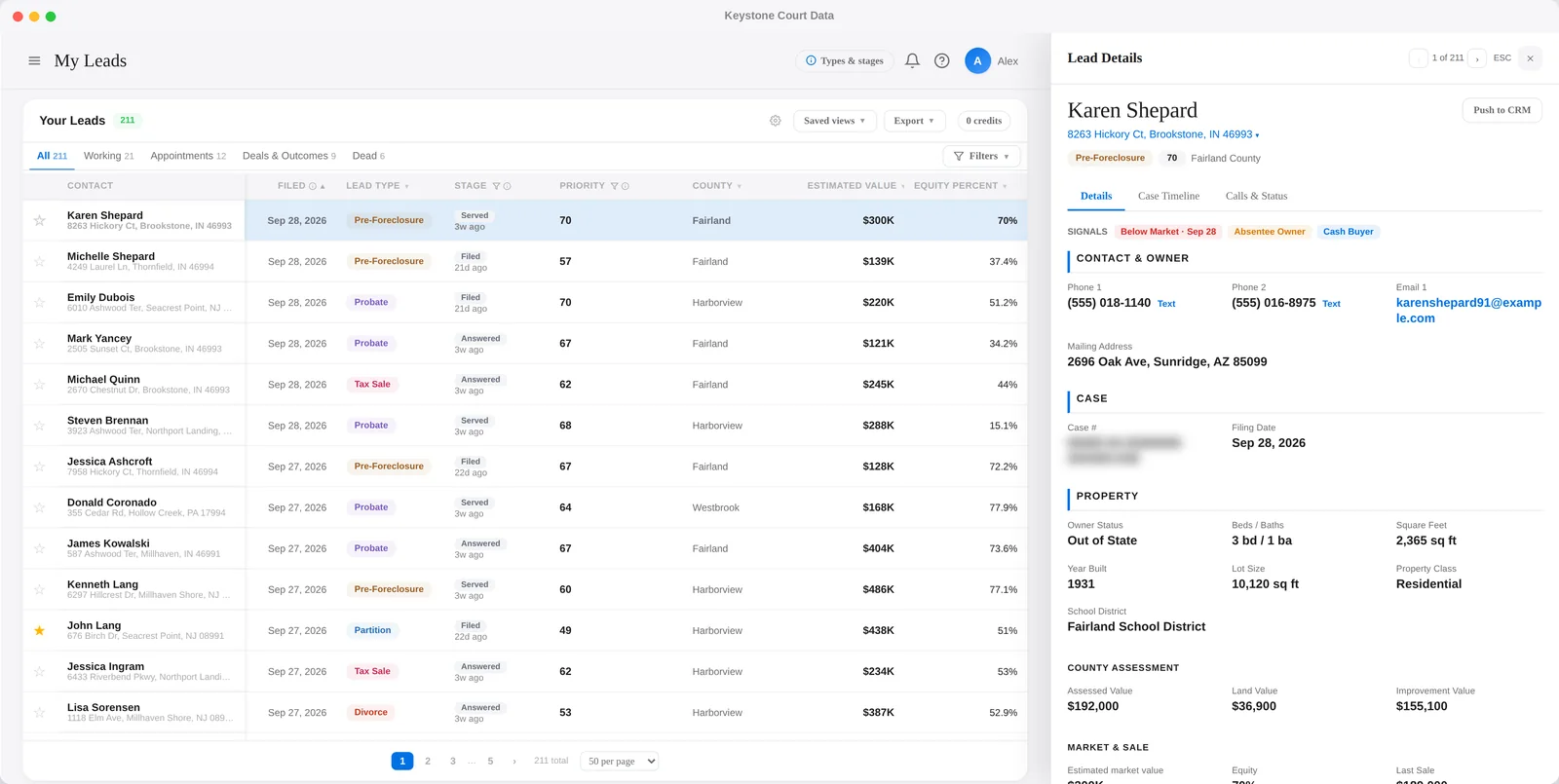
The filings behind these situations are public records. If you want them matched to the owner and property and delivered as each notice is published, Keystone's Muskegon County page shows how that works.
What to look for before making an offer
Confirm who can actually sign. In a probate situation, make sure the person you are talking to has the legal authority to sell. In a foreclosure, make sure you understand the sale status and any redemption rights before you commit money. An attorney or title company should confirm both.
Run the numbers on condition. With a high share of single-family detached homes and a meaningful number of pre-1940 houses, inspect for roof, foundation, electrical, plumbing and moisture. Write your offer with those costs in mind.
Account for taxes. After a transfer of ownership, the property's taxable value for the next calendar year is its state equalized value (MCL 211.27a(3)), so the new owner's tax bill may be higher than the seller's. Factor that into rental projections and your resale pitch.
Plan your exit. Compare the 2-bedroom and 3-bedroom HUD rent figures to your numbers for holding, and consider whether a retail buyer, a landlord or a wholesale partner is the most realistic next step.
Questions investors ask
Is Michigan a judicial or non-judicial foreclosure state?
Most Michigan mortgage foreclosures are carried out by advertisement, which means outside of court. The lender publishes notice and holds a public sale. Tax foreclosures are different, and in Muskegon County those judgments are entered by the Circuit Court.
Who runs the foreclosure auction in Muskegon County?
Michigan law has the sale held at public auction, to the highest bidder, by the person appointed in the mortgage or by the sheriff, undersheriff or a deputy sheriff of the county (MCL 600.3216).
Can an heir or executor sell an inherited house in Muskegon County?
Usually only after the probate court has given the personal representative authority to act for the estate. Heirs can talk with buyers earlier, but a closing generally has to wait for that authority. Ask an estate attorney how the process applies to a specific case.
How long do owners have to pay delinquent property taxes before a tax sale?
Under Michigan law, redemption rights expire on the March 31 after the circuit court's foreclosure judgment, or 21 days after the judgment in a contested case (MCL 211.78k(5)). Foreclosed property is then offered at auction between the third Tuesday in July and the first Tuesday in November (MCL 211.78m(2)). Interest and fees accrue in the meantime, so confirm exact deadlines with an attorney.
Can I call owners I find in court filings?
Calls are regulated. Federal rules on telephone solicitations set the National Do Not Call Registry, a calling window of 8 a.m. to 9 p.m. local time and company do-not-call lists (47 C.F.R. 64.1200). Michigan uses the federal list as its state do-not-call list, bars telephone solicitations that use a recorded message, requires the caller to give their name and organization at the start of the call, and bars solicitation calls to anyone who has asked not to get them (MCL 445.111a, 445.111b, 445.111c). Whether a call offering to buy a house is covered depends on the facts, so a Michigan attorney can confirm. Many investors prefer a short, respectful letter. If you are not sure what applies to your outreach, ask an attorney.
See Muskegon County leads for 7 days, free
Real court filings with the owner and property matched. No credit card.