Pre-foreclosure in Snohomish County, Washington: what investors should know
A county with a $645K median home value, fewer free-and-clear owners than the U.S. and a tight vacancy rate. Here is what that means when a homeowner falls behind.

What the housing looks like for pre-foreclosure in Snohomish County, Washington
Snohomish County has 834,648 residents and 327,893 housing units, and the median home value is $645K. At that price level, a single missed stretch of payments can mean a large loan balance sitting against the house. That shapes everything else about pre-foreclosure here.
Less free-and-clear ownership. About 28% of owner-occupied homes have no mortgage, compared with 39% across the U.S. Of homes in the county, 68% are owner-occupied. So most of the owner-occupied homes you will run into carry a loan, and the owner's equity depends on how long they have held the home and how much they borrowed against it.
A tight, newer housing stock. Vacancy is 5% (U.S.: 10%), and only 5% of homes were built before 1940 (U.S.: 12%). About 64% are single-family detached homes (U.S.: 61%). Expect fewer abandoned properties and fewer century-old repair projects than in many older markets. Condition problems tend to come from deferred maintenance on newer homes, not from age alone.
Demand signals. New housing units permitted in 2025 came to 3,372, a change of -19% from 2024. Slower building and low vacancy point to a market where a well-priced house usually has buyers or renters waiting. For buy-and-hold math, HUD Fair Market Rent for the Seattle-Tacoma-Bellevue area is $2,549 for a 2-bedroom and $3,324 for a 3-bedroom.
The local economy leans on aerospace. Aerospace manufacturing is the largest part of the county's manufacturing employment, and Boeing plays a prominent role. Boeing established its 747 plant at Paine Field near Everett in the late 1960s. When one industry anchors so many paychecks, a downturn there can show up in household budgets across Everett, Marysville, Edmonds and Lynnwood.
Source: U.S. Census ACS 2023
Which court filings tend to come before a sale here
Foreclosure is the obvious one, but it is not the only way a house ends up in play. Each situation tells you something different about the owner and the timeline.
- Pre-foreclosure. The owner has missed payments and the lender has started the process to sell the home. The owner usually still holds the house and still has options.
- Probate. The owner has died and the estate must be settled. The person handling the estate may need to sell, or heirs may decide they do not want the home.
- Divorce. A couple may need to sell or buy out one spouse. Timing often depends on the court process and on whether both people agree.
In this county, a filing can mean different things depending on equity. With 28% of owner-occupied homes owned free and clear, an estate or a divorce more often involves a home with a mortgage still attached. Pay-off amounts, not just value, decide whether a deal works.
Because 14% of residents are 65 or older (U.S.: 17%), probate is less dominant than in a retiree-heavy county. It still matters, and it tends to produce calmer, less time-pressured sellers than foreclosure does.
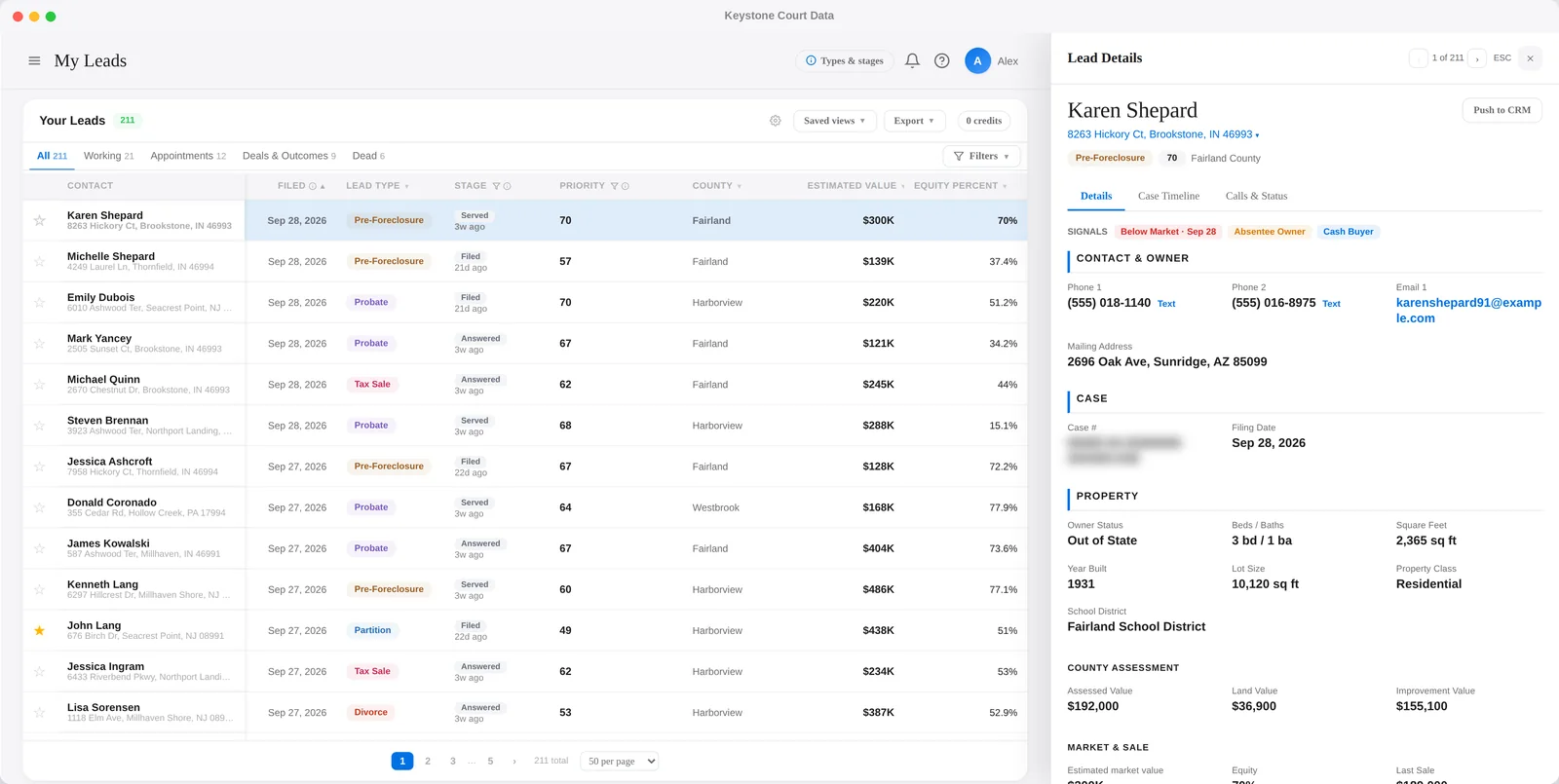
These filings are public records. Keystone Court Data delivers pre-foreclosure, probate and divorce filings for the county with the owner and property already matched, so your time goes to talking with people. You can see the county at Snohomish County leads.
How foreclosure works in Washington, in plain terms
Mostly non-judicial. Most residential foreclosures in Washington run under the Deed of Trust Act, chapter 61.24 RCW. A trustee, not a judge, runs the sale. That is why the process can move without a lawsuit. The statute sets required notices and minimum waiting periods, so confirm the exact timeline for any specific property with a Washington attorney.
The sale itself. Lender foreclosures in the county are often sold as Trustee's Sales or Sheriff Sales on the courthouse steps on Fridays. Buyers there generally need to be ready with funds, and you are buying with limited ability to inspect the property.
Redemption. After a trustee's sale, no one has a right to redeem the property (RCW 61.24.050). Real property sold at Sheriff's sales, by contrast, may carry a redemption period of eight months to one year. That affects who can occupy the home and when you can take possession or resell. Whether a particular sale carries a redemption period is a legal question, so have an attorney confirm it before you bid.
Tax foreclosure is its own track. The Snohomish County Treasurer conducts a once-a-year tax lien foreclosure auction under chapter 84.64 RCW. The 2026 auction is tentatively set for Thursday, December 3, 2026, and is held online. Bidders must pre-register and pay a pre-sale deposit. Buyers receive a Tax Deed, not a tax certificate, because Washington is not a tax lien state. Property taxes are due in two halves, April 30 and October 31, and unpaid taxes are what start this process. The Superior Court handles tax foreclosure cases, with the 2026 tax foreclosure filed there.
Probate and divorce. Both are handled in Superior Court. Probate puts a personal representative in charge of the estate, and what that person may do with the house depends on the will and on the powers the court gave them. Divorce property decisions can be agreed between spouses or set by the court. In both cases, ask who has the legal authority to sell before you talk price.
Approaching owners respectfully and legally
People facing foreclosure, a death in the family or a divorce are having a hard year. Your first contact should be short, honest and easy to decline.
Say who you are and why you are calling or writing. Tell them you buy homes, that you saw the home may be in a difficult position, and that you can talk if it helps. Do not claim you represent the lender, the court or a government program.
Respect Do Not Call and state telemarketing rules. If you phone, honor the National Do Not Call Registry (see donotcall.gov) and Washington's telemarketing rules, keep your own internal do-not-contact list, and stop when asked. Mail and in-person visits come with their own rules, so check with an attorney about what applies to you.
Never pressure. Owners in default often get a lot of solicitations. The one that sounds patient and clear stands out. Encourage them to talk to a housing counselor or attorney, and be honest that a sale to you is one option among several.
Be careful with timing. For a probate family, a first note after a death is rarely welcome. Give people room, and speak to the person with legal authority over the estate, not just whoever answers the door.
What to look for before you make an offer
A filing tells you a property may be available. It does not tell you whether the deal works. Before you offer, work through these points.
- Total debt against value. With fewer free-and-clear owners, expect first and sometimes second loans. At a $645K median value, even a modest discount can disappear once every lien is paid.
- Where the sale stands. Know whether the home is still with the owner, headed to a trustee's sale, or already sold, and whether any redemption period applies.
- Who can sign. In probate, confirm the person has legal authority. In divorce, confirm both spouses agree or that a court order allows the sale.
- Condition. Newer stock means fewer very old systems, but deferred maintenance and owner-occupant wear still add up. Walk it if you can, and budget for surprises if you cannot.
- Your exit. If you plan to rent, test the numbers against the HUD Fair Market Rents of $2,549 (2-bedroom) and $3,324 (3-bedroom). If you plan to resell, remember that low vacancy and slower permitting can support demand but do not guarantee it.
Have a Washington real estate attorney or title professional review any purchase out of foreclosure, estate or divorce. The rules differ by situation, and mistakes are costly.
Questions investors ask
Is foreclosure in Snohomish County done through the courts?
Most lender foreclosures follow Washington's non-judicial deed of trust process, run by a trustee instead of a judge. Tax foreclosure and some other cases are handled in Superior Court. Which route applies depends on the loan documents and the situation, so confirm with an attorney.
When and where are foreclosure sales held?
Lender foreclosures in the county are often sold as Trustee's Sales or Sheriff Sales on the courthouse steps on Fridays. The tax foreclosure auction is separate, held once a year and online. The 2026 one is tentatively set for Thursday, December 3, 2026.
Is there a redemption period after a sale?
After a non-judicial trustee's sale there is no right to redeem (RCW 61.24.050). Real property sold at Sheriff's sales may carry a redemption period of eight months to one year. Whether it applies to a given sale is a legal question, so have an attorney confirm it before you bid.
What do I get if I win the county tax auction?
You receive a Tax Deed, not a tax certificate, because Washington is not a tax lien state. Bidders must pre-register and pay a pre-sale deposit. Talk with an attorney or title company about what a tax deed does and does not clear.
Can I call homeowners in pre-foreclosure?
You can, but follow the National Do Not Call Registry and Washington's telemarketing rules, identify yourself honestly and stop when asked. Many investors send a short, polite letter instead. Never pressure someone or imply you work for the lender.
See Snohomish County leads for 7 days, free
Real court filings with the owner and property matched. No credit card.