Pre-foreclosure in Collin County, Texas: what investors should know
A county of newer, mostly single-family homes, less free-and-clear equity than the U.S. average, and a foreclosure process that usually runs without a judge. Here is what that means for your offers.

Collin County pre-foreclosure starts with a very particular housing market
Collin County has 1,116,601 residents and 421,938 housing units, and 64% of homes are owner-occupied. If you are researching pre-foreclosure in Collin County, Texas, that ownership share is the pool you are working in. Most of it is single-family: 68% of homes are single-family detached, against 61% nationally.
Less free-and-clear equity than average. Only 30% of owner-occupied homes here have no mortgage (U.S.: 39%). More owners carry a loan, which means more households exposed to a missed payment and more properties where a lender can start the foreclosure process. It also means equity is not a given. A seller may owe a lot, so you need to understand the payoff before you talk numbers.
Newer homes, tight supply. Just 1% of homes were built before 1940 (U.S.: 12%), so you will see fewer century-old money pits and more suburban houses with systems of moderate age. Vacancy is 5% (U.S.: 10%), and the median home value is $448K. Homes that need work still tend to sell here, which helps your exit when you buy.
Growth keeps the pressure on. The county calls itself the sixth most populous and still the fastest growing large county in Texas. About 19,082 new housing units were permitted in 2025, up 1% from 2024. New construction competes with resale homes, so a fair price matters when you pitch an owner.
The big cities are Plano, Frisco, Allen and McKinney, and McKinney is the county seat. Owners in each can have very different equity and repair situations, so avoid treating the county as one uniform market.
Source: U.S. Census ACS 2023
Which filings come before a sale in Collin County, and why
Different life events lead to different filings, and each tells you something different about the owner. Reading a filing correctly is most of the work of approaching someone kindly.
- Pre-foreclosure: the lender or its trustee has started the process after missed payments. The owner is usually under time pressure and often embarrassed.
- Probate: an owner has died and the estate is being opened. The heirs may live out of state, may not want the house, and are often grieving.
- Divorce: a couple may need to sell or buy out a spouse. Timing depends on the court and the parties, and emotions can run high.
Why probate matters here, in proportion. With 11% of residents aged 65 or older (U.S.: 17%), estate sales will be a smaller share of the story than in older counties. They still happen, and estate properties often have an owner who wants simplicity more than top price.
Why equity differs by filing. A divorce or estate sale on a home with no mortgage can carry a lot of equity. A pre-foreclosure home often carries less. In a county where 30% of owner-occupied homes are free and clear, expect many leads to involve a loan, so ask about the balance early and be honest if the numbers do not work.
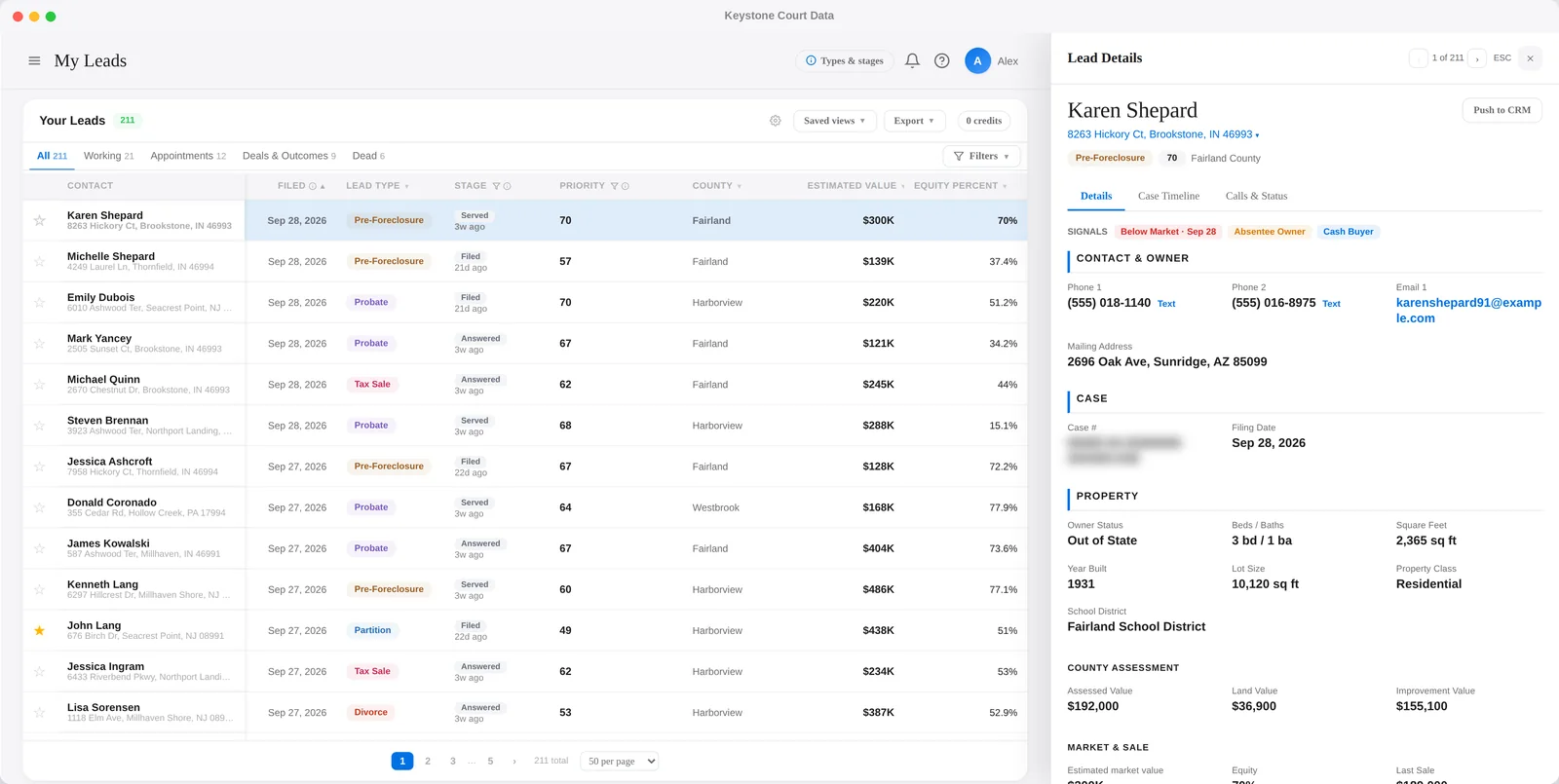
A lead is a reason to start a respectful conversation, not a guarantee that someone wants to sell. Keystone delivers pre-foreclosure, probate and divorce filings for Collin County matched to the owner and property, and you can try the county free for 7 days.
How a Texas pre-foreclosure works, in plain terms
Texas uses non-judicial foreclosure. Most mortgages here are secured by a deed of trust that gives a trustee the power to sell the property if the borrower defaults. The lender does not need to file a lawsuit first, so there is no judge setting the pace. A home equity loan is different: it can be foreclosed only by court order (Texas Constitution art. XVI, sec. 50(a)(6)(D)).
Notice of default. For a home the borrower lives in, Texas Property Code 51.002(d) requires the mortgage servicer to send a written notice of default by certified mail giving at least 20 days to cure before the notice of sale can be given. If the borrower does not cure, the lender can move forward with the sale.
Notice of sale. The notice of sale must be given at least 21 days before the sale date. Texas trustee sales happen on the first Tuesday of a month between 10 a.m. and 4 p.m., or the first Wednesday when that Tuesday is January 1 or July 4. Confirm any specific deadline with a Texas attorney, because loan terms, bankruptcy filings or loss-mitigation steps can change what happens in a given case.
Who runs the sale. In Collin County, trustees appointed by the mortgage holders conduct and oversee the foreclosure auctions, including setting their times, and county employees cannot advise the public on bidding. The Precinct 1 Constable's Office does not conduct trustee foreclosure sales. Those are run by trustees or attorneys for the lending institutions.
After the sale. Texas has no general right to redeem a home after a mortgage foreclosure sale. That makes the weeks before the sale the real window for a negotiated deal, where the owner can sell, catch up, or work out another option with the lender.
Property tax delinquency is a separate path. Collin County does not hold a tax lien certificate sale. Instead the property itself is sold at auction and the buyer receives a Constable's deed without warranty. Tax sale property carries a two-year redemption right for homestead and agricultural property and a 180-day right for other property, running from the date the purchaser's deed is filed with the County Clerk.
Probate and divorce in Collin County: who is involved
Collin County has a Probate Court. The judge cannot appoint an administrator or executor of an estate unless that person is represented by a licensed attorney. That is useful for you in a practical way: if you talk to an executor, an attorney is almost certainly involved, and your offer will probably be reviewed by that attorney.
Authority matters. Until a personal representative is appointed, nobody may have authority to sell. Heirs may be eager to talk but unable to sign. Ask politely who is handling the estate and respect it if they refer you to the attorney.
Divorce is about two people. A house in a divorce can be sold by agreement, bought out by one spouse or handled under a court order. Both spouses may need to sign, and the court's orders can limit what either can do. Do not take sides or press one person to commit without the other.
Rules and timelines vary from case to case. Both probate and divorce deals should be reviewed by a Texas attorney before you commit.
How to approach owners respectfully and legally
People facing foreclosure, a death or a divorce are often stressed and may be wary of investors. Honest, low-pressure contact works better and keeps you out of trouble.
- Say who you are and why you are reaching out. Give your name and company, and do not imply you are a lender, court or government agency.
- Offer information, not a deadline. Explain what you can do, and let them say no without a fight.
- Use written mail and in-person visits thoughtfully. A short, kind letter is easy to ignore, easy to keep and easy to answer when the owner is ready.
- Respect the answer. If someone says no, stop. If they ask you to stop contacting them, do so right away and keep a note.
Phone calls have rules. If you phone, check numbers against the National Do Not Call Registry and follow Texas telemarketing rules, including any registration and calling-hour requirements that apply to you. Confirm which ones apply to your business with an attorney. Text and recorded messages have their own limits.
Buying from someone facing foreclosure can raise extra legal issues, so talk to a Texas attorney before you structure a deal. Never promise to save a home you cannot save.
What to check before you make an offer
A filing tells you the story is starting. It does not tell you whether the numbers work. Before you offer on a Collin County home, work through these points.
- Payoff and liens. Know which lien is foreclosing and what other liens are recorded against the home, and have a title professional confirm which ones a sale would leave in place.
- Property taxes. A tax lien attaches to property on January 1 each year to secure that year's taxes. Collin County statements are mailed in October and are due upon receipt, with penalties avoided by paying by January 31, 2027. Unpaid taxes can follow the property.
- Value. Property values are set by the appraisal district, and disagreements are settled by an independent appraisal review board. Do not treat the appraised value as your price. Compare it with real sales and the $448K median home value for context.
- Condition. With few pre-1940 homes (1%), expect repair budgets to be driven by deferred maintenance on newer homes rather than ancient wiring and plumbing. Look inside before you commit.
- Exit. If you plan to rent, HUD Fair Market Rent in the Dallas-Fort Worth-Arlington area is $1,807 monthly for a 2-bedroom and $2,275 for a 3-bedroom. Those are benchmarks for the metro, not rent guarantees for a specific Collin County street.
Buying at a trustee sale is a different risk from a negotiated purchase, since a buyer at a Texas trustee sale takes the property "as is," at the buyer's own risk, with no warranties except as to title (Texas Property Code 51.009), and you may not be able to inspect the property. If you consider an auction, talk with a Texas real estate attorney about the terms first.
Questions investors ask
Is foreclosure in Collin County judicial or non-judicial?
It is non-judicial in the usual case. Most Texas mortgages include a deed of trust with a power of sale, so a trustee can conduct the sale without a lawsuit. The trustee, not the county, runs the auction in Collin County.
How long do owners have after a notice of default?
For a home the borrower lives in, Texas law requires the servicer to give at least 20 days to cure after the default notice, and the notice of sale must come at least 21 days before the sale. Actual timelines vary with the loan, bankruptcy or loss-mitigation steps. Confirm specifics with a Texas attorney.
Can I redeem a home after a Collin County foreclosure sale?
Texas does not give a general right to redeem after a mortgage foreclosure sale. Tax sales are different, with a two-year redemption right for homestead and agricultural property and 180 days for other property. Get legal advice for your specific situation.
Can an executor sell a house in Collin County without going through probate court?
Generally an executor needs authority from the court or the will before selling. In Collin County, the Probate Court judge cannot appoint an administrator or executor unless that person has a licensed attorney. Ask for the attorney's contact and let them confirm authority.
Are phone calls to pre-foreclosure owners allowed?
Sometimes, but you must follow the National Do Not Call Registry and Texas telemarketing rules. Many investors prefer a respectful letter or visit. Talk to an attorney about which rules apply to you.
See Collin County leads for 7 days, free
Real court filings with the owner and property matched. No credit card.