Pre-foreclosure in Bergen County, New Jersey: what investors should know
A high-value, mostly owner-occupied county with older homes and a judicial foreclosure process. Here is what each filing means and how to deal with owners fairly.

What housing looks like behind pre-foreclosure in Bergen County, New Jersey
Bergen County has 954,717 residents and 368,535 housing units, and the median home value is $593K. That price level shapes everything about pre-foreclosure Bergen County New Jersey investors will see. Even a modest shortfall on a loan can sit on a property with real value behind it.
Few empty homes. Only 4% of housing units are vacant, against 10% for the U.S. In a county this tight, a distressed property rarely sits unnoticed, and owners often have more choices than they think, including a traditional listing.
Not mostly single-family. About 53% of homes are single-family detached, compared with 61% nationally. Expect condos, townhomes and smaller multi-unit buildings in your mix, each with its own rules and costs.
Older homes. About 19% of homes were built before 1940, against 12% for the U.S. Plan repair budgets with that in mind: roofs, old wiring, plumbing and possibly environmental issues in the oldest houses.
Owners with equity. 65% of homes are owner-occupied, and 38% of owner-occupied homes have no mortgage (U.S.: 39%). That is close to the national share, but at these values a free-and-clear home carries a lot of equity. It matters most in estate and divorce situations, covered below.
Source: U.S. Census ACS 2023
Which filings come before a sale here, and why
A single property can show up through several kinds of court or tax filings. Each one tells you something different about the owner's situation.
- Pre-foreclosure. A lender has started a foreclosure case in court. The owner is behind, but the home is not yet sold, so there may be time to sell, reinstate or negotiate.
- Probate. An owner has died and the estate is being settled. Bergen County's median resident age is 42.1 (U.S.: 38.9), and 18% of residents are 65 or older (U.S.: 17%). Estates are a steady source of homes that heirs may not want to keep.
- Divorce. Divorce matters are heard by the Family Part of the Superior Court, Chancery Division (N.J.S.A. 2A:34-8, 2A:34-23). A shared home often has to be sold or bought out, and with substantial equity the stakes for both spouses are high.
- Tax sale. Unpaid property taxes can lead to a tax sale process. Rules on timing and redemption are set by state law: the municipal tax collector sells a lien, and the owner can redeem until the right is cut off by a foreclosure judgment (N.J.S.A. 54:5-19, 54:5-54, 54:5-86). An attorney can confirm the specifics.
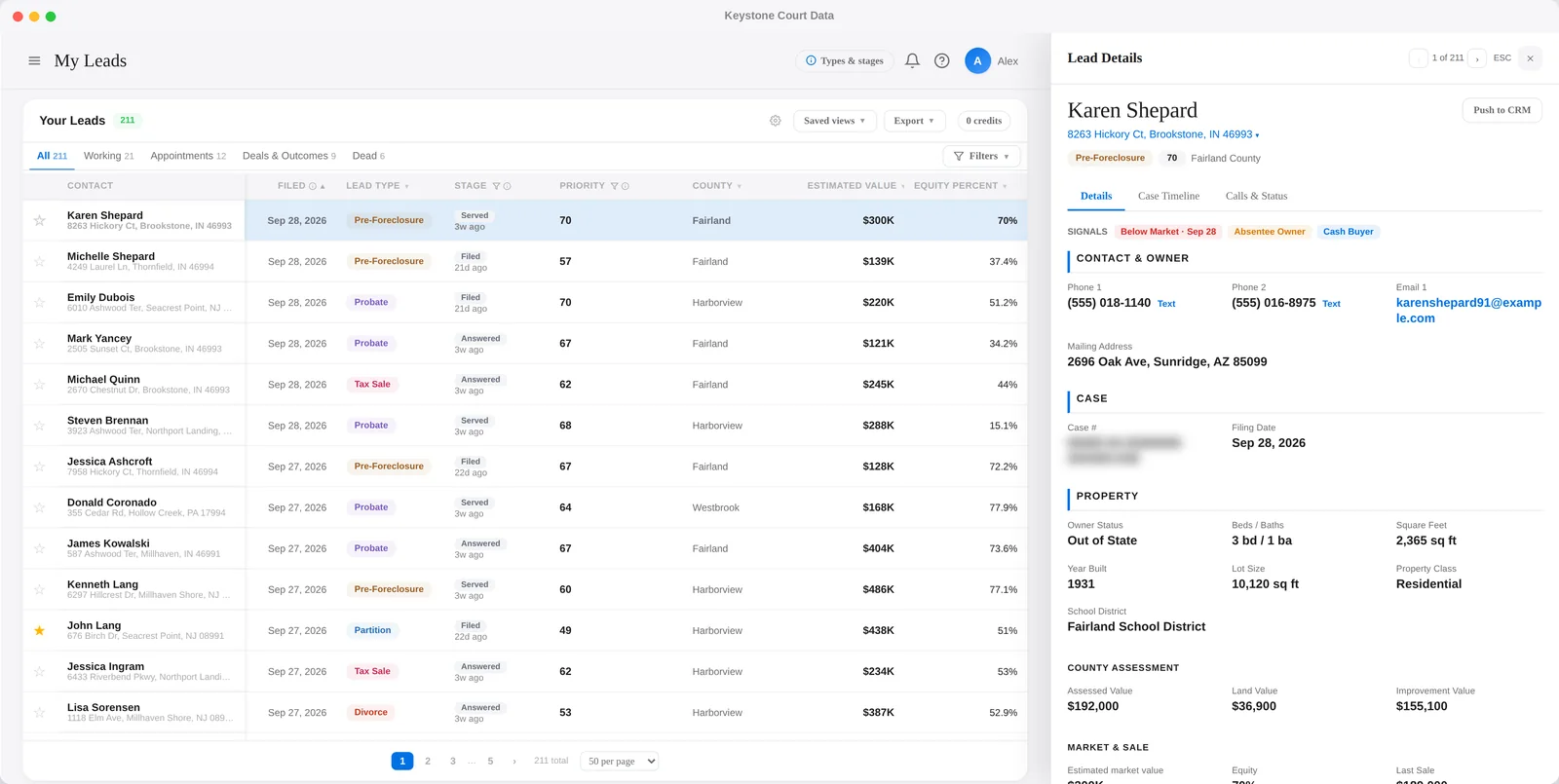
Keystone Court Data turns these public filings into leads with the owner and property already matched, so you can spend your time on conversations rather than paperwork. The records themselves are public.
How foreclosure works in New Jersey, in plain terms
It is a judicial process. A lender cannot simply auction a New Jersey home on its own. It has to bring a case in the Superior Court, Chancery Division. For a residential mortgage, the lender must first send the borrower a written notice of intention to foreclose at least 30 days, and not more than 180 days, before starting the case, and the borrower can cure the default up to final judgment (N.J.S.A. 2A:50-56, 2A:50-57). An attorney can confirm current requirements.
The sheriff runs the sale. After the court process, the Bergen County Sheriff's Office conducts foreclosure sales of real property. Under its published terms, these are open auctions with no sealed bids, and the plaintiff, usually the lender, makes the starting minimum bid.
Buyer terms are strict. Under the Sheriff's terms, the winning bidder must pay 20% when the property is struck off and the balance within 30 calendar days. If you buy this way, line up your funds first.
Redemption. The Sheriff's terms give the original owner the right to redeem within ten calendar days from the date of the sale, and that period may be extended. That means a buyer at auction should not assume the deal is final immediately; an attorney can review the timeline and title position.
Probate is separate. For estates, New Jersey uses a county Surrogate, and Bergen County has one. Once appointed, an executor or administrator can sell estate real estate unless the will or a court order limits it, except property the will leaves to a specific person (N.J.S.A. 3B:14-23); an attorney can confirm authority in each case.
How to approach owners respectfully and legally
People facing foreclosure, a death in the family or a divorce are often stressed and wary. Treat the first contact as an introduction, not a pitch. Say who you are, why you are writing, and that there is no obligation.
Prefer letters and plain language. A short, honest letter lets the owner read it on their own time. Do not imply you are a lender, a court official or a government program, and do not use false deadlines.
If you phone, know the rules. Telemarketing sales calls are covered by the National Do Not Call Registry and New Jersey's telemarketing law, which bars calls to numbers on its no-call list and between 9 p.m. and 8 a.m. and requires identification within the first 30 seconds (N.J.S.A. 56:8-128). The FTC's Telemarketing Sales Rule also applies to telemarketing. Honor opt-out requests immediately.
Be careful with timing and tone. With probate, the family is grieving. With divorce, both spouses may be represented, and a message that reaches one of them can feel intrusive. Suggest they speak with an attorney or housing counselor, and never pressure them to sign.
Know foreclosure-specific rules. New Jersey's Foreclosure Rescue Fraud Prevention Act regulates foreclosure consultants and purchases of owner-occupied one-to-four unit homes in foreclosure that involve one: a covered purchase must be in a written contract, and the owner can cancel until midnight of the 10th business day after signing or the end of the sheriff's sale, whichever comes first (N.J.S.A. 46:10B-54, 46:10B-60, 46:10B-61). An attorney can confirm whether a particular deal is covered.
What to look for before making an offer
- Title and liens. Mortgages, judgments, unpaid taxes and other claims can sit on a property. A title professional or attorney can sort out what survives a sale.
- Condition. With 19% of homes built before 1940, assume older systems until proven otherwise. Get inspections and price repairs honestly.
- Property type. Single-family detached homes are 53% of the housing stock. For condos and townhomes, ask about association rules and any unpaid dues.
- Authority to sell. In an estate, confirm who can legally sign. In a divorce, confirm whether both spouses must agree or a court must approve.
- Your exit. With a median home value of $593K, resale and rental math differ from cheaper markets. Fair Market Rent for the New York-Newark-Jersey City area is $2,324 for a two-bedroom and $2,835 for a three-bedroom, which is a useful reference for buy-and-hold underwriting.
- Supply. New housing units permitted came to 2,970 in 2025, down 11% from 2024. Less new construction can mean fewer new options for your buyers, but it is no guarantee about prices.
Putting it together for Bergen County
Bergen County rewards patience and preparation. Values are high, vacancy is low, and the process runs through the courts and a sheriff's sale with firm deposit and payment terms. Owners often have equity and options, so the best offers are usually the ones that solve a real problem for them.
If you want to see how this looks in practice, the Bergen County lead page shows what is offered here, and the pre-foreclosure leads overview explains the lead type. You can also read about New Jersey more broadly.
Questions investors ask
Is foreclosure in New Jersey handled through the courts?
Yes. New Jersey foreclosure is a judicial process: cases are brought in the Superior Court, Chancery Division. If the case ends in a judgment, the sheriff conducts the sale.
How does a Bergen County sheriff's sale work for buyers?
Under the Sheriff's published terms, sales are open auctions with no sealed bids, and the plaintiff makes the starting minimum bid. The winning bidder pays 20% when the property is struck off and the balance within 30 calendar days. Line up funds before bidding; an attorney can review the purchase.
Can the owner get the house back after a sheriff's sale?
The Sheriff's terms give the original owner the right to redeem within ten calendar days from the date of the sale, a period that may be extended. Because of that, an attorney can review the timeline and title position before a buyer relies on the purchase.
Can an owner in pre-foreclosure still sell the house?
Often yes, since the owner holds title until a sale is completed. Whether a sale makes sense depends on the loan balance, liens and timing, and an attorney or a housing counselor can help the owner weigh it. Your role is to offer a clear option, not to pressure anyone.
Do the Do Not Call rules apply when I contact owners?
For telemarketing sales calls, yes: the National Do Not Call Registry and New Jersey's telemarketing law apply (47 CFR 64.1200(c); N.J.S.A. 56:8-128), and anyone who asks to stop should not be contacted again. Letters in plain, honest language are often the gentler first step.
See Bergen County leads for 7 days, free
Real court filings with the owner and property matched. No credit card.