Pre-foreclosure in Marion County, Indiana: what investors should know
Indiana handles foreclosure through the courts, so the process is visible, structured, and full of decision points for owners. Here is what each stage means and how to deal with owners fairly.

What the housing looks like and why pre-foreclosure in Marion County, Indiana matters
Marion County has 439,034 housing units, and 56% of them are owner-occupied. The median home value is $207K, according to the U.S. Census Bureau's 2023 American Community Survey. That mix of a large owner base and a mid-range value means a lot of ordinary family homes with ordinary mortgages.
Why that matters for you. Pre-foreclosure in Marion County, Indiana mostly involves owners who bought a regular house, fell behind for a real-life reason, and now face a lawsuit. These are not abstract portfolio assets. They are people with a job loss, a medical bill, a separation or a death in the family behind the missed payments.
The rest of the housing stock is rented or vacant, which is why you will also see owners who are landlords, heirs holding an inherited house, or co-owners who no longer agree on what to do with a property. Each of these situations has its own court filing and its own conversation.
Source: U.S. Census ACS 2023
Which court filings tend to come before a sale here
A sale rarely appears out of nowhere. Something usually happens in court first, and the type of filing tells you what the owner is dealing with.
- Pre-foreclosure: A lender sues to enforce the mortgage after missed payments. The owner is often under financial stress but still holds title and may have real equity.
- Probate: When an owner dies, someone has to be appointed to manage the estate. Heirs may not want to keep or maintain the house, especially if they live elsewhere.
- Divorce: Indiana calls it dissolution of marriage. A house is often the largest shared asset, and a sale or buyout is a common outcome.
- Partition: Co-owners who cannot agree ask a court to divide the property or order it sold. This often involves inherited property.
Each of these means something different. A foreclosure defendant is racing a calendar. A personal representative is following a legal duty. A divorcing couple may be deciding who stays. Treat them as different conversations, not one script.
How foreclosure works in Indiana, in plain terms
Indiana is judicial. A lender cannot simply auction a home. It files a complaint in court, serves the owner, and needs a court judgment before the property can be sold.
Indiana law also adds steps for residential mortgages. Its foreclosure prevention program requires early contact between lenders and owners, and borrowers in foreclosure cases filed after June 30, 2009 generally have the legal right to ask for a settlement conference with the lender when the home is the borrower's primary residence (IC 32-30-10.5-8). That conference can lead to a loan modification or another workout, which is one reason many filings do not end in a sale.
The sale is a sheriff's sale. After the judgment, and after any waiting period the law requires, the county sheriff sells the property at public auction following published notice. Exact time periods and amounts depend on the mortgage and the case, and an Indiana attorney can confirm them for a given property.
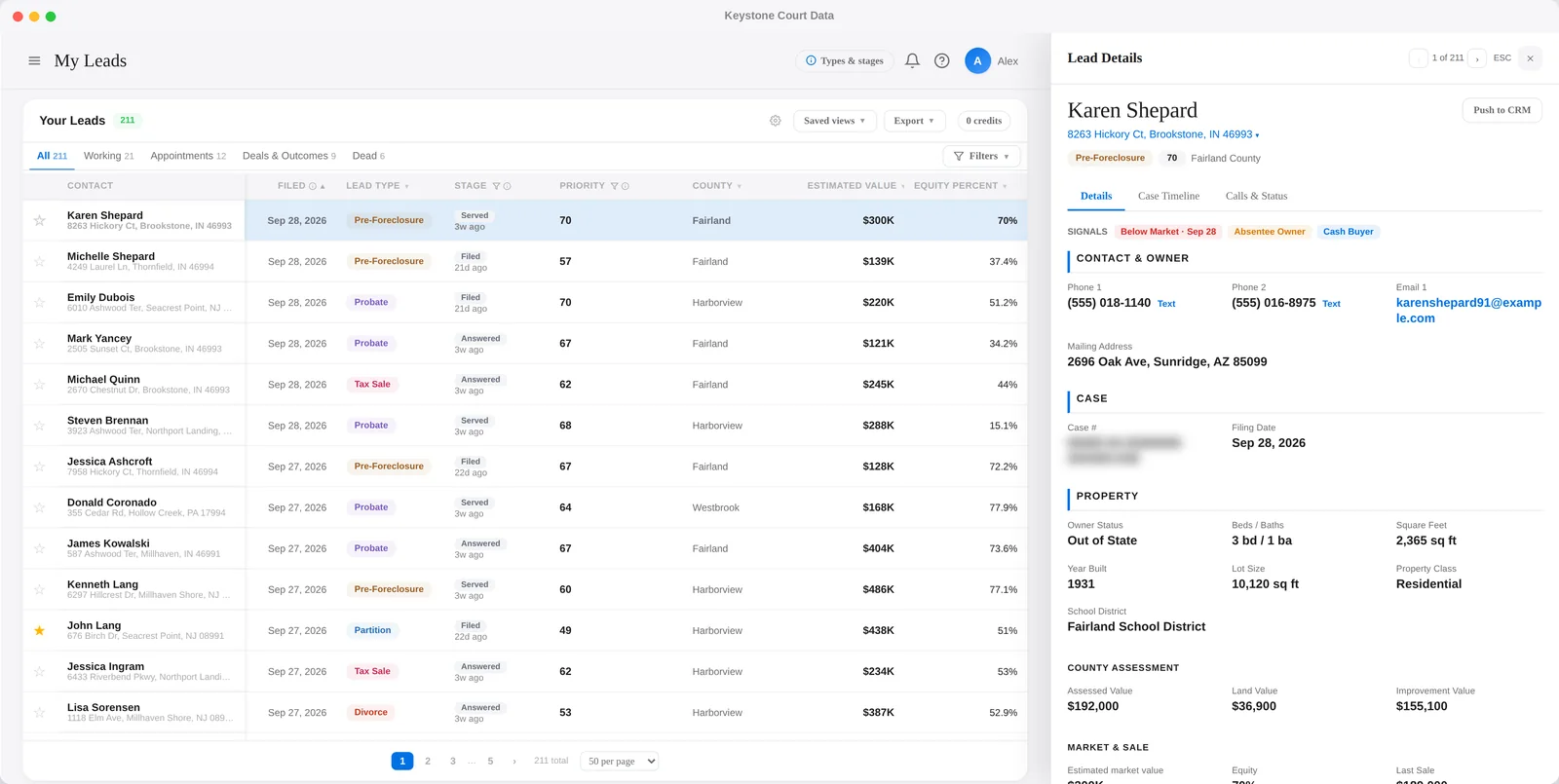
The filing itself is a public court record. The records are public, and Keystone delivers them matched to the owner and property if you would rather spend your time talking to people than assembling paperwork.
Who handles probate, divorce and partition
Probate in Indiana is handled by the county's court system. A personal representative is appointed by the court, and that person generally has the authority to deal with estate property, subject to the will, the type of administration and any court requirements. Whether the representative can sell without further approval depends on the situation, so a respectful first question is simply who is handling the estate.
Divorce cases are filed in the county's courts, and a house is divided through the settlement or the judge's decree. Until then, what either spouse can do with the house depends on who holds title and on any provisional orders the court issues while the case is pending. The timing of a sale depends on the agreement or order.
Partition is a lawsuit among co-owners. The court can order the property divided or sold, and that can mean a sale on a schedule nobody chose. In all three cases, the person you speak with may not be the only person with a say.
How to approach owners respectfully and legally
Assume the person is having a hard year. Someone facing foreclosure may be ashamed. Someone in probate is grieving. Someone divorcing may be exhausted. Open by saying who you are, why you are reaching out, and that they are free to say no. Do not mention their situation in a way that sounds like you are circling.
Mail and in-person letters are usually gentler than cold calls. Phone outreach is covered by the federal Do Not Call Registry, the federal Telemarketing Sales Rule's calling-hour limits and Indiana's own do-not-call list, which the Attorney General's office runs. Honor every request to stop contact immediately, and keep a record of it.
- Say plainly that you are an investor and that you buy houses.
- Implying a tie to the lender, the court or a government agency is misleading.
- Pressing owners to sign something the same day is best avoided.
- Owners are often pointed to a housing counselor or an attorney. Indiana offers foreclosure prevention counseling, and mentioning it builds trust.
Indiana also has laws aimed at foreclosure rescue and equity-skimming schemes, and rules on how contracts and assignments are advertised and used can vary. A real estate attorney can review agreements before they are used with a distressed owner.
What to look for before making an offer
Who actually owns it and who can sign are the first questions. In a foreclosure, that means the owner on title. In probate, it means the appointed personal representative. In divorce and partition, it may mean more than one person. A signature from the wrong person is worth nothing.
Understand what is owed and what is attached. Look beyond the first mortgage. Second loans, tax obligations, HOA dues, judgments and mechanic's liens can all affect what a buyer can acquire and what the seller nets. A title company can tell you what is actually on the property.
Know the timeline. Where is the case: just filed, in a settlement conference, decreed, or scheduled for sheriff's sale? Your offer, and how fast you can close, has to fit that stage. An owner who will lose the house at auction has different options than one who just received a summons.
Check occupancy and condition. Occupied homes bring tenants' rights, personal belongings and sometimes heirs who are not ready to leave. Be honest about the repairs and your plan, and give the seller a fair, clear number.
When you want a deeper look at one filing type, see our overview of pre-foreclosure leads or the Indiana page.
Questions investors ask
Is Indiana a judicial or non-judicial foreclosure state?
Indiana is judicial. A lender files a lawsuit and obtains a court judgment before the property is sold at a sheriff's sale. That is why a public filing exists at the start of the process.
Does a foreclosure filing mean the owner will lose the home?
No. Owners can negotiate a loan modification, catch up on what they owe, sell the property, or otherwise resolve the case. Indiana's process includes the chance to ask for a settlement conference, and many cases end without a sheriff's sale.
Can I buy a house at a Marion County sheriff's sale?
Yes, sheriff's sales are public auctions run by the county sheriff after notice is published. Terms, payment requirements and what you receive depend on the case and the lien position, so review them with a title company or attorney before bidding.
Can I call homeowners who have a foreclosure filed against them?
Telemarketing calls are covered by the National Do Not Call Registry, the FTC's Telemarketing Sales Rule and Indiana's telemarketing law; texting and auto-dialed calls carry more rules. An attorney licensed in Indiana can say which rules apply to a given campaign.
How do probate and pre-foreclosure differ for an investor?
In pre-foreclosure the owner is alive and has a mortgage dispute with a lender. In probate the decision maker is usually a court-appointed personal representative or heirs, and the conversation is about settling an estate. Tone, timing and who can legally sign are different in each.
General information about Indiana law. Laws change, so check the current statute. This is not legal advice and does not create an attorney-client relationship. Talk to an attorney licensed in Indiana before relying on it.
See Marion County leads for 7 days, free
Real court filings with the owner and property matched. No credit card.