Investing in Somerset County, New Jersey: where motivated sellers show up in the court record
Somerset County is tight, expensive and mostly owner-occupied. That shapes which court filings lead to sales, and how you should talk to the people behind them.

Somerset County New Jersey real estate investing starts with a tight, high-value market
Only 2% of housing units in Somerset County are vacant, compared with 10% nationally. Of the 132,831 housing units in a county of 346,203 people, 74% are owner-occupied. If you are used to markets with rows of boarded-up houses, this is not that.
Value is high and homes are mostly standard stock. The median home value is $524K, and 59% of homes are single-family detached (the U.S. figure is 61%). Only 10% of homes were built before 1940, against 12% nationally, so you will find fewer century-old houses than in many Northeast counties. That does not remove repair risk, but it changes the typical scope.
New supply is arriving. Builders were permitted for 763 new housing units in 2025, up 20% from 2024. That is worth keeping in mind if you plan to buy and resell, because buyers have some new construction to compare against.
The county seat is Somerville, and the county has 21 taxing districts. Franklin Township, Bridgewater Township, Hillsborough Township and Bernards Township have the largest net taxable values. Each town has its own character and its own tax rate, so treat this as a collection of local markets rather than one.
Source: U.S. Census ACS 2023
What the equity and age numbers mean for you
In Somerset County, 35% of owner-occupied homes have no mortgage, a bit below the U.S. figure of 39%. Fewer free-and-clear owners means more of the distress you meet will involve a lender, a lien or a payoff. Even so, at a $524K median value, many owners with a mortgage can still hold meaningful equity.
Estates and divorces are about people, not just property. The median age here is 41.9, against 38.9 nationally, and 17% of residents are 65 or older, the same as the U.S. share. So probate is a steady source of sales rather than an unusual one. Families inheriting a house in a high-value county often live elsewhere, and many simply want it handled without drama.
The point: your edge here is rarely a bargain on a neglected shell. It is being a reliable, clear, low-pressure buyer for people who need to sell for a reason that has nothing to do with the house.
Which court filings tend to come before a sale here
Each filing type signals a different kind of seller. Knowing what the filing means tells you how to talk to the owner and how much time they probably have.
- Pre-foreclosure. Foreclosure actions are brought in the Superior Court of New Jersey, Chancery Division (N.J.S.A. 2A:50-56). A filing means a lender has gone to court over unpaid debt. The owner may be trying to sell, catch up, modify the loan or walk away, and each of those calls for a different conversation.
- Probate. When an owner dies, the house often passes through an estate. Heirs may live out of state, may not want to maintain the property, and may need to sell to divide the proceeds.
- Divorce. Divorces are heard in the Family Part of the Superior Court, Chancery Division (N.J.S.A. 2A:34-8, 2A:34-23). A divorce can force a sale or buyout when neither spouse can keep the house alone. It is a sensitive situation, and timing is often driven by the court process.
- Tax sale. In New Jersey, unpaid municipal property taxes and charges can lead to a tax sale, where the lien is sold. The owner keeps a right to redeem until it is cut off by a foreclosure judgment on the tax sale certificate, and rules and timelines are set by statute (N.J.S.A. 54:5-54, 54:5-86); an attorney can confirm details.
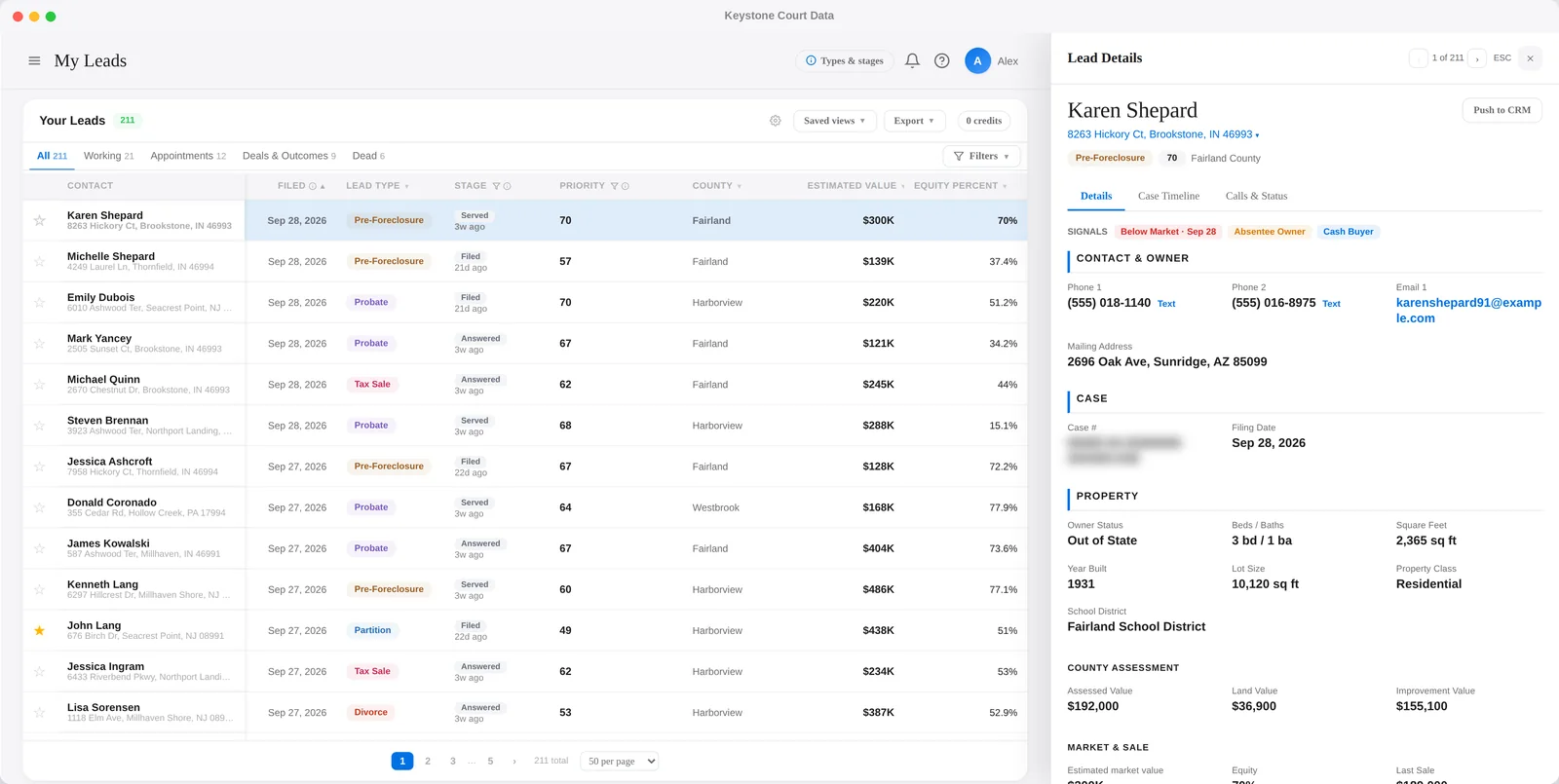
These records are public. If you want them delivered with the owner and property already matched, that is what Keystone's Somerset County page covers, and you can try a county free for 7 days with no credit card.
How the process works in New Jersey, in plain terms
Foreclosure is judicial. A lender must go through the court rather than sell the property on its own authority. The case is brought in the Chancery Division after a written notice of intention to foreclose sent at least 30 days ahead, the owner can cure the default up to final judgment, and if the lender prevails, the property is sold at a sheriff's sale (N.J.S.A. 2A:50-56, 2A:50-57). Timing varies with the case, and an attorney can confirm any deadline; do not assume a schedule.
The Sheriff runs the sale. The Somerset County Sheriff conducts foreclosure sales and sets the bidding, deposit and payment terms. By state law, the upset price must be posted on the sheriff's website at least four weeks before the sale, and sales can be adjourned (N.J.S.A. 2A:50-64, 2A:17-36). Read the current terms before bidding, and do not assume a sale result is final on the day; an attorney can confirm where a particular sale stands.
Probate runs through the county Surrogate. In New Jersey, the county Surrogate admits wills to probate and grants letters (N.J.S.A. 3B:3-17). Once appointed, an executor or administrator has the power to sell estate real estate without court approval unless the will or a court order limits it, except property the will leaves to a specific person (N.J.S.A. 3B:14-23). How that applies to a given estate is a question for the estate's attorney, not for you to answer on the owner's behalf.
Rents and taxes: the buy-and-hold math
HUD publishes Fair Market Rents for the New York-Newark-Jersey City, NY-NJ area, which is the area figure that applies here rather than a Somerset-only number. For that area, the two-bedroom figure is $2,486 per month and the three-bedroom figure is $2,981 per month. Treat these as a benchmark, not a promise of what a particular house will rent for.
Property tax decides the numbers. The 2025 general tax rate per $100 varies by municipality, from 1.204 in Bedminster Township to 4.543 in North Plainfield. Two houses with the same price can carry very different annual costs depending on the town. Run your holding costs town by town before you set an offer.
Assessment appeals go to the Somerset County Board of Taxation (N.J.S.A. 54:3-21). With a median value of $524K and low vacancy, expect competition from owner-occupant buyers on any house that is move-in ready.
How to approach owners respectfully and legally
Most people tied to these filings are dealing with a death, a breakup or a debt. A short, honest letter that says who you are, that you buy houses, and that there is no pressure usually does more than a hard sell. Say plainly that you are an investor and that they can ignore you.
Be careful with phone calls. Sales calls are covered by the National Do Not Call Registry, the FTC's Telemarketing Sales Rule and New Jersey's telemarketing law, which bars calls to numbers on its no-call list and between 9 p.m. and 8 a.m. (N.J.S.A. 56:8-128; 16 CFR 310.4). Respect any request to stop.
Never pressure a grieving or stressed seller. Do not imply the court or lender is about to take the house unless you know that is true, and do not give legal advice. Suggest they speak with their own attorney, and offer to wait while they do.
What to look for before making an offer
Before you put a number on paper, check the things that change what you can pay.
- Who has authority to sell. In an estate, the person you are talking to needs letters from the Surrogate before they can sign; the estate's attorney can confirm it. In a divorce, both spouses and possibly the court may need to agree.
- What is owed. Mortgages, tax liens and judgments come out of the proceeds or follow the property. A title company and attorney can sort out payoffs before you commit.
- The town's tax rate. With rates ranging from 1.204 to 4.543 per $100, the same purchase can cost very differently to hold.
- Condition and exit. With 10% of homes built before 1940, many houses are newer, but inspect anyway. Know whether you will resell to an owner-occupant or rent against the HUD benchmarks.
- Timing and funds. If you are buying at a sheriff's sale, read the Sheriff's current deposit and payment terms before the day.
For a broader look at the state, see our New Jersey guide, and how Keystone works if you want the filing information delivered ready to use.
Questions investors ask
Is Somerset County a good place to invest in real estate?
It is a high-value, low-vacancy market where 74% of homes are owner-occupied and the median home value is $524K. That means competition from owner-occupant buyers and higher entry costs. Opportunities tend to come from sellers in a life or financial transition rather than from abandoned property.
Is foreclosure judicial in New Jersey?
Yes. Foreclosure actions are brought in the Superior Court of New Jersey, Chancery Division, and the lender must first send a notice of intention to foreclose at least 30 days ahead (N.J.S.A. 2A:50-56). If the lender succeeds, the property is sold at a sheriff's sale. Because timelines vary, an attorney can confirm any deadline.
How do Somerset County sheriff's sales work?
The Somerset County Sheriff conducts the sales and sets the bidding, deposit and payment terms. By state law, the upset price must be posted on the sheriff's website at least four weeks before the sale, and sales can be adjourned (N.J.S.A. 2A:50-64, 2A:17-36).
Can an executor sell a house in Somerset County?
Usually yes. Once the county Surrogate has admitted the will and issued letters, New Jersey law gives the executor the power to sell estate real estate unless the will or a court order limits it, except property the will leaves to a specific person (N.J.S.A. 3B:3-17, 3B:14-23). The estate's attorney can confirm authority before anything is signed.
Can I call homeowners I find through court filings?
Contact is regulated. The National Do Not Call Registry, the FTC's Telemarketing Sales Rule and New Jersey's telemarketing law apply to sales calls, and the caller must give their name and purpose within the first 30 seconds (N.J.S.A. 56:8-128). A respectful letter is often the gentler first step, and an attorney can confirm what applies to you.
See Somerset County leads for 7 days, free
Real court filings with the owner and property matched. No credit card.