Investing in Santa Rosa County, Florida: where motivated sellers show up in the court record
A county of mostly owner-occupied single-family homes, with Milton as the seat, Gulf Breeze and Jay as separate tax districts, and oil field interests in the mix.

What Santa Rosa County real estate investing looks like on paper
Santa Rosa County has 78,275 housing units for a population of 193,719, and 80% of homes are single-family detached, against 61% across the U.S. If you are doing Santa Rosa County Florida real estate investing, you are mostly buying houses from people who live in them, not apartments from landlords.
Owners dominate. About 80% of homes are owner-occupied, and the median home value is $302K. That points to deals with a real homeowner on the other side: someone with a family, a mortgage history and a personal reason for selling.
Equity is solid, but not as deep as average. About 35% of owner-occupied homes have no mortgage, compared with 39% nationally. Plenty of sellers will have a loan to pay off, so your offer has to leave room for the payoff and closing costs, and you should not assume every estate or divorce sale is free and clear.
Newer housing. Only 1% of homes were built before 1940, against 12% nationally. You are less likely to meet century-old wiring and plumbing, though you should still inspect every house on its own merits.
Demand signals. Vacancy is 9%, slightly under the U.S. figure of 10%. The county permitted 1,929 new housing units in 2025, a change of -3% from 2024. For buy-and-hold, HUD Fair Market Rent for the Pensacola-Ferry Pass-Brent area is $1,548 for a 2-bedroom and $2,034 for a 3-bedroom. Those are benchmarks, not guarantees of what a specific house will rent for.
Source: U.S. Census ACS 2023
Which court filings come before a sale here, and why
A court filing is a record that something in an owner's life has changed. Here is what each type usually means for a seller in this county.
- Pre-foreclosure: the lender has gone to court over missed payments. The owner may want to sell before the case ends, but may also be hoping to catch up or modify the loan.
- Probate: an owner has died and the estate is being opened. With 16% of residents aged 65 or older (the U.S. figure is 17%) and a median age of 40.0, estates are a steady source of houses that heirs may not want to keep.
- Divorce: a married couple's home often has to be sold or bought out by one spouse. Timing and goodwill matter more than price to many of these sellers.
- Tax sale: unpaid property taxes can lead to a sale process. In Florida this generally starts with a tax certificate, and a deed can follow if taxes stay unpaid. The details and deadlines are set by statute, so confirm them with an attorney.
None of these filings means a person must sell to you. They tell you why a conversation might be welcome, and the rest is up to the owner.
How the process works in Florida, in plain terms
Foreclosure is judicial. In Florida a lender has to file a lawsuit in court to foreclose on a home. The owner is served, can respond, and the court decides the case. A sale, if there is one, follows a court judgment. Exact timelines depend on the case, so do not promise a seller a date.
Probate runs through the circuit court. A personal representative, often named in the will and always appointed by the court, handles the estate. That person's authority to sell real estate depends on the will and on court orders, so ask for proof of authority and let the estate's attorney guide the paperwork.
Divorce is also a court matter. A marital home may be sold, kept by one spouse, or dealt with under a settlement or court order. A sale may need both spouses to sign, or the court's approval, so find out who actually has the right to sell.
Taxes follow a calendar. The Property Appraiser's materials explain that taxing authorities mail each owner a Notice of Proposed Property Taxes in August. For homesteads, the Save Our Homes cap for 2026 is 2.7%. Non-homestead property has a 10% annual assessment cap that took effect with the 2009 tax roll; that cap does not apply to the School Board millage. When a house changes hands or loses homestead, that cap protection can change the tax bill, so do not use the seller's current bill as your own.
Taxes, towns and oil field interests to account for
Where a house sits matters. On the first millage table the Property Appraiser lists, the unincorporated county total is 11.3781 mills, and the Gulf Breeze district shows a city millage of 1.9723. City property taxes are paid to the City of Milton, the City of Gulf Breeze or the Town of Jay, so two similar houses can carry different tax loads.
Run the numbers by district. Before you commit to a rental projection, confirm which taxing districts apply to the property and have a professional check the figures.
Mineral and oil interests. Oil fields in Jay and the Blackjack Creek Field are part of the local economy, and their mineral rights and working interests are taxable. If a property or an estate has mineral rights or working interests attached, treat that as a separate item to review with your title company or attorney. It can affect what is actually being sold.
How to approach owners respectfully and legally
The people behind these filings may be grieving, stressed or embarrassed. You are not there to pressure anyone. You are there to offer an option and accept a no.
- Introduce yourself plainly and say you buy houses. Do not pose as a lender, a court officer or a government agency.
- Do not tell anyone a deadline will pass or a house will be lost unless you are sure, and never give legal advice. Suggest they speak to an attorney or a HUD-approved housing counselor.
- Send a short, polite letter or card first. It lets people respond on their own time, particularly after a death.
- If you phone, follow the National Do Not Call Registry, the federal telemarketing rules and Florida's telephone solicitation law. Stay within the permitted calling hours and keep your own internal do-not-contact list.
- When someone says no, stop. Record it and do not contact them again.
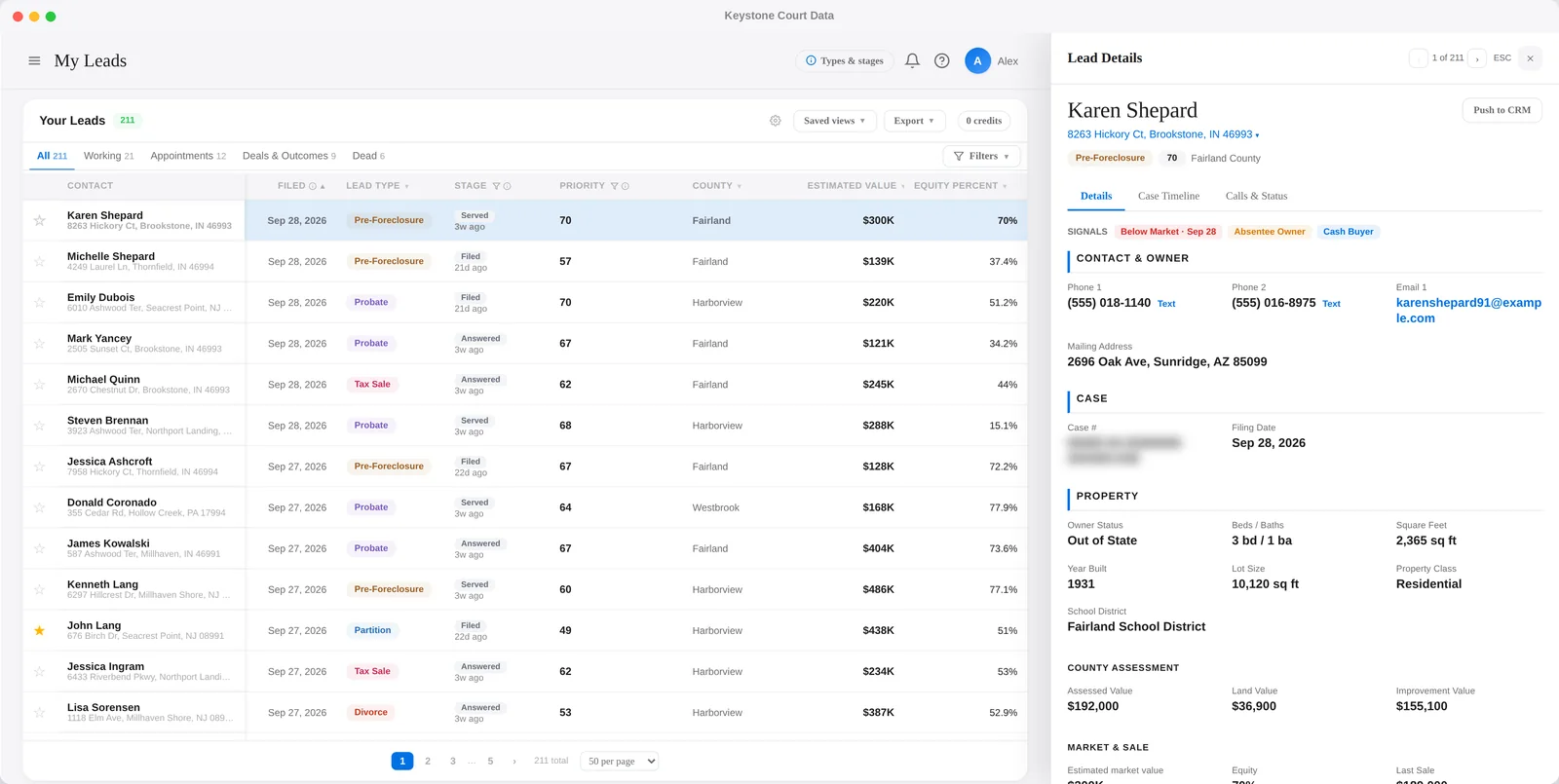
Rules on contact and on marketing to people in distress can change, so confirm what applies to you with a Florida attorney. If you want the filings themselves matched to owners and ready to work, Keystone's Santa Rosa County page shows what is offered for this county. Public records are the source, and you can read more on how it works.
What to look for before you make an offer
Confirm who can sign. In an estate, that means the personal representative with court authority. In a divorce, it may mean both spouses or a court order. In foreclosure, the owner still holds title until the process ends.
Understand the payoff. A free-and-clear house leaves a lot of room. A house with a mortgage, tax debt or other liens needs a conservative offer. With 35% of owner-occupied homes mortgage-free here, do not assume equity: ask for payoff information through the seller's own paperwork or the title company.
Inspect the house. Most of the stock is newer than the national average, but newer does not mean sound. Budget for roof, HVAC, moisture and storm-related repairs, and get your own bids.
Check the taxes and the neighborhood's district. Use the millage for the right district and expect a reassessment after a sale.
Test the rent. If you plan to hold the house, compare your expected rent with the HUD figures of $1,548 for a 2-bedroom and $2,034 for a 3-bedroom, and then with real local rental comparisons.
Use a title company and an attorney. Court-driven sales have more moving parts, and professional help is cheaper than a defect found after closing.
Questions investors ask
Is foreclosure judicial in Santa Rosa County?
Yes. Florida lenders have to file a lawsuit in court to foreclose, and the sale follows a court judgment. The same state rules apply in Santa Rosa County as elsewhere in Florida. Timelines vary by case, so confirm specifics with an attorney.
Who handles probate in Santa Rosa County?
Probate is handled in the circuit court, with a personal representative managing the estate. That person's authority to sell the home depends on the will and court orders. Ask for proof of authority and involve the estate's attorney.
Can I buy a house from a divorcing couple?
Often yes, but you need to know who has the right to sell. A sale may need both spouses to sign, or follow a settlement or court order. Be patient and straightforward, and suggest they check with their own attorneys.
How do I call owners without breaking the rules?
Follow the National Do Not Call Registry, the federal telemarketing rules and Florida's telephone solicitation law. Call only at permitted hours, identify yourself honestly and stop when asked. A letter is often a gentler first contact. Confirm what applies to you with a Florida attorney.
Do oil and mineral rights matter when buying a house in the county?
They can. Oil fields in Jay and the Blackjack Creek Field are part of the local economy, and mineral rights and working interests are taxable. If a property or estate includes them, have your title company or attorney review what is being conveyed.
See Santa Rosa County leads for 7 days, free
Real court filings with the owner and property matched. No credit card.