Investing in Niagara County, New York: where motivated sellers show up in the court record
An older population, a lot of paid-off homes and a stock of pre-1940 houses shape which sellers you meet in Niagara County, and which court filings tend to come first.

Niagara County real estate investing: what the housing looks like
Niagara County sits in the extreme western part of New York, just north of Buffalo, bordered by Lake Ontario, the Niagara River and Canada. About 211,341 people live here, in 100,335 housing units, and 71% of homes are owner-occupied. The median home value is $177K.
Mostly single-family, and mostly older. About 68% of homes are single-family detached, compared with 61% nationally. Another 28% were built before 1940, more than double the national 12%. That mix means plenty of the classic detached houses that flippers and landlords like, with the age-related repair questions that come with them.
Vacancy is not unusually high. Housing unit vacancy is 9%, slightly under the U.S. figure of 10%. This is not a market full of empty shells. Most of your opportunities will involve a house someone still owns and has a reason to move on from.
Rents for buy-and-hold. HUD's Fair Market Rent for the Buffalo-Cheektowaga area, which is the figure published for this region, is $1,423 a month for a 2-bedroom and $1,732 for a 3-bedroom. Run those against your purchase price and repair budget before you decide whether a property is a flip or a rental.
New construction is small but moving. 271 new housing units were permitted in 2025, up 62% from 2024. That is a modest base, so existing homes remain where most deals come from. The county's cities are Lockport, Niagara Falls and North Tonawanda, and the county seat is Lockport.
Source: U.S. Census ACS 2023
Why paid-off homes and an older population point to probate
Two figures in the county data stand out. 46% of owner-occupied homes are owned free and clear, against 39% nationally. And 20% of residents are 65 or older, against 17% nationally, with a median age of 43.2 compared with 38.9 for the U.S.
What that means for you. When an owner with no mortgage dies, the heirs often inherit a house with substantial equity and no lender pushing a timeline. Some keep it. Many do not: they live elsewhere, they are dividing the estate among siblings, or they simply do not want to maintain an older home from a distance.
Equity changes the conversation. With no mortgage balance to cover, a seller has room to accept a fair, as-is offer that saves them cleanup, repairs and months of carrying costs. Your pitch is convenience and certainty, not a deep discount extracted from someone in distress.
The same equity shows up in divorce, where a paid-off or mostly paid-off home is often the largest asset to be divided. Older stock plus long ownership also means deferred maintenance, which is often what makes an heir willing to sell without listing.
Which court filings tend to come before a sale here
Each filing type tells you something different about the owner's situation and timing. Keystone tracks five of them in this county.
- Probate. An estate is being opened after an owner's death. The estate is handled by the person the Surrogate's Court issues letters to. These are often calm, unhurried sales.
- Pre-foreclosure. A lender has started a foreclosure case on a mortgage. The owner has an unpaid loan and usually limited time, but also usually a way out if they can sell for more than they owe.
- Divorce. A couple is separating and the home may be sold, bought out or kept as part of dividing property. Motivation varies widely, and so does sensitivity.
- Tax sale. Unpaid property taxes have led to enforcement against the property. The owner may have little equity left to protect, or may have owned the home free and clear and fallen behind for other reasons.
- Partition. Co-owners, often heirs who inherited together, cannot agree, and the dispute ends up in court. These are common with inherited family houses.
Because so many Niagara County homes are owned outright, probate and partition may deserve more of your attention here than a pure foreclosure strategy would suggest.
How the process works in New York, in plain terms
Foreclosure is judicial. In New York, a lender has to bring a court case to foreclose on a home mortgage. That means there is a filing, a process for the owner to respond, and a court-supervised sale. Before the case begins, state law requires lenders to send certain pre-foreclosure notices on home loans, including a 90-day notice under Real Property Actions and Proceedings Law section 1304. Details depend on the loan and the facts, so confirm any deadline with an attorney.
Probate runs through Surrogate's Court. The Surrogate's Court oversees estates. The court issues letters to the person who handles the estate (the fiduciary), and that person acts for the estate under them. A buyer generally needs to deal with the person who has that authority, and what that person may do can depend on the paperwork they hold.
Divorce and partition. A divorce is a court case, and New York law directs the court to distribute marital property equitably, which does not always mean a 50/50 split. Partition is also a court case between co-owners.
Tax enforcement. Unpaid property taxes are enforced under Article 11 of the Real Property Tax Law, through a county foreclosure in court after the redemption period. Timelines and owner rights vary by situation, so anyone relying on them should confirm the specifics with the county or an attorney.
You can read the statutes yourself on the New York State Senate's Real Property Actions and Proceedings Law page. None of this is legal advice, and procedures can change.
How to approach owners respectfully and legally
Almost everyone in these filings is dealing with a death, a divorce or a debt. Treat that as the starting point of every conversation.
Lead with honesty. Say who you are, that you buy houses, and that there is no obligation. Do not imply you are affiliated with the court, a lender or a government agency. Do not claim a deadline that does not exist.
Respect phone rules. If you call, follow the federal National Do Not Call Registry and the federal telemarketing rules, including calling-time limits and honoring any request to stop. Many investors prefer a short, personal letter, which gives the person space to respond when ready. Either way, an owner who says no should hear nothing further.
Be patient with estates. An heir may be grieving, may not yet have legal authority, and may need to consult family or an attorney. Offer to wait. Suggest they speak with their own attorney or advisor before signing anything.
Do not pressure anyone facing foreclosure. Some owners have options besides selling, and they should hear that from a qualified professional. The Consumer Financial Protection Bureau publishes plain-language information for homeowners that you can point people toward.
What to look for before you make an offer
With 28% of homes built before 1940, assume age until proven otherwise.
- Condition. Older houses can hide issues with roofs, foundations, wiring, plumbing and heating. Lake-effect weather is hard on exteriors. Build your repair budget from an actual inspection, not a drive-by.
- Authority to sell. For an estate, confirm who is legally able to sign. For divorce or partition, confirm whether a court order or the other party's agreement is needed.
- Title and liens. Order a title search through a title company or attorney. Unpaid taxes, mortgages or judgments may need to be paid at closing.
- Exit math. Compare your all-in cost to the $177K median home value for resale, or to HUD's $1,423 (2-bedroom) and $1,732 (3-bedroom) Fair Market Rents for a rental. Local values vary a lot by town, so use real comparables.
- Time and process. Court-driven sales can pause or change. Write your contract to allow for that, and have a New York real estate attorney review it.
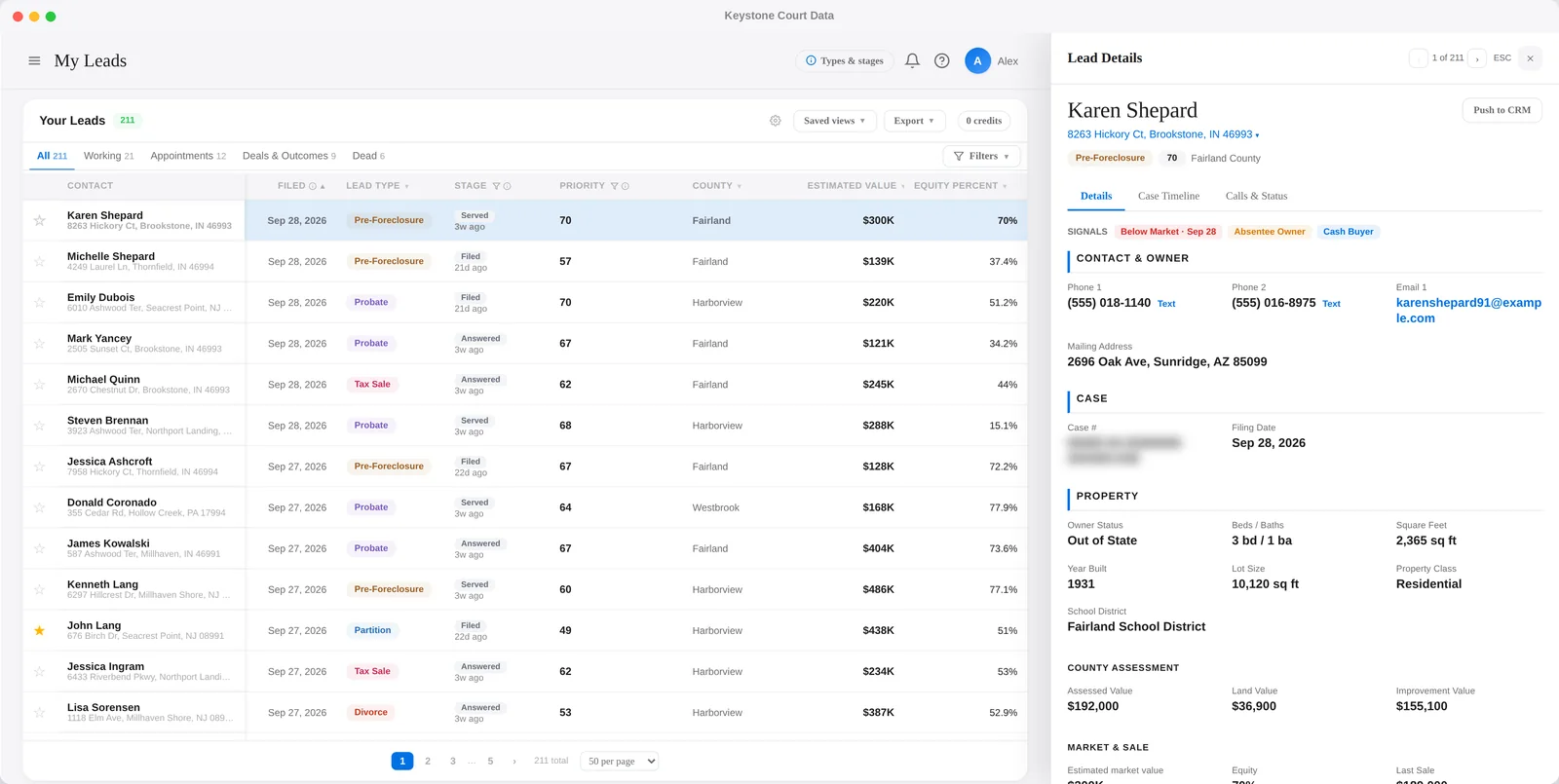
Court filings are public records, and Keystone delivers them matched to the owner and property so you can spend your time on conversations and due diligence. You can also see how it works before trying a county.
Questions investors ask
Is New York a judicial foreclosure state?
Yes. Lenders have to bring a court case to foreclose on a home mortgage, and the sale is supervised by the court. Pre-foreclosure notice rules also apply on many home loans. Confirm specific deadlines with an attorney.
Who handles probate in Niagara County?
Probate in New York goes through Surrogate's Court, which oversees estates. The person the court issues letters to (the fiduciary) acts for the estate.
Can an executor sell a house in Niagara County?
It depends on the will and the authority the court has given them. Buyers should confirm that authority before signing and have an attorney review the contract.
Why does probate matter so much in Niagara County?
46% of owner-occupied homes here are owned free and clear and 20% of residents are 65 or older. That combination means estates frequently include homes with real equity, and heirs who may prefer a simple sale.
Can I call owners I find in these filings?
You can, but follow the federal National Do Not Call Registry and telemarketing rules, and stop when asked. Many investors send a respectful letter instead. Keep the tone honest and low-pressure.
See Niagara County leads for 7 days, free
Real court filings with the owner and property matched. No credit card.