Investing in Champaign County, Illinois: where motivated sellers show up in the court record
A college-town county with a median age of 30.9, a lot of renters, and a large base of owners with no mortgage. Here is what that means for finding and treating motivated sellers well.

Champaign County Illinois real estate investing starts with a young, renter-heavy market
Champaign County has 94,351 housing units for 206,098 residents, and only 53% of homes are owner-occupied. The median age is 30.9, compared with 38.9 for the U.S. That is what you would expect with the University of Illinois and Parkland College in the county, and it shapes everything an investor does here.
Housing mix. Single-family detached homes make up 52% of housing, against 61% nationally. The rest leans toward apartments, duplexes and attached units, so you will see more small multifamily and condo-style properties in the mix than in a typical Illinois county. The median home value is $205K.
Rents. HUD Fair Market Rent for the Champaign-Urbana area is $1,173 a month for a 2-bedroom and $1,474 for a 3-bedroom. Those are benchmarks, not promises, and student demand near campus can behave differently from family demand in a town like Rantoul or Savoy.
Vacancy and building. Vacancy is 11%, slightly above the U.S. figure of 10%. At the same time, 860 new units were permitted in 2025, up 52% from 2024. New supply competes with older rentals, so run your numbers on the specific submarket rather than the county average.
Source: U.S. Census ACS 2023
Why the demographics change your seller mix
Only 14% of residents are 65 or older, compared with 17% nationally. In many counties, aging owners drive a steady flow of estate sales. Here that pull is weaker, so probate is one source among several instead of the dominant one.
What that means for you. Expect your motivated sellers to be a broader mix: landlords who bought as investors and are stretched, households going through a divorce, heirs who live elsewhere, and owners who fell behind on taxes. Younger owners and out-of-town heirs may be less attached to a property and more open to a clean, simple sale.
Homes built before 1940 are 12% of the stock, the same as the national share. Age is not what sets this county apart, but any older house still needs a real inspection and a repair budget.
Equity in estate and divorce sales
41% of owner-occupied homes in the county are owned free and clear, slightly above the U.S. figure of 39%. When an owner dies or a couple splits, a home with no mortgage means there is equity to divide and fewer lender demands on the timeline.
Why that matters. A seller with equity can say no. They can list with an agent, wait, or take a better offer. You are not competing against a payoff deadline, you are competing against the seller's other options, so your value is certainty, speed of closing and a fair price, not pressure.
It also means more of these sellers are in a calm, practical position, even if the circumstances are painful. Treat them accordingly.
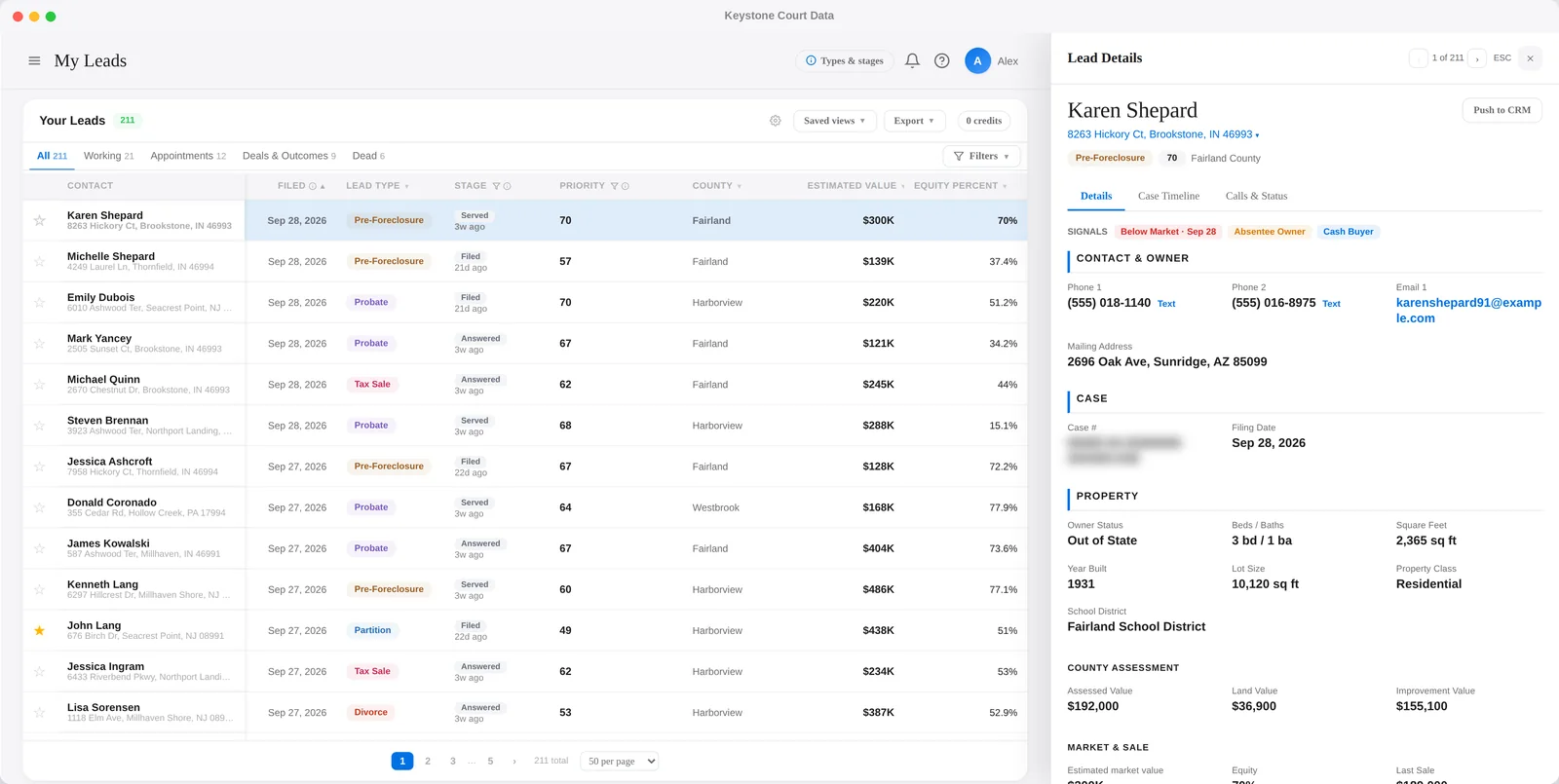
Which court filings tend to come before a sale here, and why
Cases in the county are heard in the Circuit Court of the Sixth Judicial Circuit. Each filing type below tells you something different about the owner's situation.
- Pre-foreclosure. A lender has filed suit over missed mortgage payments. The owner may be trying to catch up, sell, or negotiate. Timing and equity vary a lot.
- Probate. An owner has died and the estate is being opened. The personal representative may need to sell, and the heirs may not want to keep or manage the house.
- Divorce. A dissolution of marriage case often ends with a home that has to be sold or bought out. These owners usually want a clean, documented result.
- Tax sale. A property with delinquent taxes signals an owner under financial strain, though not every delinquency ends in a sale.
A filing is a signal, not a verdict. Some owners resolve the problem and keep the property, and your outreach should assume that is a real possibility. These are public records, and Keystone delivers them with the owner and property already matched, if you want them in that form: see the Champaign County page.
How the process works in Illinois, in plain terms
Foreclosure is judicial. In Illinois a lender must go through the court to foreclose. That generally gives the owner more time and more chances to resolve things than in non-judicial states, which is why a pre-foreclosure owner may still be able to sell. For a home, the owner can generally redeem until the later of 7 months after being served or 3 months after the judgment, unless the statute shortens it (735 ILCS 5/15-1603); an attorney can confirm the dates in a given case.
Sales are run by the Sheriff. Judicial mortgage foreclosure sales held on or after January 1, 2025 are conducted by the Champaign County Sheriff unless the court grants leave otherwise. The Sheriff warns that a sheriff's deed is not a warranty deed and is more like a quit claim deed. Properties sell as-is, and a sale will not proceed if the plaintiff's representative is absent.
Tax delinquency. Real estate tax bills are paid in two installments. Unpaid property taxes bear interest of 1.5% per month or part of a month (Property Tax Code, Sec. 21-15). After a tax sale, a tax buyer who wants a deed files a petition in the circuit court in a window that opens 6 months and closes 3 months before the redemption period expires, and the court directs a deed only if the property is not redeemed (Property Tax Code, Sec. 22-30). For you, the practical point is that delinquent real estate taxes are a sign of a stressed owner.
Probate and divorce. Both run through the circuit court. In an estate, an independent representative can sell without a court order, while a supervised one must petition the court unless the will gives a power of sale (755 ILCS 5/28-8, 20-5, 20-15); in a divorce it depends on the court's orders, so a title company or attorney should confirm authority before you rely on anyone's signature.
Approaching owners respectfully and legally
People in these cases are dealing with a death, a breakup or money trouble. Lead with a short, honest message that says who you are, why you are writing and that there is no pressure. Do not imply you work for the court or the lender, and do not describe an owner's case back to them in a way that feels like surveillance.
Phone rules. Calls are regulated. Federal rules on telephone solicitations set the National Do Not Call Registry, a calling window of 8 a.m. to 9 p.m. local time and company do-not-call lists (47 C.F.R. 64.1200), and the Illinois Telephone Solicitations Act bars calls soliciting the sale of goods or services between 9 p.m. and 8 a.m. and requires the caller to stop calling anyone who asks (Sec. 15 of that Act). Whether a call offering to buy a house is covered depends on the facts, so an Illinois attorney can confirm. Mail and in-person letters are often better received than a cold call to someone grieving.
For estates. Be patient. Heirs may not yet have authority to sell, and some families need time before they can talk about the house. A courteous note and an easy way to reach you later works better than follow-up calls.
Be straight about price. A seller with equity will compare you with a listing. If your offer is lower because of repairs or speed, say why. Sellers remember fairness.
What to look for before making an offer
- Who can sell. In an estate, confirm the representative's authority. In a divorce, confirm what the court has ordered. In foreclosure, confirm the status of the case with an attorney.
- Title and deed type. A sheriff's deed is closer to a quit claim deed, so buying at a foreclosure sale carries title risk that a normal purchase does not. Work with a title company or attorney.
- Condition. Foreclosure sale properties are sold as-is. With 52% single-family detached housing and plenty of older and multi-unit buildings, inspect for roof, mechanicals and, in older homes, wiring and plumbing.
- Property taxes. Property is assessed at one-third of its fair cash value (Property Tax Code, Sec. 9-145), and owners can appeal an assessment to the county Board of Review. Check how a reassessment could affect your carrying costs.
- Exit and rent math. Compare the HUD rents of $1,173 (2-bedroom) and $1,474 (3-bedroom) with your actual costs, and allow for the 11% vacancy rate and new supply being permitted.
- Demand drivers. The University of Illinois, Carle, Parkland College, Kraft Foods, local school districts and OSF Heart of Mary Medical Center anchor the local economy, which is described as strong in education, health care, government, high technology, light industry and agriculture. Proximity to those employers matters for rentals.
Questions investors ask
Is Illinois a judicial foreclosure state?
Yes. Lenders must file a case in court to foreclose, which usually gives owners more time to sell or work something out. For a home, the owner can generally redeem until the later of 7 months after being served or 3 months after the judgment, unless the statute shortens it (735 ILCS 5/15-1603); an attorney can confirm the dates in a given case.
Who runs foreclosure sales in Champaign County?
Judicial mortgage foreclosure sales held on or after January 1, 2025 are conducted by the Champaign County Sheriff unless the court grants leave otherwise. Properties sell as-is, and the sheriff's deed is closer to a quit claim deed than a warranty deed.
How do unpaid property taxes and tax sales work in Champaign County?
Unpaid property taxes bear interest of 1.5% per month or part of a month (Property Tax Code, Sec. 21-15). After a tax sale, a tax buyer who wants a deed petitions the circuit court in a window 6 to 3 months before the redemption period expires, and a deed issues only if the property is not redeemed (Property Tax Code, Sec. 22-30). Confirm current county sale rules with the Champaign County Treasurer before planning around tax sales.
Are estate sales a big part of the market here?
They matter, but only 14% of residents are 65 or older, below the U.S. figure of 17%. Divorce, foreclosure and tax-related distress make up a larger share of the picture than in an older county. With 41% of owner-occupied homes owned free and clear, estate sales often carry equity.
Can I call owners I find through court filings?
Calls are regulated. Federal rules on telephone solicitations set the National Do Not Call Registry, a calling window of 8 a.m. to 9 p.m. local time and company do-not-call lists (47 C.F.R. 64.1200), and the Illinois Telephone Solicitations Act bars calls soliciting the sale of goods or services between 9 p.m. and 8 a.m. and requires the caller to stop calling anyone who asks (Sec. 15 of that Act). Whether a call offering to buy a house is covered depends on the facts, so an Illinois attorney can confirm. Keep calls brief and polite, and consider a letter first for sensitive situations like a death in the family.
See Champaign County leads for 7 days, free
Real court filings with the owner and property matched. No credit card.