How to Run Comps on a House You Can't See Inside
Most motivated-seller homes are locked, cluttered or occupied by someone who isn't ready to give you a tour. Here is how to build a value range you can defend anyway.

- 1Write down what you can verify from outside
- 2Select sales that match on the big features
- 3Sort the comps by condition
- 4Adjust for differences, one at a time
- 5Build a low, middle and high value
- 6Pressure-test the range
- 7Update the number when new facts arrive
Why comps matter more when you can't see inside
You are standing on the sidewalk in front of a house with the blinds drawn. The owner has not called you back, the yard is overgrown, and you still need a number. This is the normal situation when you learn how to run comps for wholesaling, and it is where most bad offers get born.
The interior is the biggest unknown. Two houses with the same square footage, bedroom count and street can sit far apart in value because one has a working kitchen and the other has a failed roof and water damage. A comp tells you what a house sold for. It does not tell you why, so you have to supply the why.
Your buyer will check your math. A cash buyer who gets a contract package will run their own numbers and look at the same neighborhood sales you did. If your value rests on the best-looking sale you could find, you lose their trust, and a wholesaler without buyer trust has no business.
The owner will notice too. People dealing with a death, a divorce or debt are often already wary. An offer that is wildly off from what they know about their home ends the conversation. An offer with a clear, honest explanation can keep it going.
Treat the first pass as a screening tool. Its job is to tell you whether the property is worth a real conversation, not to set a final price.
The steps
- 01
Write down what you can verify from outside
List the facts you can confirm without entering: style, approximate size, number of stories, garage or no garage, lot shape, roof and siding condition, and the look of the street. Mark each one as seen, reported or guessed. This list becomes the template for every comp you choose.
- 02
Select sales that match on the big features
Look for recent sales close by that match your subject on size, style, age and lot. Stay on the same side of any major dividing line, and prefer ordinary open-market sales. A local agent can help you confirm sale details if you are unsure.
- 03
Sort the comps by condition
Separate sales into groups: fully updated, light cosmetic work, and needs significant repair. Do not average across groups. Your subject probably belongs near the lower groups until you learn otherwise.
- 04
Adjust for differences, one at a time
Adjust each comp for obvious differences such as extra bedrooms, a missing garage or a much larger lot. Keep the adjustments modest and explainable, and avoid stacking several large ones on a single comp. If a comp needs too many changes to match, drop it.
- 05
Build a low, middle and high value
Use the needs-repair group for your low case, the light-cosmetic group for the middle, and the updated group for the after-repair high. Your wholesale math should work at the lower end of that spread, not only at the top.
- 06
Pressure-test the range
Show your comps and assumptions to a local agent or contractor and ask where you are most likely wrong. Fix what they flag. Treat their reaction as a check on your thinking, not a replacement for it.
- 07
Update the number when new facts arrive
Photos, a walkthrough, an inspection or an honest description from the owner all beat a guess. Revise the range, note the reason, and be willing to walk away if the property no longer works.
Common mistakes when running comps blind
Assuming the house is average. It is tempting to treat an unseen interior as middle of the road. Distressed owners often have deferred maintenance, so the safer starting assumption is that the home needs work until someone shows you otherwise.
Using only the nicest sales. Renovated, staged and professionally photographed homes dominate sale listings. If you pull only those, you are pricing your subject as if it were already finished.
Ignoring the sale type. A sale between family members, an estate sale or a bank-owned sale may not reflect the open market. Note how each comp sold before you let it influence your range.
Crossing dividing lines. Comps from across a major road, a school boundary, a railroad or a different subdivision can be misleading even when they sit close on a map. Buyers feel those boundaries, and so should your adjustments.
Stacking guesses. Guessing the condition, then the repair cost, then the resale value, then your margin leaves very little room for error. Each guess compounds the one before it.
Skipping the second opinion. Ask a local agent or an experienced contractor to react to your range. They do not need to see inside to tell you the number is out of line for the area.
What to do after you have a range
Reach out with honesty and no pressure. Say who you are, why you are contacting them and that you are interested in the property. Do not pretend to know more than you do, and do not rush someone who is grieving or stressed.
Follow the calling rules. If you phone, check the National Do Not Call Registry requirements and your state's telemarketing rules first, and keep your own internal do-not-contact list. Mail and in-person letters have their own rules, so ask an attorney if you are unsure.
Replace assumptions with facts. When the owner agrees to a walkthrough, or sends photos, update your condition sort and tighten the range. Write down what changed so you can explain it to your buyer.
Be open about what you do. If you plan to assign the contract rather than buy the property yourself, disclose it in line with your state's rules. Requirements for wholesalers vary, so confirm yours with a real estate attorney.
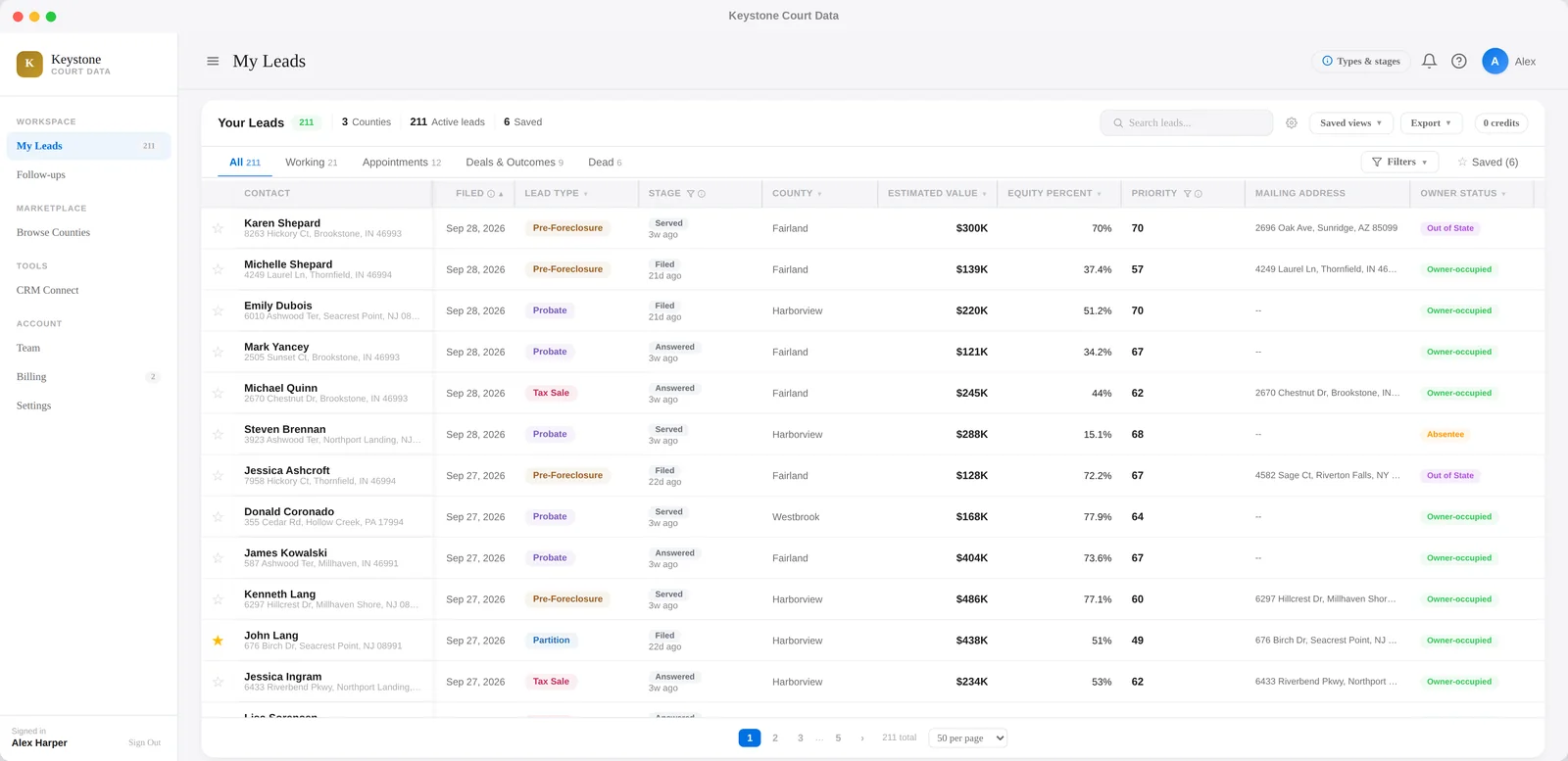
Fill your pipeline with people worth the effort. Comps take time, and you want to spend that time on owners who have a real reason to sell. Public court filings are one place those situations show up, and Keystone delivers them with the owner and property already matched, so your time goes to valuation and conversation instead of paperwork.
Questions investors ask
Can I run comps without seeing the inside at all?
Yes, but the result is a range, not a precise value. Be clear about your condition assumptions and expect to revise them. Do not commit to a final price until you have photos or a walkthrough.
How many comps do I need?
There is no magic count. You need enough good matches to see a pattern within each condition group. A few well-matched sales are worth more than a long list of loose ones.
Should I ask the owner for photos?
Often, yes, if you ask politely and explain why. Some owners are uncomfortable sharing, and that is their choice. If they decline, keep your range conservative and say so.
Do I need a license to give an owner a value opinion?
Rules on valuation and brokerage activity vary by state, and what counts as an appraisal or a broker's opinion differs. Confirm with your state real estate commission or an attorney before you present a value as anything more than your own business estimate.
Can I call owners to ask about the condition?
You can in many cases, but you must follow the National Do Not Call Registry and your state's telemarketing rules. Keep the call short, respectful and honest about why you are calling, and stop if they ask you to.
See leads in your county for 7 days, free
Real court filings with the owner and property matched. No credit card.