Pre-foreclosure in Belmont County, Ohio: what investors should know
Ohio foreclosures go through the courts, which shapes how much time an owner has and what a buyer can realistically offer. Here is how the process works in Belmont County and how to approach it fairly.

What Belmont County's housing looks like
Belmont County has 31,599 housing units, and 74% of them are owner-occupied, according to the U.S. Census Bureau's 2023 American Community Survey. That is a market of mostly homeowners, not renters, which matters when you think about who ends up in a court filing: individual owners with a mortgage, a family estate or a marriage tied to the property.
The median home value is $143K. That figure shapes the math. On a home in that range, a mortgage balance, unpaid property taxes, legal fees and repair needs can use up equity quickly. Some pre-foreclosure owners will have room to sell. Others will not, and knowing which is which matters before price comes up.
Treat the median as a reference point, not a promise about any one house. Individual properties can sit well above or below it, and condition varies a great deal.
Source: U.S. Census ACS 2023
Which court filings come before a sale in Belmont County
A court filing is a signal that someone may need to sell, or may have to. Each type means something different.
- Pre-foreclosure: A lender has started a case because the loan is in default. The owner is under time pressure but usually still holds title and can still sell.
- Probate: An owner has died and the estate is being opened. The house may be sold by the personal representative, or kept by heirs who live elsewhere and do not want the upkeep.
- Divorce: Spouses may need to sell or buy each other out as part of a settlement. Timing often depends on the court's orders and on negotiations.
- Tax sale: Unpaid property taxes can lead to a delinquent tax case. The owner may be looking for a way out before a forced sale.
- Partition: Co-owners, often heirs, cannot agree, and one asks the court to force a sale or division.
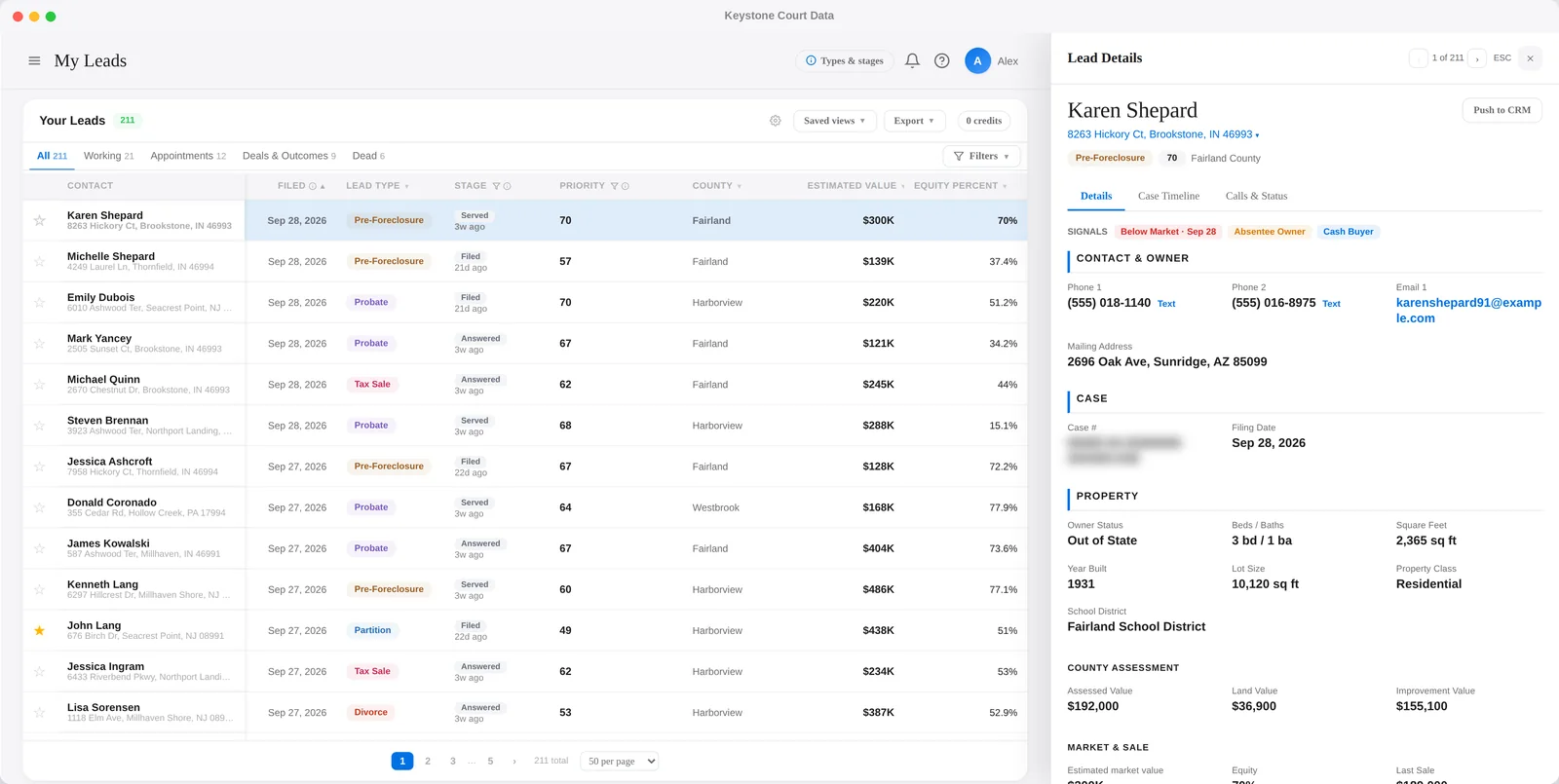
These filings are public records. Keystone delivers them with the owner and property already matched, so you can spend your time on the conversation instead of the paperwork.
How foreclosure works in Ohio, in plain terms
Ohio is a judicial foreclosure state. A lender has to file a complaint in the county court of common pleas and prove its case. It cannot simply auction the home on its own: a foreclosure sale must be ordered by the court (R.C. 2323.07). For most mortgages on a borrower's principal residence, federal servicing rules also bar the servicer from making the first foreclosure filing until the loan is more than 120 days delinquent, apart from a few listed exceptions (12 CFR 1024.30, 1024.41(f)), which gives the owner some breathing room first.
After the complaint is filed, the owner is served and normally has a set period to answer. In Ohio the answer is due 28 days after service, or 28 days after service by publication is complete (Ohio Civ.R. 12(A)(1)). If the owner does not respond or loses, the court issues a judgment and a decree of foreclosure. The property is then appraised and offered at a sheriff's sale (or by a private selling officer the court authorizes, R.C. 2329.152), and the court must confirm that sale (R.C. 2329.31).
Until the court confirms the sale, the owner can redeem, except where the statute provides otherwise (R.C. 2329.33). That means paying off what the court says is owed. Until then, a private sale, a short sale with lender approval, or a refinance may still be possible. Foreclosure can take many forms depending on contested issues, loss mitigation, bankruptcy and court schedules, and an Ohio attorney can confirm specifics. Statutes on sheriff's sales are in Chapter 2329 of the Ohio Revised Code.
Probate is a different track. Estates in Ohio go through the county probate court, which appoints an executor or administrator. Whether that person can sell real estate depends on the will, the type of estate and sometimes court approval, so an estate attorney can confirm before any contract is signed.
Approaching owners respectfully and legally
Someone facing foreclosure is often scared, embarrassed and getting a lot of mail. A calm, honest approach stands out. Say who you are, that you buy houses, and that you are calling about a possible sale. Implying a tie to the lender or the court is misleading.
Keep the pressure low. A fake deadline is misleading. Owners are usually pointed to an attorney, a HUD-approved housing counselor or their lender before deciding. If someone says no or asks you to stop, stop and record that request.
Phone outreach has its own rules. Phone calls are covered by the National Do Not Call Registry, calling-hour limits, Ohio telemarketing and solicitation rules, and any federal rules that apply. Texts and automated calls carry additional consent requirements. A personal letter is often better received, and it gives the owner time to think.
For probate and divorce, go gently. A family that just lost a parent or is separating needs patience more than a pitch. A short, kind note that says the offer stands whenever they are ready is enough.
Federal rules regulate paid foreclosure-rescue services (the Mortgage Assistance Relief Services rule, 12 CFR Part 1015), and other consumer-protection laws can reach deals with distressed homeowners. A real estate attorney can review contracts and how they are presented.
What to look for before you make an offer
A filing tells you a sale might happen. It does not tell you the deal works. Before you quote a number, get clear on these points:
- Who holds title. Whether the person on the phone can legally sell is the first question. In probate and partition, that may be several people or a court-appointed representative.
- What is owed. Mortgage balance, other liens, back taxes, and any judgments can all come out of the sale. Order a title search to see the full picture.
- Where the case stands. A case just filed is different from one with a judgment and a scheduled sale. A title company or attorney can say how that affects a closing timeline.
- Lender involvement. If the sale will not pay the loan in full, a short sale needs lender approval, which takes time.
- Condition and occupancy. Inspect the property, and find out whether anyone is living there and whether they plan to stay.
- Bankruptcy or other stays. A bankruptcy filing can pause a foreclosure and change what you can do.
With a median home value of $143K, the margin for error is small, so build in a buffer for repairs and holding costs. If the numbers only work at a price that would leave the owner with nothing, it is fair to walk away and say so kindly.
Getting Belmont County leads in front of you
The records behind all of this are public court records. If you would rather skip the paperwork, Keystone's Belmont County page covers pre-foreclosure, probate, divorce, tax sale and partition filings, delivered with the owner and property already matched. You can read more about pre-foreclosure leads or look at Ohio more broadly.
Whatever source you use, the work that wins deals is the same: understand the case, treat the owner with respect, and make an offer you can stand behind.
Questions investors ask
Is Ohio a judicial or non-judicial foreclosure state?
Ohio is judicial. A foreclosure sale must be ordered by the court (R.C. 2323.07), so a lender files a case in the Court of Common Pleas and gets a court judgment before the home is sold at a sheriff's sale. The court must then confirm that sale (R.C. 2329.31).
Can a Belmont County homeowner sell during foreclosure?
Often, yes. The owner still holds title until a sheriff's sale is confirmed, and can sell, or redeem under R.C. 2329.33, before then. Whether a sale works depends on what is owed and on lender approval if it is a short sale, so an attorney can confirm the details.
Who handles an estate if the owner has died?
The county probate court oversees the estate and appoints an executor or administrator. Whether that person can sell the house depends on the will, the type of estate and sometimes court approval. The probate court or an estate attorney can confirm.
Can I call homeowners in pre-foreclosure?
Telemarketing calls are covered by the National Do Not Call Registry, the FTC's Telemarketing Sales Rule and Ohio's telemarketing law; texting and auto-dialed calls carry more rules. An attorney licensed in Ohio can say which rules apply to a given campaign.
Do divorce and partition filings matter to investors?
They can. Divorce may lead to a sale or buyout as part of a settlement, and partition cases can end in a court-ordered sale among co-owners. Each involves several parties, so who has authority to sign matters.
General information about Ohio law. Laws change, so check the current statute. This is not legal advice and does not create an attorney-client relationship. Talk to an attorney licensed in Ohio before relying on it.
See Belmont County leads for 7 days, free
Real court filings with the owner and property matched. No credit card.