Investing in McHenry County, Illinois: where motivated sellers show up in the court record
A county of owner-occupied single-family homes, a judicial foreclosure state, and a Woodstock courthouse where life events turn into property decisions.

What McHenry County housing looks like for an investor
If you are researching McHenry County Illinois real estate investing, start with the shape of the housing stock. The county has about 311,366 residents and 120,605 housing units, and 83% of homes are owner-occupied. The median home value is $287K. This is a homeowner county, not a renter market.
Single-family is the default. 77% of homes are single-family detached, compared with 61% for the U.S. That means nearly every deal you see is a house on its own lot, and your comps, repair scopes and exit strategies should be built around that product.
Equity is solid but not universal. 31% of owner-occupied homes have no mortgage, below the U.S. figure of 39%. So a larger share of owners than usual have a loan against the house. When a job, health or family event strains a budget, that loan matters, and it is why pre-foreclosure and divorce sales deserve attention here. A free-and-clear home in an estate is a different conversation, with more room for a fair, flexible offer.
The market is tight and the stock is not especially old. Vacancy is 4% against 10% nationally, and only 8% of homes were built before 1940 (U.S.: 12%). Permits for new units were 1,393 in 2025, down 11% from 2024. Fewer new homes and little slack in vacancy suggest buyers and renters have limited choices, which supports resale and rental demand but also means sellers know their houses are wanted.
The county sits in northeastern Illinois, has more than 30 communities, and is the sixth most populous county in the state. County government is based in Woodstock. Major employers include Northwestern Medicine, school districts 47 and 158, the County of McHenry, and manufacturers such as Follett Library Resources and Catalent Pharma Solutions. Steady health care, education and manufacturing payrolls tend to anchor a housing market, though a job change at any one employer can still put a household under pressure.
Sources for these figures are the Census Bureau's American Community Survey and the Census building permits survey.
Source: U.S. Census ACS 2023
Which court filings tend to come before a sale in McHenry County
A court filing is not a lead by itself. It is a sign that an owner may be facing a decision about a property. Understanding what each filing means helps you speak to people accurately and kindly.
Pre-foreclosure. A foreclosure complaint means a lender has asked the court to enforce a mortgage after missed payments. Because a larger share of McHenry County owners carry a mortgage than the national average, this filing type is a real source of sellers. Many owners at this stage want to avoid a judgment on their record and keep whatever equity they have.
Probate. With 16% of residents aged 65 or older and a median age of 40.4 (U.S.: 38.9), the county has an established older homeowner base. When an owner dies, heirs often inherit a house they did not plan for, live elsewhere, and need to sort out through the court. Some of these homes have no mortgage, so there can be real flexibility on price and timing.
Divorce. When a couple owns a single-family home together, a divorce filing can mean the house must be sold or one spouse bought out. Sellers here are often motivated by clarity and speed of closing more than by price alone.
Tax sale. Illinois counties offer property with unpaid taxes to tax buyers at a tax sale (Property Tax Code, Sec. 21-205). The sale is subject to the owner's right to redeem, and a tax deed can issue only if the property is not redeemed within the redemption period (Sec. 22-30). This is a distinct activity from buying a house, and it follows its own rules, so treat it as a separate strategy and talk to an attorney before relying on it.
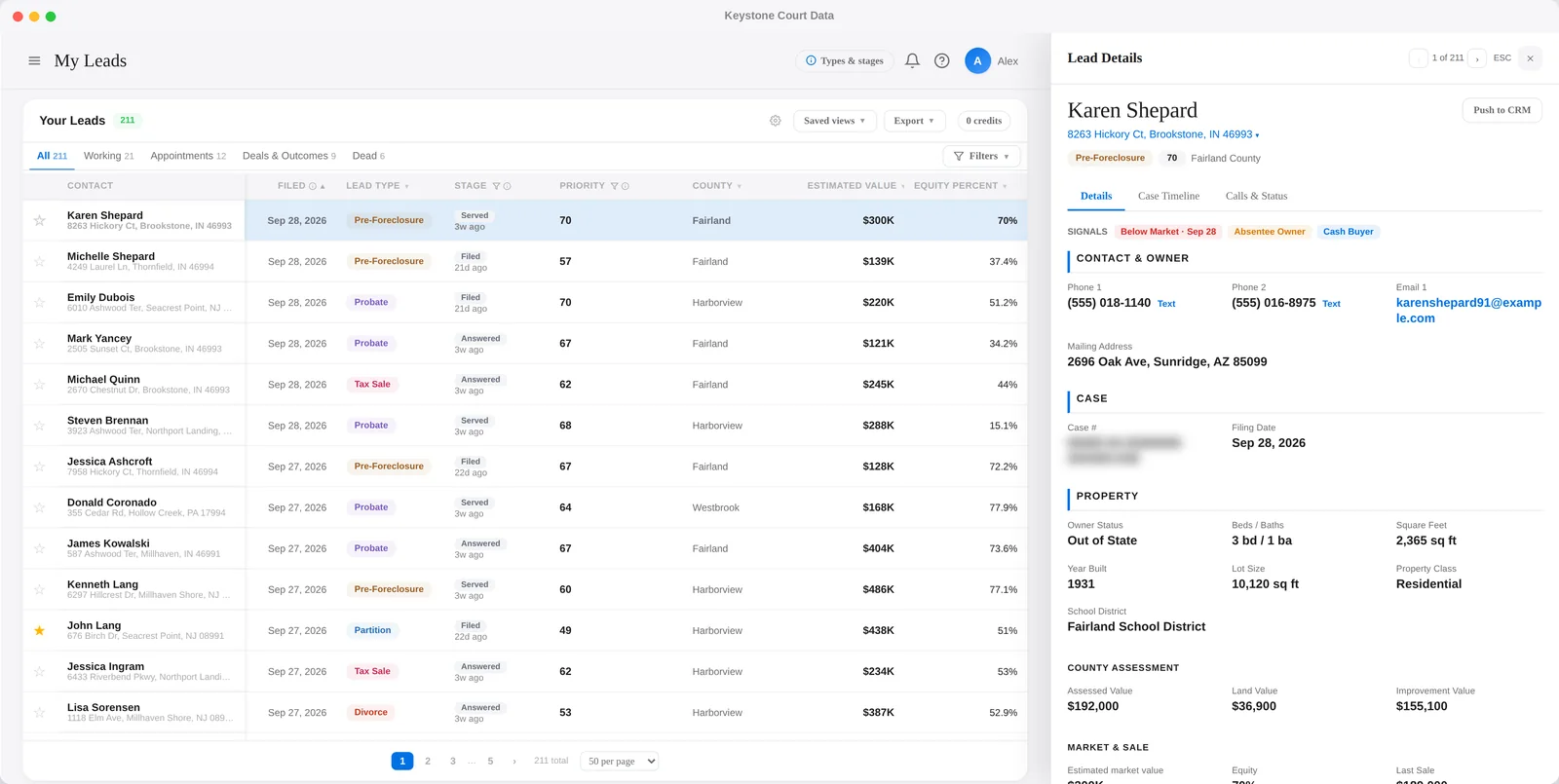
These records are public. If you want them delivered with the owner and property already matched, the McHenry County lead page shows how Keystone does that.
How the process works in Illinois, in plain terms
McHenry County cases are heard in the Twenty-Second Circuit Court, a single-tiered, unified court that hears felony, major civil, family and juvenile cases, among others. In practice, one court system touches foreclosure, estates and divorce for county residents. You can read the state's description on the Illinois Courts directory.
Foreclosure goes through a judge. Illinois is a judicial foreclosure state, meaning the lender must file a case in court rather than simply selling the house on its own. That gives owners time and a process, and it means the stage of the case matters. Redemption rights and sale timing are set by statute: for a home, the owner can generally redeem until the later of 7 months after being served or 3 months after the judgment, unless the statute shortens it (735 ILCS 5/15-1603). An attorney can confirm the deadlines in a given case.
Probate is handled by the circuit court. An executor or administrator is appointed by the court. In an estate, an independent representative can sell without a court order, while a supervised one must petition the court unless the will gives a power of sale (755 ILCS 5/28-8, 20-5, 20-15). Whether a representative can sell a house, and what approvals are needed, depends on the will, the type of estate and the court. Ask the representative whether they have authority to sell, and suggest they confirm it with their attorney.
Divorce can include mediation. McHenry County cases involving parenting time, custody, visitation or removal from Illinois must generally go through the court's Family Mediation Program before going to court on those issues. Missing the first scheduled meeting may bring court sanctions, and meetings can be rescheduled for good reason on two business days' notice, per the court's mediation guide. For you, this means a household may be under real strain and juggling appointments. Be patient and brief.
The tax calendar shapes pressure. McHenry County property taxes are billed in two installments, and owners who fall behind can feel a squeeze around those due dates. The general homestead exemption lowers the taxable value of an owner-occupied primary residence by up to $8,000 in counties next to Cook County, such as McHenry (Property Tax Code, Sec. 15-175), which matters if an heir or buyer later changes how the home is used. Anyone interested in the tax sale route should read the county's current rules and speak to an attorney well ahead of time.
How to approach owners respectfully and legally
Most of the people behind these filings are dealing with a death, a split or a debt. They did not ask for your call or letter, and they will remember how you treated them.
Lead with honesty. Say who you are, that you buy houses, and why you are reaching out. Do not imply that you are connected to the court, the lender or a government office. Do not pressure anyone to decide on the spot. A short, plain letter that says you are available if they want to talk is often better received than a hard pitch.
Respect the phone rules. Calls are regulated. Federal rules on telephone solicitations set the National Do Not Call Registry, a calling window of 8 a.m. to 9 p.m. local time and company do-not-call lists (47 C.F.R. 64.1200), and the Illinois Telephone Solicitations Act bars calls soliciting the sale of goods or services between 9 p.m. and 8 a.m. and requires the caller to stop calling anyone who asks (Sec. 15 of that Act). Whether a call offering to buy a house is covered depends on the facts, so an Illinois attorney can confirm. When someone says no, record it and do not contact them again. Autodialed or prerecorded calls and texts to cell phones need prior express consent, and written consent for telemarketing (47 C.F.R. 64.1200(a)).
Do not give legal advice. You can explain your offer. You should not tell an heir what the probate court will allow or tell a borrower what a foreclosure judgment will mean. Encourage people to speak with their own attorney or a HUD-approved housing counselor.
Be careful around foreclosure. Buying from an owner in foreclosure can raise legal issues of its own. If an owner is behind on payments, talk with a real estate attorney before you sign anything.
What to look for before making an offer
Because the market is tight, you will not win on mystery discounts. You win by being clear, fair and able to close.
- Authority to sell. In an estate, confirm who can sign and whether court approval is needed. In a divorce, find out whether both spouses must agree. In foreclosure, ask where the case stands and talk to an attorney about timing.
- Condition. Only 8% of homes predate 1940, so many houses will be newer, but age is not the only risk. Plan inspections for roof, drainage, mechanicals and any deferred maintenance common in long-held or inherited houses.
- Equity and liens. With 31% of owners free and clear, some sellers will have large equity and others will have a loan balance that limits what they can accept. Have a title company confirm liens and payoff figures.
- Property taxes. Unpaid installments can affect closing. Assessment complaints to the Board of Review must be filed within 30 days of publication of the assessment list (Property Tax Code, Sec. 16-55), so know that window if you plan to hold.
- Exit strategy. For resale, the $287K median value is your rough anchor, but price each house on its own comps. For rental, HUD Fair Market Rent in the Chicago-Naperville-Elgin area is $2,011 for a 2-bedroom and $2,586 for a 3-bedroom, per HUD. That is a regional figure, so check it against what local houses actually rent for.
For the steps and cost of working McHenry County leads, see how it works and Illinois coverage.
Questions investors ask
Is McHenry County a good market for buy-and-hold?
The numbers point to a stable, owner-heavy market with low vacancy at 4%. HUD Fair Market Rent is $2,011 for a 2-bedroom and $2,586 for a 3-bedroom in the Chicago-Naperville-Elgin area, which is a regional benchmark. Check any deal against a $287K-style median and the real rents for the specific house.
Does Illinois use judicial or non-judicial foreclosure?
Illinois uses judicial foreclosure, so a lender must go through the court. For a home, the owner can generally redeem until the later of 7 months after being served or 3 months after the judgment, unless the statute shortens it (735 ILCS 5/15-1603). An attorney can confirm the deadlines in a given case.
Can an executor sell a house in McHenry County?
Often yes. An independent representative can sell without a court order; in a supervised estate the representative needs a court order unless the will gives a power of sale (755 ILCS 5/28-8, 20-5, 20-15). The executor or administrator is appointed through the circuit court. Ask them to confirm their authority with their attorney before you sign anything.
How should I contact someone going through a divorce or a death in the family?
Keep it short, honest and low-pressure, and offer to answer questions rather than push for a decision. Calls are regulated. Federal rules on telephone solicitations set the National Do Not Call Registry, a calling window of 8 a.m. to 9 p.m. local time and company do-not-call lists (47 C.F.R. 64.1200), and the Illinois Telephone Solicitations Act bars calls soliciting the sale of goods or services between 9 p.m. and 8 a.m. and requires the caller to stop calling anyone who asks (Sec. 15 of that Act). Whether a call offering to buy a house is covered depends on the facts, so an Illinois attorney can confirm. Stop contacting anyone who asks you to.
Where can I see the filings themselves?
Court filings are public. Keystone delivers them with the owner and property already matched, and you can try a county free for 7 days with no credit card.
See Mchenry County leads for 7 days, free
Real court filings with the owner and property matched. No credit card.