Ask experienced real estate investors which lead type they prefer, and probate comes up again and again. There is a reason for that. Probate leads convert at a higher rate than most other sources because the underlying motivation is built into the situation. Heirs inherit property they often do not want, cannot afford to maintain, and need to liquidate to settle an estate. That combination produces sellers who are ready to make decisions.
For investors who understand how probate works and how to approach heirs with respect and a clear offer, this lead type consistently delivers some of the best deals in the market.
What Probate Is and Why It Creates Opportunities
Probate is the legal process of settling a deceased person's estate. When someone dies owning real property, that property cannot simply transfer to their heirs automatically in most cases. It must go through probate court, where a judge oversees the identification of assets, payment of debts, and distribution of remaining property to beneficiaries.
The process exists to protect creditors and ensure the decedent's wishes (or state law, if there is no will) are followed. But for the heirs involved, probate is often a burden. They are grieving, dealing with paperwork, and managing a property that may be in another city or state. The property may need repairs. Property taxes and insurance still need to be paid. If there is a mortgage, payments continue to come due.
All of this creates motivation to sell. And because the heirs did not buy the property themselves, they do not have the same emotional attachment to a specific price that a typical homeowner would. They are more likely to accept a reasonable offer that lets them move on quickly.
Why Probate Leads Convert Better
Several factors make probate leads higher-converting than other lead types.
Motivated sellers with real urgency. Probate cases have legal timelines. Courts expect estates to be settled in a reasonable period, and personal representatives (the people appointed to manage the estate) have a fiduciary duty to act in the best interest of the beneficiaries. Selling a property that is sitting vacant and costing money each month is often the responsible thing to do.
Properties are frequently free and clear. Many probate properties, especially those owned by older individuals, have been paid off for years. There is no mortgage to deal with, no lender to negotiate with, and no short sale process to navigate. This simplifies the transaction dramatically and often means the heirs receive cash at closing with no strings attached.
Below-market pricing is common. Heirs are typically optimizing for speed and convenience rather than maximum sale price. A property that might sell for $180,000 on the open market after repairs and staging might go to an investor at $130,000 or $140,000 because the heirs want a quick, clean sale without the hassle of listing, showing, and waiting.
Less competition from retail buyers. Probate properties often need work. They may have been occupied by an elderly person for decades without updates. They may have deferred maintenance issues. Retail buyers looking for move-in ready homes are not interested, which means investors face less competition.
How Probate Works in Indiana
Indiana probate cases are handled at the county level through the circuit or superior court system. When someone dies owning property in Indiana, the estate is probated in the county where they resided. The process generally follows these stages.
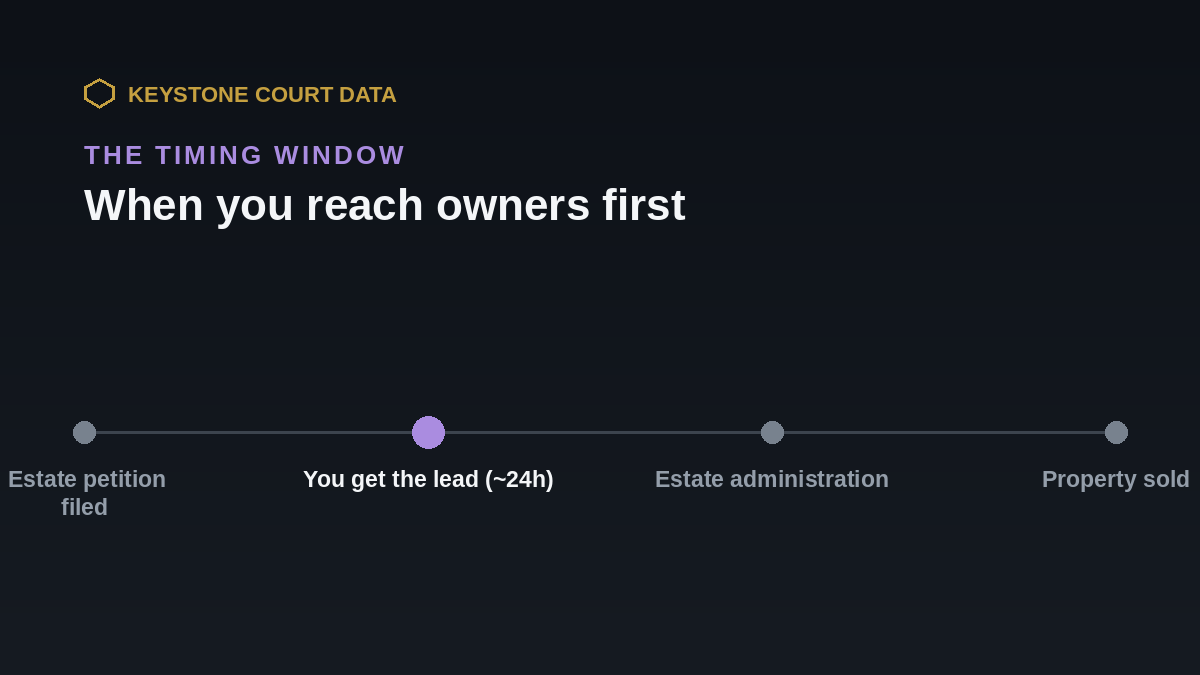
Filing the petition. An interested party, usually a family member, files a petition with the county court to open the estate and appoint a personal representative. This filing creates a public court record that identifies the decedent, the petitioner, and often lists real property owned by the estate.
Appointment of personal representative. The court appoints someone to manage the estate. If the decedent had a will, the person named as executor is typically appointed. If there is no will, the court appoints an administrator, usually a close family member.
Inventory and appraisal. The personal representative is required to inventory all estate assets, including real property. This stage is where the full picture of what the estate owns becomes clear.
Payment of debts and distribution. The estate pays outstanding debts (medical bills, taxes, outstanding balances) before distributing remaining assets to beneficiaries. If the estate needs to sell property to pay debts, this creates additional urgency.
Indiana has a simplified small estate process (called a "small estate affidavit") for estates under $50,000, but most estates with real property exceed this threshold and go through supervised or unsupervised probate. The typical Indiana probate takes six months to a year, though it can extend longer for contested cases.
High-volume probate counties in Indiana include Lake County, Vanderburgh County, St. Joseph County, Hendricks County, and Clark County. Each of these markets produces a steady flow of probate filings throughout the year.
What Data Comes from Probate Court Filings
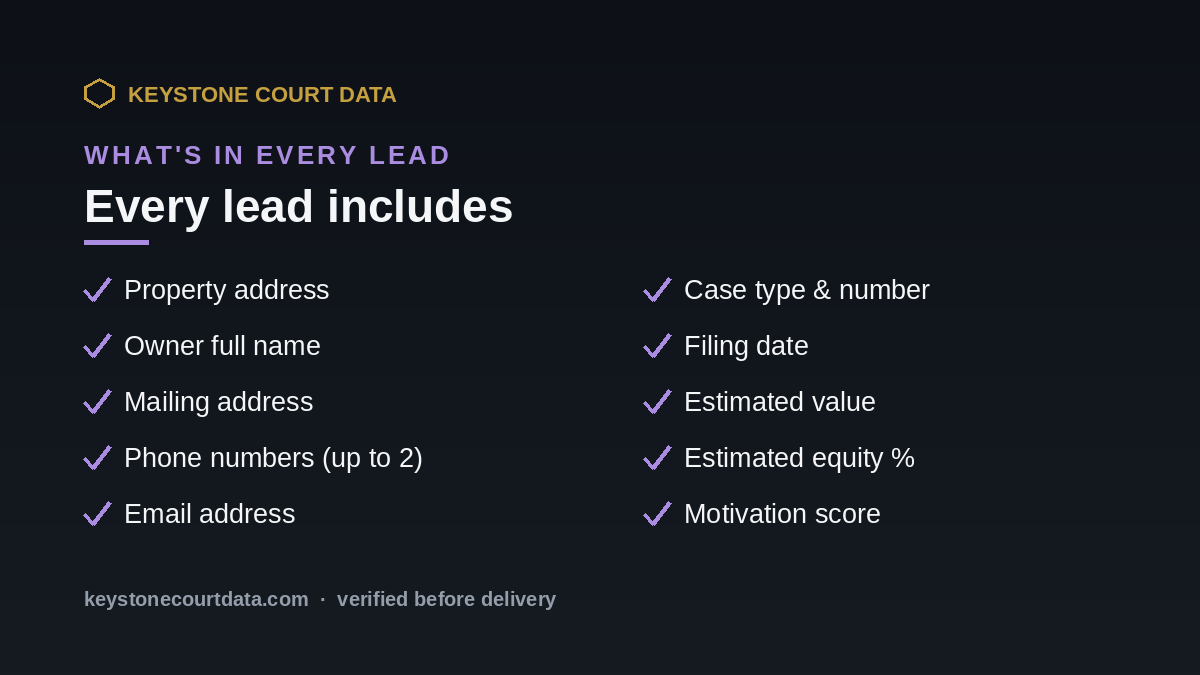
Probate filings are public records, and they contain valuable information for investors. A typical probate case file includes:
- The decedent's name and date of death
- The personal representative's name (phone lookups where offered)
- Real property addresses and legal descriptions
- The case number, filing date, and current status
- Whether the estate is being administered with or without a will
- Scheduled hearing dates
When this court data is combined with property records showing estimated value, equity, and current condition indicators, investors can quickly evaluate whether a probate property fits their criteria. Keystone Court Data delivers probate leads with this information already assembled, including the personal representative's name (phone lookups where offered) and motivation scoring to help you prioritize your outreach.
Approaching Heirs with Sensitivity
Probate outreach requires more care than other lead types. You are contacting people who have recently lost a family member. Getting this wrong does not just cost you a deal. It damages your reputation and the reputation of investors as a whole. Here is how to do it right.
Wait an appropriate amount of time. Reaching out the day after a death or even the week after a filing is too soon. Give the family at least three to four weeks after the filing before making contact. This shows respect and also means the personal representative has had time to assess the estate and start thinking practically about what needs to happen.
Lead with empathy, not a pitch. Your first contact should acknowledge the loss and express that you understand this is a difficult time. Then explain that you work with families in similar situations and that you may be able to help if they are considering selling the property. Keep it brief and non-pressuring.
Offer to solve problems. Heirs dealing with probate property often face specific problems: the house needs to be cleared out, there are maintenance issues, they live out of state and cannot manage showings, or they just want the process to be simple. Position yourself as someone who can handle all of that. You buy the property as-is, you handle closing costs, and you can close on their timeline.
Be patient with follow-up. Probate deals often take longer to develop than other lead types. The personal representative may need court approval to sell. Multiple heirs may need to agree. Give the process time, follow up regularly but not aggressively, and be available when they are ready to move forward.
Common Deal Structures for Probate Properties
Probate properties lend themselves to several deal structures that investors should be familiar with.
Cash purchase. The most common structure. You make a cash offer, close quickly, and the proceeds go to the estate for distribution to heirs. This is attractive because it is simple and fast.
Seller financing. In some cases, the personal representative may agree to seller financing, where the estate carries a note and you make payments over time. This works when the heirs are not in a rush for the full proceeds and you want to preserve cash for renovations.
Wholesale assignment. If you identify a strong probate deal but do not want to close on it yourself, you can assign the contract to another investor for an assignment fee. Probate deals are particularly attractive to wholesale buyers because the motivation and pricing are already built in.
Probate real estate investing rewards patience, empathy, and consistent deal sourcing. The investors who build reliable probate pipelines do not treat it as a one-time strategy. They monitor new filings across their target counties, reach out systematically, and build a reputation as someone who makes the process easier for families going through a difficult time.
Start reviewing probate leads in Indiana today. Request a free trial to see real leads with owner data, property details, and motivation scoring across all covered counties.