Keystone Court Data's tracking of Test County filings shows 38,566 pre-foreclosure cases on record, up 3 percent from the prior period. That volume tells you something important: distress in this market is not a blip. It's a consistent, measurable pipeline of motivated sellers that most investors never see because they're waiting for the auction notice or a wholesaler's list that's already weeks old.
If you're working pre-foreclosure leads in Test County, Indiana, timing is the entire game. The investors who win deals here are the ones who contact homeowners early, when there's still room to negotiate, still equity to work with, and still a homeowner who hasn't been bombarded by a dozen other callers yet.
Key Takeaways
- Test County recorded 38,566 pre-foreclosure filings, up 3% based on Keystone Court Data's analysis of public court records.
- Distress hotspot ZIP codes include 47130, 47111, and 46112, each logging hundreds of filings.
- The pre-foreclosure window in Indiana typically runs several months, giving you a real contact opportunity before the courthouse steps.
- Keystone delivers leads the same day cases are filed, with one subscriber per county, so you're not racing the same list as every other investor in the market.
What a Pre-Foreclosure Lead Actually Means in Test County
A pre-foreclosure filing is a public record event. When a lender initiates foreclosure proceedings in Indiana, a case is filed in the county court system. That filing is publicly accessible, and it contains the homeowner's name, the property address, the lender involved, and the case number. What it doesn't contain, on its own, is context: how much equity is in the property, whether the owner is still living there, or how motivated they might be to sell.
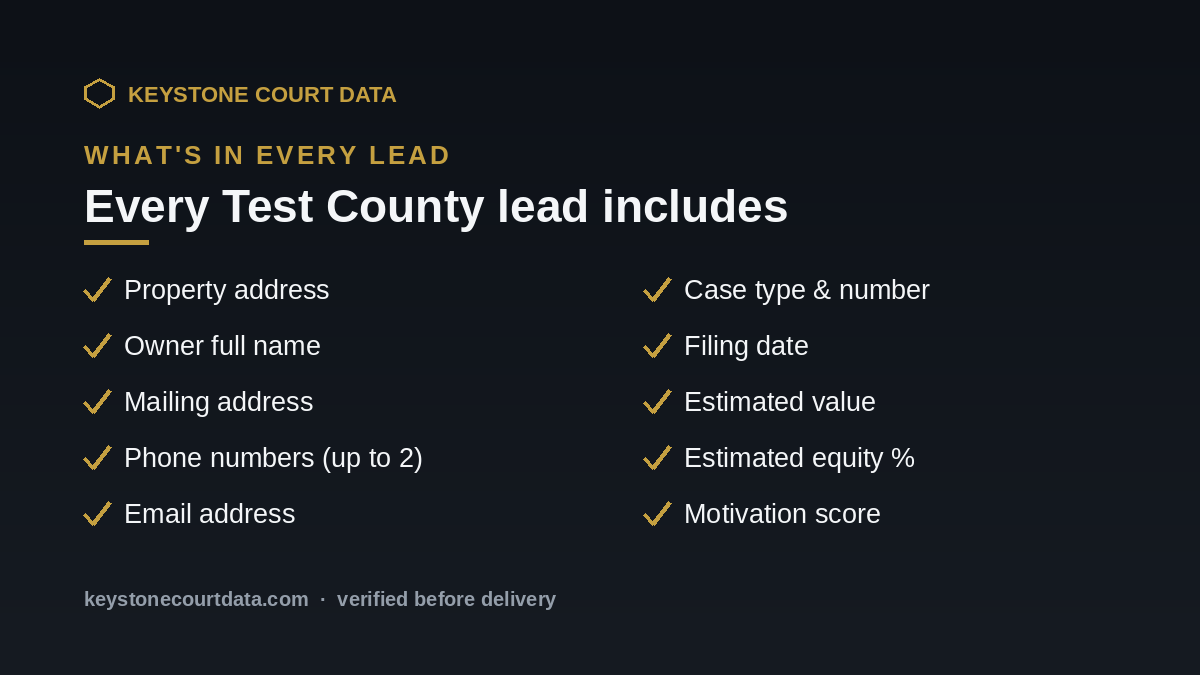
That's where the difference between raw court data and a curated lead becomes meaningful. Every pre-foreclosure lead Keystone Court Data delivers for Test County includes the court filing details alongside additional property data, an absentee owner flag, and a motivation score built from verified sources. You're not starting from a case number and a name; you're starting from a complete picture.
Test County's housing stock makes these leads particularly attractive. The market features a mix of single-family homes, rural parcels, and light industrial properties, all in price ranges that work for both first-time investors and experienced flippers. Properties in distress here often carry enough equity to support a buy-and-hold acquisition or a value-add flip, especially when acquired 15 to 30 percent below market value, which is realistic when you reach sellers early in the process.
What You Get With Every Test County Pre-Foreclosure Lead
Each lead delivered through our platform includes the following verified data fields:
- Full property address and parcel details
- Homeowner name and available contact information
- Filing date and court case number
- Lender name and filing type
- Absentee owner flag, indicating whether the property is owner-occupied or vacant
- Motivation score based on case type, filing recency, and other verified signals
- CRM-ready formatting for direct import into your workflow
You're not piecing this together from multiple sources or buying a stale list that was compiled last quarter. These leads come from public court records, verified and structured, delivered the same day the case is filed.
Where Distress Is Concentrated: Test County ZIP Code Breakdown
Filing concentration varies across Test County. Our analysis of public court records shows the highest pre-foreclosure activity in three specific ZIP codes. ZIP 47130 leads with 202 filings. ZIP 47111 follows with 148 filings. ZIP 46112 rounds out the top three at 142 filings. These aren't evenly distributed; certain neighborhoods and corridors account for a disproportionate share of the pipeline.
This matters for how you prioritize outreach. If you're working with a limited contact budget or prefer to focus on a specific geography within the county, knowing where volume clusters are gives you a real targeting advantage. You can run ZIP-specific outreach campaigns and build familiarity in a neighborhood rather than scattering across the entire county.
It also reflects the economic dynamics at play in Test County. Agriculture, light manufacturing, and regional retail are the main employment drivers in the region. These sectors can produce income volatility, and that volatility shows up in mortgage delinquency rates. When a plant cuts shifts or a farming season runs short, the court filings follow.
Investors who reach Test County homeowners in the pre-foreclosure window, before the sale date is set and before the phone starts ringing with wholesalers, routinely negotiate terms that simply aren't available at the auction.
The Lender Landscape and What It Tells You
Test County's foreclosure filings come from a competitive lender field. Based on our court records tracking, no single lender dominates the market. The top filer is US Bank NA, which accounts for 6 percent of foreclosure filings. That's a relatively low concentration, which means you're dealing with a diverse set of loan servicers and lender types rather than a market where one institution drives the majority of filings.
Why does this matter? Because lender behavior varies. Some servicers move quickly through the foreclosure timeline. Others drag it out over many months. When you know who filed and what that lender's typical pace looks like, you can better estimate how much time you have to work the lead before the sale date becomes imminent.
For a broader view of lender concentration patterns across Indiana, the Indiana Court Filings Intelligence Report breaks down filing trends, servicer activity, and geographic hotspots statewide. It's useful context if you're comparing Test County to adjacent markets or building a multi-county strategy.
The Full Filing Picture: Pre-Foreclosure in Context
Pre-foreclosure isn't the only distress signal in Test County's court system. Our analysis shows divorce filings at 138,901, representing 41 percent of all case filings and up 4 percent from the prior period. Probate cases came in at 81,843, and guardianship filings totaled 38,976, up 3 percent.
Each of these case types can indicate a motivated seller. Divorce creates forced asset liquidation scenarios. Probate surfaces inherited properties where heirs often prefer a cash sale over managing a property. Guardianship cases can signal elderly homeowners transitioning out of their residence. Pre-foreclosure at 38,566 filings sits squarely in that same distress pipeline.
Keystone monitors all of these case types daily and delivers leads across each category. If your acquisition strategy extends beyond just foreclosure situations, the full court record picture in Test County offers a substantial and varied lead pool.
The Timing Window: How Long Do You Have to Act?
Indiana's foreclosure process moves through the courts, which means there's a structured timeline between the initial filing and the sheriff's sale. In practice, the gap between when a lender files and when a property actually sells at auction can span several months, sometimes longer depending on case complexity, servicer pace, and court scheduling.
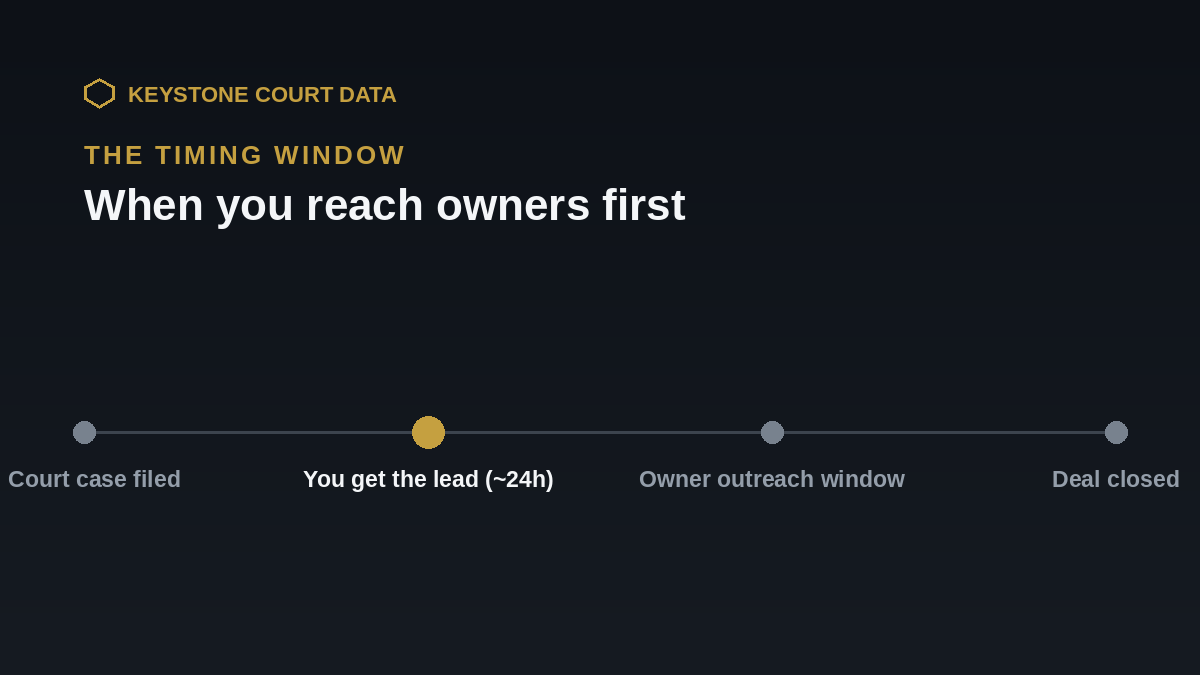
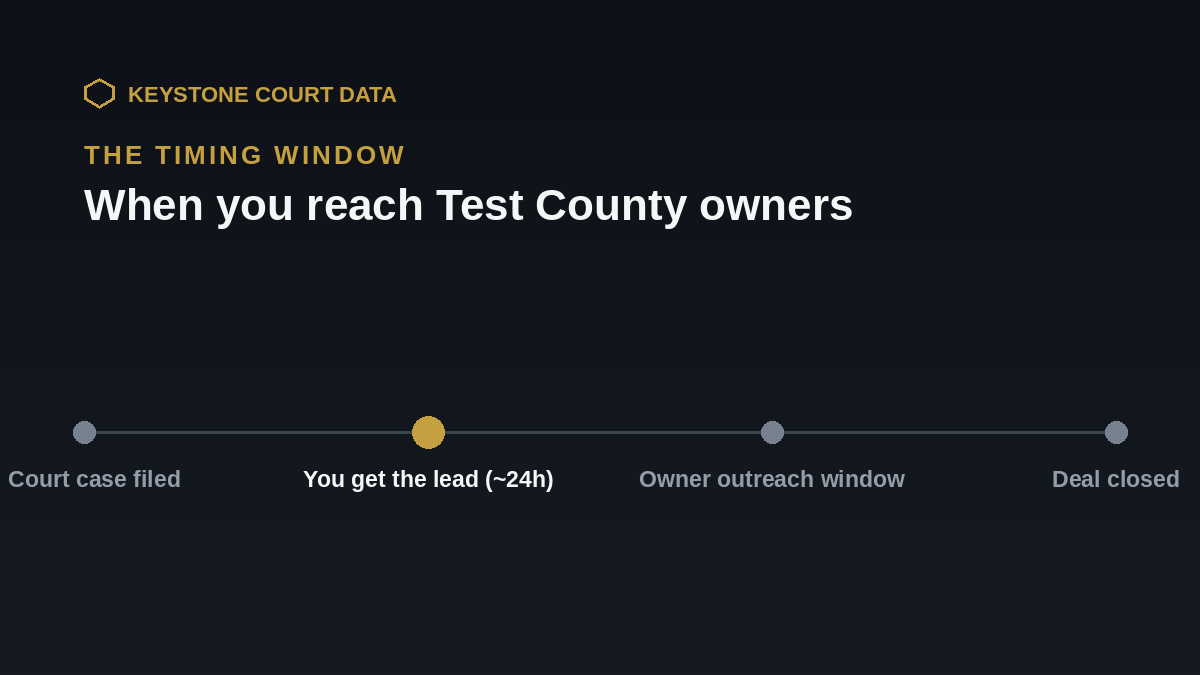
That window is where the deals happen. Here's how the typical pre-foreclosure timeline plays out:
- Filing date: Lender initiates the case; Keystone delivers the lead the same day.
- Early contact window: The first several weeks after filing are the highest-value outreach period. The homeowner is aware of the situation but has not yet been flooded with calls.
- Pre-judgment period: The court process plays out; this can take months. Negotiation is still very possible.
- Sheriff's sale scheduling: Once a judgment is entered and a sale is scheduled, the timeline tightens and your negotiating position weakens.
- Auction: Competitive bidding at the courthouse steps; no more off-market advantage.
The further left on that timeline you make contact, the better your position. Getting a lead the same day the case is filed is the only way to consistently be first. That's not something a weekly batch list or an aggregator feed can give you.
Why Exclusive Access Changes the Math
Most lead products sell the same data to multiple buyers. You're competing not just against investors who found the deal independently, but against everyone else who bought the same list. The homeowner picks up the phone to hear from you and three others by end of week. That's not a soft negotiation; that's an auction with extra steps.
Keystone operates on a one-subscriber-per-county model. When you subscribe to Test County pre-foreclosure leads, you are the only active subscriber receiving those leads in that county. No other investor on the platform is working the same pipeline.
That exclusivity changes how you can approach sellers. You can take time to build a real conversation rather than rushing to beat another caller. You can follow up more than once without worrying that someone else already has a signed contract. The math on conversion rates and deal costs is simply better when you're not bidding against your own data provider's other clients.
Visit keystonecourtdata.com/pricing to see current subscription tiers and pricing for Test County. Subscriptions include a 12-month price lock at signup, so what you pay today stays fixed for a full year.
Frequently Asked Questions
How quickly do I receive Test County pre-foreclosure leads after a case is filed?
Leads are delivered the same day the case is filed in the public court record. There's no batching, no weekly update cycle. When a new pre-foreclosure case hits the Test County docket, it comes to you that day.
Can I get pre-foreclosure leads for specific ZIP codes within Test County?
The subscription covers the full county, which includes all ZIP codes. Our data shows the highest filing concentrations in ZIPs 47130, 47111, and 46112, so if you want to prioritize outreach there, you'll have the volume to support a focused strategy.
What if a property is already past the pre-foreclosure stage when I receive the lead?
Because Keystone delivers leads on the filing date, you're starting at the very beginning of the legal process. You won't receive leads for cases that are already near the sale date. The entire value of the platform is early-stage access, not recycled data.
Does Keystone provide contact information for the homeowner with each lead?
Yes. Each lead includes the homeowner name and available verified contact information alongside the property address, lender details, filing date, absentee flag, and motivation score. The goal is to give you enough to reach out immediately, without having to cross-reference a separate skip trace service.
How does the one-subscriber-per-county model actually work? What happens if I cancel?
While you hold an active subscription for Test County, no other investor on the Keystone platform receives leads for that county. If you cancel, the county becomes available for the next subscriber. There's no overlap period. The exclusivity is real and enforced at the account level.
Pre-foreclosure leads in Test County, Indiana represent a genuine, data-backed opportunity for investors willing to move early and contact sellers directly. The filing volume is consistent, the distress geography is identifiable, and the timing window in Indiana's court-driven process gives you real room to work deals before the auction crowd arrives.
Work Test County before the competition does
See real Test County court filings from the last few days. 7-day free trial, no credit card, one subscriber per county.
Claim Test County → See pricing