If you are investing in Indiana real estate and relying solely on MLS listings, you are competing with every other investor, agent, and buyer in the market. The deals that produce the best returns rarely make it to a public listing. They come from motivated sellers who need to move quickly, and they are found in places most investors never think to look.
Indiana is one of the most attractive states for real estate investment in the Midwest. Property prices remain well below national averages in most markets, landlord laws are reasonable, and population centers like Indianapolis, Fort Wayne, and the Northwest Indiana corridor near Chicago create consistent rental demand. But the competition for good deals is real, and the investors who consistently find below-market properties are the ones who have built systems for sourcing off-market leads.
Why Off-Market Deals Matter
An off-market deal is any property transaction that happens outside of the MLS. The seller has not listed with an agent, and the property is not being actively marketed to the public. This matters for investors because off-market sellers are typically motivated by circumstances rather than price maximization. They need to sell, and they need to sell soon.
When a property hits the MLS, the seller has already made a deliberate choice to market the property. They have time to wait for offers, stage the home, and negotiate from a position of relative strength. Off-market sellers are different. They are dealing with financial pressure, legal timelines, inherited property they do not want, or life transitions that make a quick sale the priority.
The result is that off-market deals typically close at 10 to 30 percent below market value. For investors, that discount is the difference between a deal that works and one that does not pencil out.
Where to Find Off-Market Leads in Indiana
The best source of off-market leads in Indiana is the county court system. Every county courthouse processes filings that signal motivated sellers, and these records are public information. The key is knowing which case types to watch and how to act on them quickly.
Pre-Foreclosure Filings. When a lender files a foreclosure complaint, that filing becomes a public court record. The homeowner now has a limited window before the property goes to sheriff sale. This is the sweet spot for investors. The seller is highly motivated, the timeline creates urgency, and many homeowners in this situation would rather sell to an investor than lose the property at auction. Counties like Lake County and St. Joseph County see significant foreclosure volume due to their larger populations and economic conditions.
Probate Cases. When someone passes away and owns real property, that property must go through probate court. Heirs often have no interest in managing or maintaining the property, and they want to convert it to cash. Probate properties frequently sell below market because the heirs are motivated by convenience and speed rather than maximizing the sale price. Vanderburgh County and Hendricks County are two markets where probate filings regularly produce solid investment opportunities.
Divorce Filings. Divorce cases often require the sale of jointly owned real estate. Both parties want a clean financial split, and neither wants to be tied to a property with an ex-spouse. The emotional pressure and legal timeline create motivated sellers. These leads can be some of the fastest to close because both sides want it done.
Tax Sale Notices. Properties with delinquent property taxes are headed for tax sale. Homeowners in this situation are often dealing with broader financial distress, and reaching them before the tax sale gives you a chance to structure a deal that works for both sides.
Which Indiana Counties Are Hottest for Investors
Indiana has 92 counties, but investment activity is concentrated in a handful of markets. Knowing where to focus your efforts makes a significant difference in your deal flow.
Lake County sits in the northwest corner of the state, right on the Illinois border. Cities like Gary, Hammond, and East Chicago have large inventories of distressed properties, and the proximity to Chicago creates a unique investor market. Foreclosure volume is consistently high, and entry prices are among the lowest in the state.
Clark County borders Louisville, Kentucky, and the Jeffersonville and Clarksville markets benefit from cross-river demand. Investors here find opportunities in both rental properties and fix-and-flip deals, with probate and pre-foreclosure being the primary lead sources.
Vanderburgh County is home to Evansville, the largest city in southern Indiana. The market is affordable, rental demand is stable, and court filings produce a steady stream of leads across multiple case types.
St. Joseph County includes South Bend and Mishawaka. The University of Notre Dame drives rental demand, and the market has seen significant revitalization over the past decade. Pre-foreclosure and estate filings are common lead sources here.
Hendricks County is one of the fastest-growing counties in Indiana, sitting just west of Indianapolis. Higher property values mean bigger spreads on deals, and probate filings in particular tend to involve properties with significant equity.
How Indiana's Court System Works at the County Level
Indiana operates a county-based court system, which means filings happen at the individual county level rather than through a centralized state system. Each county clerk maintains its own records, and the pace of filings varies significantly from one county to the next.
For investors, this county-level structure is both a challenge and an opportunity. The challenge is that monitoring filings across multiple counties requires a system. You cannot simply check one website and see everything. The opportunity is that most investors do not bother with this level of detail, which means the ones who do have a significant competitive advantage.
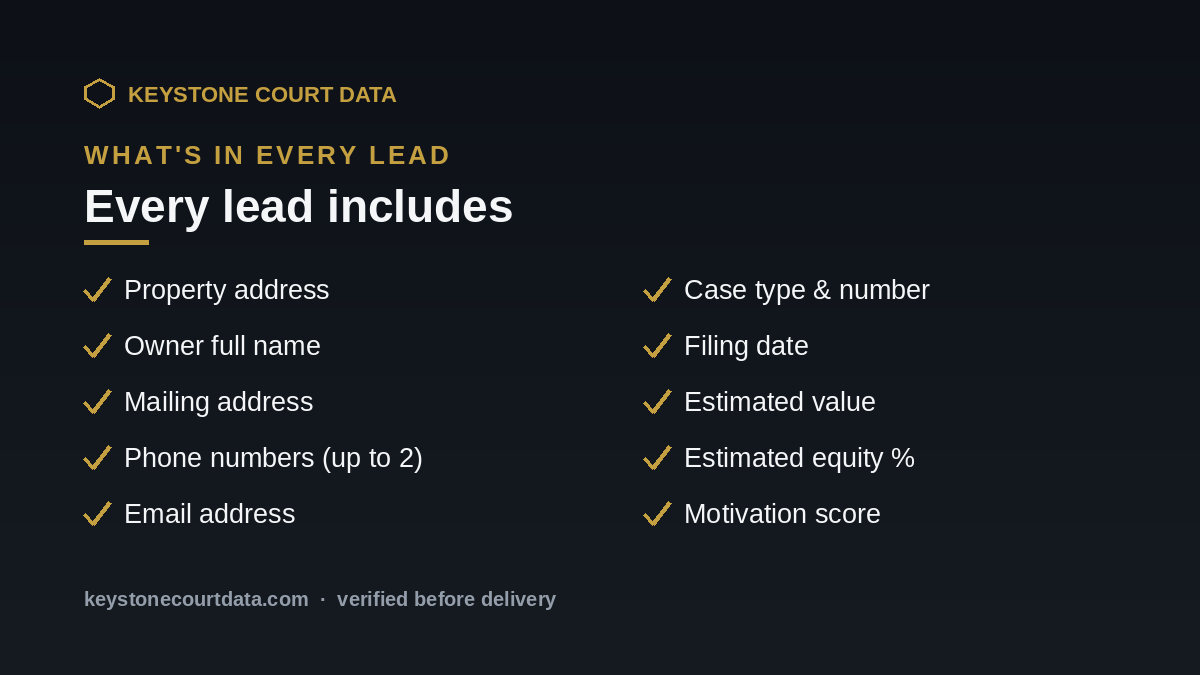
Services like Keystone Court Data monitor court filings across multiple Indiana counties and deliver leads with verified property and owner data, motivation scoring, and owner phone lookups where offered. This turns what would be hours of courthouse research into a streamlined lead pipeline.
Acting on Off-Market Leads: Outreach Strategies
Finding the leads is only half the equation. How you reach out to motivated sellers determines whether those leads convert to deals.
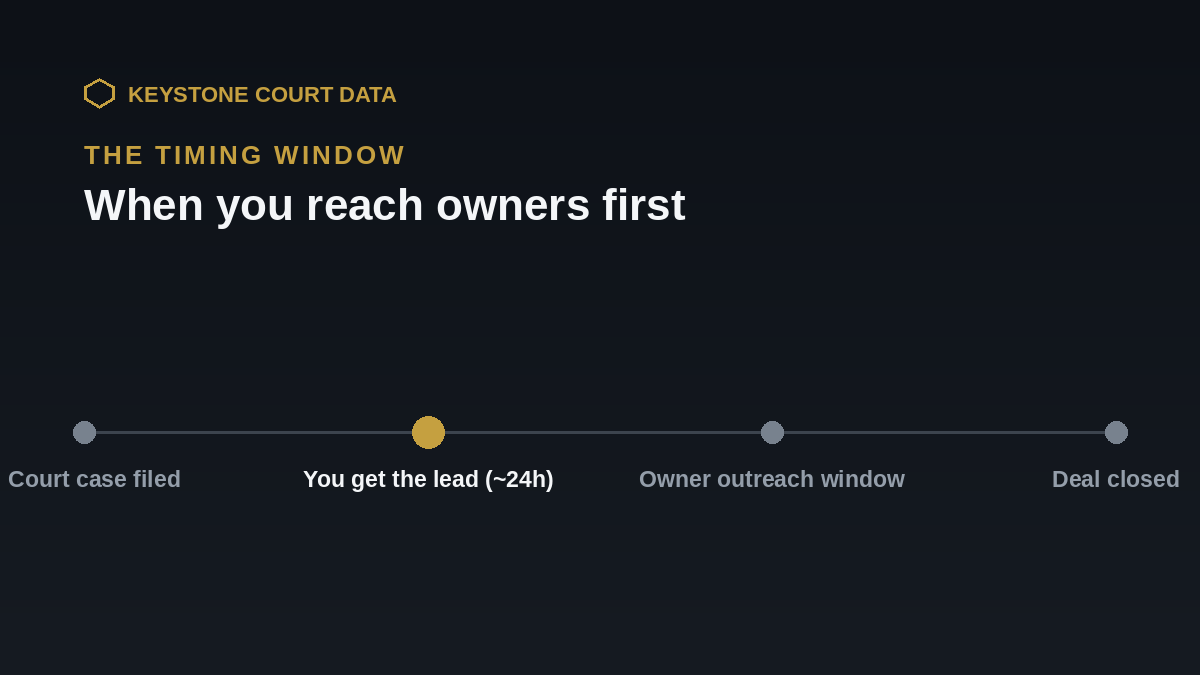
Speed matters more than anything. When a foreclosure is filed or a probate case opens, other investors may also be watching. The first investor to reach a seller with a credible offer has a massive advantage. Waiting even a week can mean the difference between winning a deal and finding out someone else already has it under contract.
Direct mail still works. A well-written letter that acknowledges the seller's situation without being pushy converts at a higher rate than most digital outreach. Keep it personal, keep it short, and make it clear you can close quickly.
Phone outreach converts fastest. If you have the seller's phone number, a direct phone call is the highest-converting outreach method. Be respectful, be direct, and lead with how you can help solve their problem rather than what you want to buy.
Follow up consistently. Many sellers are not ready to act the first time you reach out. A system that follows up at regular intervals over 60 to 90 days will convert leads that a single-touch approach misses entirely.
The investors who build consistent deal flow in Indiana are the ones who combine reliable lead sourcing with disciplined outreach. Court records are the foundation of that system, and the counties mentioned above are where the volume is. If you are serious about building a portfolio in Indiana, start with the data, focus on the counties that match your investment criteria, and move quickly when the right lead comes through.
Ready to see real leads in these counties? Request a free trial and start reviewing verified off-market leads with motivation scoring and complete property data.